Reflections On the Scriptural Readings for This Weekend — 20150726

Peter spoke up and said, “Lord, if it is really you, tell me to come to you across the water.” “Come!” he said…. But when Peter perceived how strong the wind was, becoming frightened, he began to sink and cried out, “Lord, save me!” Jesus at once stretched out his hand and caught him. “How little faith you have!” “Why did you falter?”

Walking-on-WaterI know that we all become mesmerized when we hear that Jesus walked on water. We think, how did it happen.

That is truly not the most important part of this story. The more important part of the story is about Peter’s attempt to walk on water. When he believed he was able to walk out to meet Jesus, he was able to do it. It was only when he perceived how strong the wind was that he began to sink. When Peter calls for help Jesus speaks these very poignant words: How little faith you have! Why did you falter?

The story tells us that if we have faith we can overcome even the most difficult of challenges. The fact is that so often, when we see the strength of the challenges confronting us, we falter in our faith. This story clearly tells us that if we continue to be strong in our faith we will survive and, in fact, even walk on top of the challenges.

We have to remember that life must present us with challenges in order for us to spiritually grow. If we never face challenges, we will not grow. This earthly life is all about spiritual growth. Spiritual growth only happens when we draw upon our faith to help us to live-through and truly confront life’s challenges.

This particular story of Jesus walking on water is so singular in the synoptic gospels that scholars believe that in its original context it belongs after the resurrection. Whether this was the original context or not, and it seems probably that it is, the story has a symbolic significance. This chapter begins that portion of Matthew that is called the ecclesiastical portion. The disciples in the boat represent, in a not too subtle way, the Church, from which Jesus is never far even when the situation is threatening and he is invisible. Peter’s attempt, only recorded in Matthew, increases the symbolic significance of the story. His position in the Twelve is affirmed, suggesting that he has responsibilities not shared by the others. In order to meet these responsibilities, he has to have faith.   Think about this!
The Spirituality of the Christian East — 20150726

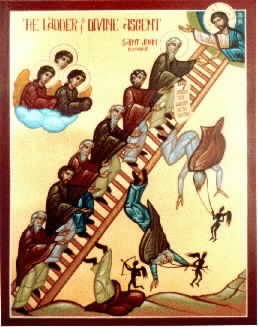
I have been sharing with you the 30 steps contained in Climacus’ Ladder of Divine Assent, interpreted for the needs of persons who are not monks. The sixth step, as I shared in the last issue, is the Remembrance of Death.

Ladder of Divine AccentAs one of the Christian virtues, remembrance of death is rooted in the knowledge that beyond death lies eternity. God   is eternal and so our relationship with Him is eternal. But what will this eternal relationship be like? Will it be eternal joy or eternal torment?

If we love God – if our life has been lived for Him – then God is our joy. If we do not want God, then His eternal presence and loving embrace are hell. How can sinners look upon the brilliant radiance and holiness of God? We think that meeting absolute goodness would be wonderful. This is like thinking of coming face-to-face with the sun as   being no different from lying on the beach on a hot summer’s day. God is absolute goodness, unbounded holiness, unrelenting love. And we have sinned against Him. We have wronged Him time and again. Thus the remembrance of death is a call to change of heart and mind.

It has been postulated by philosophers that we humans can only experience that which we are prepared to really   experience. If we reject the idea of God, there is no way that we can, just because we have died, experience Him.

The one wonderful thing about how God has created humankind is that He gives us multiple opportunities during this life and during eternity to come to know and love Him. Because we have free will, we are the only ones who can create hell for ourselves.

The remembrance of death means that we live with an awareness that we will die and that death is a transition to a different way of living. The way we live now influences our future life.

CALLED TO HOLINESS — 20150726

In the last issue of this article, I shared with my readers that one modern author suggests that the spiritual path consists of nine stages of   development which can be understood in terms of the development of consciousness. He warns, however, that the nine stages are not to be understood as neat little boxes. First, the levels of consciousness can overlap to some extent. Second, beginning with the development of the human mind, we can repress parts of our consciousness that we don’t like and these parts of ourselves can remain “stuck” at the lower levels and drain our energy so much that they can prevent our advance to the highest spiritual levels.

cross_vineThird, a person can pass to the next level of consciousness without full mastery of the level below. Only basic competence at one level of consciousness is normally required before going to the next level. Fourth, things can go wrong at every level.

I know that this probably sounds more like psychology than spiritual theology. I truly believe that it is using psychological knowledge to help us, since we are humans, to understand the process of spiritual development. If we know how human consciousness develops, then we can use this knowledge to help us understand more clearly spiritual development. The first level of human consciousness is the archaic and normally lasts into the third year of an infant’s life. It is primarily a physical level of consciousness and is ruled by sensations and impulses. It develops through two essential spiritual passages: First, the infant’s differentiation of its own body from that of the mother, and second, the later differentiation of the infant’s emotions from those of the mother. Critical spiritual principles can be drawn from these two passages, principles that will apply throughout the spiritual path. For example, each level of spiritual development, like consciousness, will be less egocentric than the last.

Understanding The Theology of Our Ukrainian Greek-Catholic Faith — 20150726

Following 1596 and the Union, the Ukrainian Greek-Catholic Church (UGCC), being an Orthodox Church in communion with Rome, ought to have continued to live an ecclesiological life of prayer traceable to its Patristic roots. Yet the Union of Brest-Litovsk, through a scholastic division of theological categories unknown to and artificial in the Eastern Christian tradition, had the consequence – unintended from the perspective of the Ukrainian Orthodox bishops who signed it – of stunting an organic growth from Patristic roots of a moral and systematic theology specific to the UGCC. Unlike the Orthodox Churches, notably the Russian and Greek Churches, whose contemporary life has been marked by just such an organic growth of a Patristic-based moral and systematic theology, founded in its total life of prayer, the Union began an unjustifiable importation of Western dogmatic and moral theology, in addition to similar encroachments in relation to the sacraments (known as the Holy Mysteries in the Christian East) into the life of the UGCC. To such an extent did these encroachments – known as ‘Latinizations’ – occur that by the time of the mid- to late-twentieth century much theological writing in the UGCC, even by those of the highest hierarchical rank, was a ‘…mere rehash of Latin theology manuals.’ This process of Latinization continued virtually unchecked until the twentieth century. Two events of the twentieth century have stemmed the advance of Latinization in of the Eastern Catholic Churches. The first of these events was the Second Vatican Council. During the plenary sessions of the Second Vatican Council, Patriarch Maximos IV Saigh of the Eastern Catholic Melkite Church refused to speak Latin and continually promoted the rights and status of the Eastern Catholic Churches. It was his role in the Council that had a major   influence on the content of the document ultimately produced by the Council Fathers on the Eastern Catholic Churches.

Thus, the Second Vatican Council raised Latin Catholic awareness of the status and role of the Eastern Catholic Churches, a group which includes the UGCC, in the contemporary life of the universal Catholic Church. The second event was the pontificate of John Paul II who, drawing upon, supplementing and advancing the work of the Council, wrote his 1995 Apostolic Letter The Light of the East (Orientale Lumen),   followed closely by his 1995 Encyclical Letter On Commitment to Ecumenism (Ut Unum Sint).       Much More to Follow!

Gaining a Deeper Understanding of the New Testament — 20150726

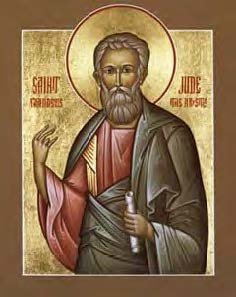
judeThe Letter in the New Testament that is attributed to JUDE, is, perhaps, truly the strangest document in the New Testament (NT). It is one of the shortest, about a page long, and is the most enigmatic. Its authorship, its date, and the community to which it was addressed, involve “guesswork”.

The author identifies himself as “Jude, a servant of Jesus Christ and brother of James”. Jude was, however, a common name in NT times. According to   Mark, one of Jesus’ brothers was named Jude. Because the author of this letter also identifies himself as “brother of James,” another brother of Jesus and leader of the Christ-community in Jerusalem, it was taken for granted until recently that the author was also a brother of Jesus.

If so, that would make Jude one of the earliest documents in the NT. But modern mainline scholars have concluded that it was written much later. Though precision is impossible, most date it around 100 CE. It contains nothing that suggests the location of either the author or its recipients, though it appears to have been written to a particular community in which “certain intruders have stolen in…who pervert the grace of our God into       licentiousness and deny our only Master and Lord, Jesus Christ”.

Much of the rest of the letter is a condemnation of these intruders as dreamers, scoffers, worldly people, waterless clouds, wild waves of the sea and wandering stars. They are accused of being bombastic in speech and flattering people to their own advantage. But what the conflict was about is unclear. Most likely it was a form of antinomianism, that is the conviction that God’s grace means that behavior doesn’t matter very much, if at all.

Jude and 2 Peter share so many distinctive phrases in common that it is clear that one author knew the letter of the other. The scholarly consensus is that 2 Peter used Jude rather than vice versa, and so Jude is earlier than 2 Peter.

St Jerome acknowledges that some rejected the epistle because of its citation of the apocryphal Book of Enoch, but states that the ancient authority it enjoyed and its use in the churches assured its place in the canon of the inspired writings.

The energetic and picturesque style of this epistle is reminiscent of that of the early prophets. Why not try reading it?

Learning Our Faith From the Greek Fathers of the Church — 20150726

St. Gregory teaches, along with all the great Fathers of the Church, the vision of Christ in glory which he sees as truly synonymous with the mystery of the precious and life-giving Cross. This is precisely because the Cross reveals to us the Way of Christ and as such is the only way to salvation. The Cross is the way to the cleansing of the passions and the cultivation of the virtues. It is the way to the illumination of the mind, heart and soul. It is the way to the real and true sanctification of the body and to perfect union with God. The vision of Christ in glory is given only when we arrive at the foot of the Cross, in imitation of Christ’s own self-emptying. The vision of Christ in glory is given when we truly understand that He gave of Himself totally and completely in order to show us how to live. This, inevitably, involves repentance, a profound and continuous change of heart and mind on the part of the human person, without which it is impossible to become Christlike.

What this means, in practical terms, is that we are taking up our cross each time we find ourselves in truly difficult circumstances; each time that we are tempted to think or act according to the way of the world; and every time that we resist this impulse for the love of Christ and ask for His help and mercy. Each time we take up our cross, we are striving to change our way of life in accordance with the WAY of living which Jesus showed us by His life.

The fact is that if we wish to be with Christ, then we must become like Him. This is the mystery of the adoption of sons, of which the great Paul speaks, which is offered to each and every one of us. We can never be God. Only God is divine by nature, but as the great St. Maximus says, the person who has been deified by grace will be in every respect as God   is, except for His very essence. This means that we have been created to contain the very Life of the Holy Trinity. That is what is meant by being created in the image of God: to have the God-given capacity of containing and living the divine Life.

This, according to the Eastern Church, is the end and purpose of this earthly life, to learn how to become like God – to become a spiritual person.

The glory of how God created us is that He allows us freely to choose to become like Him. We are not forced to be like our Creator but, rather, are given the help to be like Him if we choose.

Reflections On the Scriptural Readings for This Weekend — 20150719

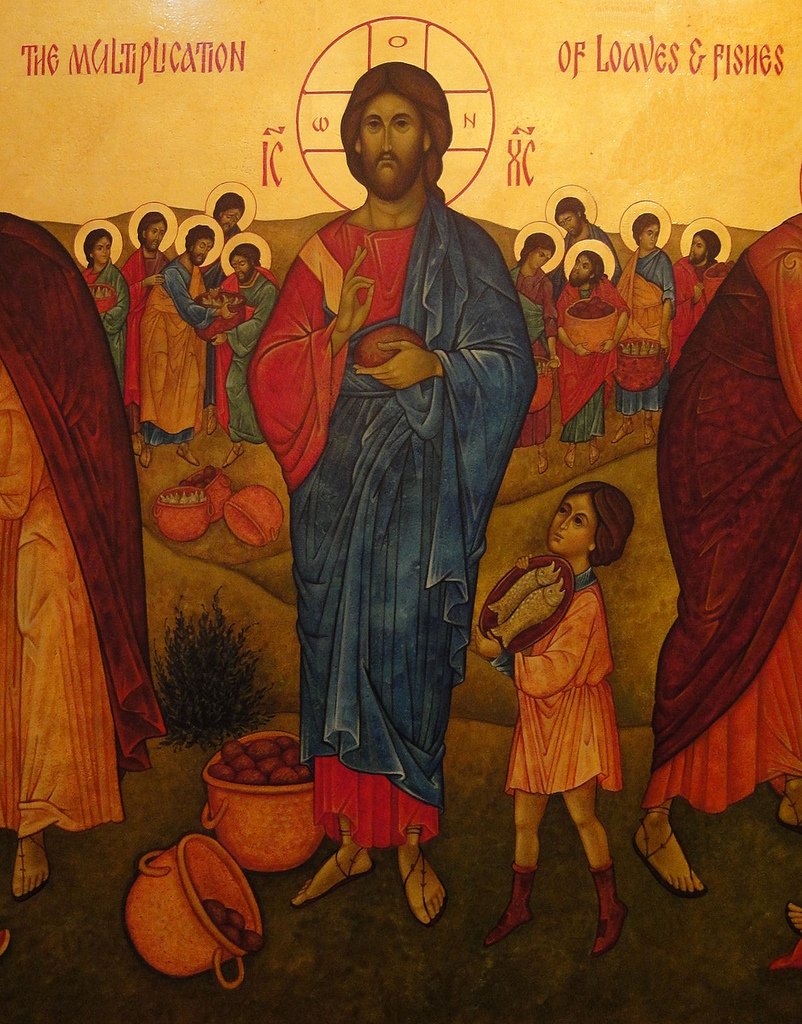
5125870112_c630d33278_bThe Gospel story assigned to be read this weekend is interesting in several regards. It is one of the stories that tells us of the multiplication of the loaves – Jesus feeding many people who came to hear Him teach with very little food.

First, it is unlikely that very many of the crowd would have left home for a day’s journey without carrying some food. The modern Palestinian peasant would not be so improvident. Further, the amount mentioned – five loaves and a couples of fish – would not have even been suffice for Jesus and the Twelve. The particular ceremonial with which Jesus blesses and distributes the food anticipates the Last Supper. The Twelve hand out the food and collect twelve baskets of fragments, one basket for each of the apostles.

Matthew heightens the number of the people by telling us that uncounted women and children were fed besides 5,000 men. This is the number that Mark mentioned in his account. The number is very probably exaggerated, and is not the result of a head count in any case. Oral tradition tends to raise such figures.

The usual note of wonder that follows miracles is not mentioned here. The incident is related less for the element of the miraculous than as a symbol and an anticipation of the Eucharist and of the Messianic banquet.

The association with the Eucharist is more explicit in John’s Gospel (chapter 6), where the multiplication of the loaves is followed by John’s Eucharistic discourse. It is a Messianic sign and symbol that will find its fulfillment in the true Messianic banquet, the Eucharist. Matthew abbreviated this story less sharply than other stories. Truly his abbreviations, achieved by the omission of some details and dialogue, have the effect of heightening the symbolic significance of the incident.

So what is the meaning of this story? We must remember that in Matthew’s Gospel this is the first miracle sign that Jesus performs. It is meant to remind us that the teachings of Jesus are food indeed for the spirit and not the body.

This tells us that the teachings of Jesus are, in reality, food for our spirits. If we ingest them, they will help us to spiritually grow. Trying to live like Jesus lived can only have one effect: spiritual growth. This, of course, is the meaning and purpose of this earthly life, that is to spiritually grow so that we can come into deeper and more complete union with God our Creator.

Ask yourself this: What does this story mean to me? How does it help me?

CALLED TO HOLINESS — 20150719

In our call to holiness we are called to map the path to the Kingdom of Heaven. The older maps could not take into account the huge amount of scholarship that has been done by modern developmental psychology in mapping the levels of growth in human consciousness from infancy to functioning adulthood.

Modern authors have worked to map the spiritual path taking these new findings into consideration. Modern scholarship has found that the fundamental structures of human consciousness do not vary from one historical period to another. The stages through which human consciousness progresses to what Christians call union with God and, afterwards, the inner non-dual vision of the kingdom of Heaven here on Earth, are the same now as they were for the early Christians. In philosophical terms, this never-changing structure of human consciousness development has been called the perennial philosophy for that reason: it is indeed unchanging.

I would just remind my readers that, since we are made in God’s image and likeness, consciousness is one of the characteristics of children of God since, as I explained, God’s consciousness permeates the entire universe.

It must be noted that the basic structures of human consciousness do not vary. Human beings are the same everywhere. The same nine stages and structures are to be found in the Roman philosopher/mystic and the spiritual master Plotinus (a teacher for St. Augustine and many Church Fathers) as in the Buddhist philosopher/mystic and spiritual master Nagarjuna.

During the come weeks I will share with you what one modern author sees as the divisions of the spiritual path. He divides the path into nine stages, each stage corresponding to a separate level of consciousness. Again, is this reality? No! But it is one way to look at the development of human consciousness.

Gaining a Deeper Understanding of the New Testament – 20150719

This article has been dealing with the last book in the New Testament, that is Revelation or the Apocalypse. It is one of the most difficult to understand because it abounds in unfamiliar and extravagant symbolism, which at best appears unusual to the modern reader. Symbolic language is one of the chief characteristics of apocalyptic literature, of this which is truly an outstanding example. It contains an account of visions in symbolic and allegorical language borrowed in part from the   Old Testament, especially Ezekiel, Zechariah, and the apocalyptic Book of Daniel. Whether the visions presented were real experiences of the author or simply literary convention employed by him is an open question.

4Ev-MariaLaach

Though Revelation is eschatological – ultimate salvation and victory are said to take place at the end of the present age when Christ will come in glory at the Parousia – the book presents the decisive struggle of Christ and his followers again Satan and his cohorts as already over. Christ’s overwhelming defeat of the kingdom of Satan has ushered in the everlasting reign of God. Even the forces of evil unwittingly carry out the divine plan, for God is the sovereign Lord of history.

The Book of Revelation had its origin in a time of crisis, but it remains valid for Christians of all time. In the face of evils from within and without, the Christian can confidently trust in God’s promise to be with the church forever.

Rome is a central and consistently negative image in the book. This view of the Roman government stands in sharp contrast to the rest of the New Testament, where Rome is seen as the protector of Christianity. In the early days of missionary activity, Roman judges protected Christians from Jewish mobs. It was Roman justice to which Paul turned in his time of need. As a result, the apostles, it seems, urged submission to Rome. But in Revelation, the attitude is quite different. Rome is seen as a whore, drunk with the blood of many Christians and deserving nothing but destruction.

This shift in attitude is due to one thing – Caesar worship. Although Roman rulers were, for a long time, considered divine, their centrality in Roman civil religion was not enforced until the end of the first century. Then it became obligatory for citizens all across the Roman Empire to appear once a year before a magistrate to burn a pinch of incense and declare, “Caesar is Lord.” Thus the negative bend in Revelation.

Smart and Stupid Ways to Think About God — 20150719

As you my readers know, I have been sharing the Smart and Stupid Ways to think about God that authors Michael Shevack and Jack Bemporad have conceived and I have adapted. I have already shared two stupid ways and one smart way to think about God. The second smart is:

GOD IS LIVING

If God were just the Origin, just the Infinite Sum of everything, it would not be God. For God to be God, He must have existed before time and space and he must be alive. Indeed either God is living or the whole idea of God is dead or pure illusion.

By saying that God is living means that He permeates everything, possesses a quality that distinguishes Him from every other existing thing and He must be conscious, possessing far more than vegetative consciousness. For God to be God, He must be at least as conscious as we. He must not be merely conscious, but self-conscious. Conscious of Himself, knowing Who He Is.

Further, God must have a self-concept that is not based on self-deceit. His awareness must be all-embracing and must fathom the depths of His own infinities.

His consciousness IS His Being, His very nature. It is the substance from which everything else is made. Organic or inorganic, it was formed from, formed by, formed out of His Consciousness.

This Living Awareness, the Living Origin of everything, that is what we mean by God. His consciousness informs all of creation, maintaining the order and design of all creation.

Consider this. All DNA in our creation is constructed from the same chemicals or elements. BUT, each phylum of created objects have their unique characteristics and nature which is maintained by the order established in His Consciousness. The whole universe is maintained and formed in God’s Consciousness.

There is one word that people use to describe God. That word is spirit. It is neither scientifically accurate nor mathematically precise. It hardly as perfect as the God it is meant to convey. But at least it works. It has withstood the test of time.

Nobody knows exactly what spirit is. But then, if no one really knows what God is, maybe spirit is pretty good.

Eastern theology tells us that the only thing we can do is describe what God is not. He is not limited, circumscribed or lacking intelligence. His consciousness permeates all energy and matter, using them to bring all things into existence and to maintain them in existence.

We know this to be true. He must be a person since He cannot create anything that He is not or that is greater than Him. Since He IS a person, we can have a relationship with Him!