June 14, 2015

Do not lay up for yourselves an earthly treasure.
Moths and rust corrode; thieves break in and steal.
Make it your practice instead to store up heavenly treasure,
which neither moths nor rust corrode nor thieves break in and steal.
Remember, where your treasure is, there your heart is also.

3rdpostpentBy our Initiation into the Church we are called to be followers of Jesus Christ and to embrace The Way. He taught us, by word and example, how to live. He is God’s revelation about how to live this human life given to us. There are several different aspects to The Way. The first, I believe, is the way to personalize our worship of God. He calls us to join Him in the worship of the Father by offering our very lives back to the Father in thanksgiving for the gift of life.

The second aspect of The Way, I believe, is the way to treat and interact with others. Jesus taught us that all humans are the children of God and, as a result of that, are related to us as brothers and sisters. This means that we must treat them like we want to be treated and show them unconditional love.

If all others are part of our human family, then the way to treat others is with respect, kindness and patience. This means putting up with some of their idiosyncrasies. It also means that we are called to forgive them if they do hurtful things and not to judge them.

This, is the challenge that life presents us. When we learn to treat others in this way, we grow more like God as He revealed Himself in the Person of Jesus.

One of the impediments to learning how to treat others in this manner can be our own experiences with actual siblings. It seems that biological families are not always without stress which can complicate how siblings treat one another. So quite often where we must begin our work at personal transformation is within our own biological family. We must, if we have siblings that we are not close to, learn how to forgive them and learn how to unconditionally love them.

Our biological family is the first school of learning that life provides us. It is from our biological family that we learn how to treat and interact with others. If we find that we have a problem with being able to unconditionally love others, we truly need to examine our past, let go of past hurts, and make an effort to adopt a new way of interacting with others.  Why? Because as Jesus said, the way we treat others is the way that we treat God.

Learning Our Faith From the Greek Fathers of the Church — 20150614

image547In this article I have been sharing some of the thoughts of the Greek Fathers of the Church on Theosis. I am sure that all of my readers know the famous words of St. Athanasius the Great: God became man that we might be made gods. In the Epistle reading for the Divine Liturgy on Christmas Day, where Paul identifies the Incarnation as the fullness of time, he also makes the following very important point:

But when the fullness of the time was come, God sent forth His Son, made of a woman, made under the law, to redeem them that were under the law, that we might receive the adoption of sons. And   because you are sons, God has sent forth the Spirit of his Son into your hearts, crying, Abba, Father. Wherefore you are no more a servant, but a son; and if a son, then an heir of God through Christ.

Thus the purpose of Christ’s redemption of mankind is “that we might receive the adoption of sons” through union with Him, for thereby we receive the Spirit, Who cries in our hearts “Abba, Father;” and thereby we truly become “heirs of God through Christ.”

It is in Christ Jesus, therefore that we not only encounter true and perfect God, but also true and perfect man. In other words, we see in Him not only the great God and Savior, but also what we have been called to become.

In Christ Jesus we find man’s true place, “on the right hand of the Father,” sharing in the divine life; but, as with the two natures in Christ, united without confusion; in other words, we never cease to be His creatures, for He alone is Uncreated and Pre-eternal.

It is much like the case of our earthly fathers. We become equal to them in every way except for the fact that we can never say that we gave them life. They always remain the source of our lives.

Throughout the History of Salvation – in the Old  Testament as well as the New – it was this same Son and Word of God, Who was in the beginning with the Father, Who of old revealed Himself to our spiritual forefathers. In other words, it was the Pre-Incarnate Word, He Who by His Incarnation became the Christ, it was He who visited Abraham under the Oak at Mamre, it was He Who wrestled with Jacob, it was He Who spoke with Moses and the Prophets. This is He of Whom the Prophet-King David tells, “The LORD said unto my Lord, Sit thou at my right hand until I make thine enemies thy footstool.

Although we think of Jesus coming into human history at a certain time, we must remember that there is no time in God. Christ always was Incarnate. What does this mean to you?

Think about this. It is important to understand!

The Spirituality of the Christian East — 20150614

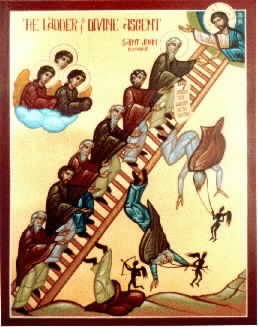
Ladder of Divine AccentThe fifth step on St. John’s Ladder of Divine ascent, is REPENTANCE. St. John says that Repentance is the renewal of baptism and is a contract with God for a fresh start in life.

The Greek word for repentance, as my readers probably already know, is metanoia, which means to have a change of heart or mind, while the Greek word for sin, hamartia, means to miss the mark. Now if sin means missing the mark, then repentance means getting back on target. It is really only when we understand repentance in this way that we can comprehend it as an ongoing positive and creative process.

Repentance lies at the very heart of Christian life. The preaching of our Lord Himself began with repentance: Repent, for the kingdom of heaven is at hand. All Eastern Church Fathers have taught that there is no salvation without it. St. John is no exception. He wrote:

It is impossible for those of us who have fallen into the sink of iniquity ever to be drawn out of it unless we also plumb the depths of the humility shown by the penitent.

It is clear that repentance, like obedience, is rooted in humility. A proud person cannot repent, for repentance allows no room for ego and conceit. Pride blinds us to our own sins, while we go on hating those very same sins when we see them in others. Humility alone is capable of seeing the truth, of enabling us to see ourselves as we really are.

It is critical. I think, to remember that metanoia does not only deal with some of our less than noble acts. Metanoia also deals with our attitudes of mind which are the true foundation of our behaviors. Attitudes which are un-Christlike result in real behaviors that are un-Christlike. The personal transformation which is the primary task of life, begins with our personal attitudes

Gaining a Deeper Understanding of the New Testament – 20150614

I ended the last installment of this article on the New Testament with the idea that REVELATION contains highly symbolic language and that numbers are also highly symbolic, especially the number seven. In Revelation there are seven letters, a scroll with seven seals, seven angels with seven trumpets, seven bowls of wrath. The number twelve appears twenty-two times. So also the number 144,000 is symbolic – twelve times twelve times one thousand.

There are also symbolic animals in the book: the Lamb; a pale green horse; locusts with crowns of gold, teeth like lions, and tails like scorpions; horses with lions’ heads and tails like serpents; a red dragon with seven heads, ten horns, and seven crowns; a beast rising from the sea whose number is 666; another beast with two horns like a lamb who speaks like a dragon.

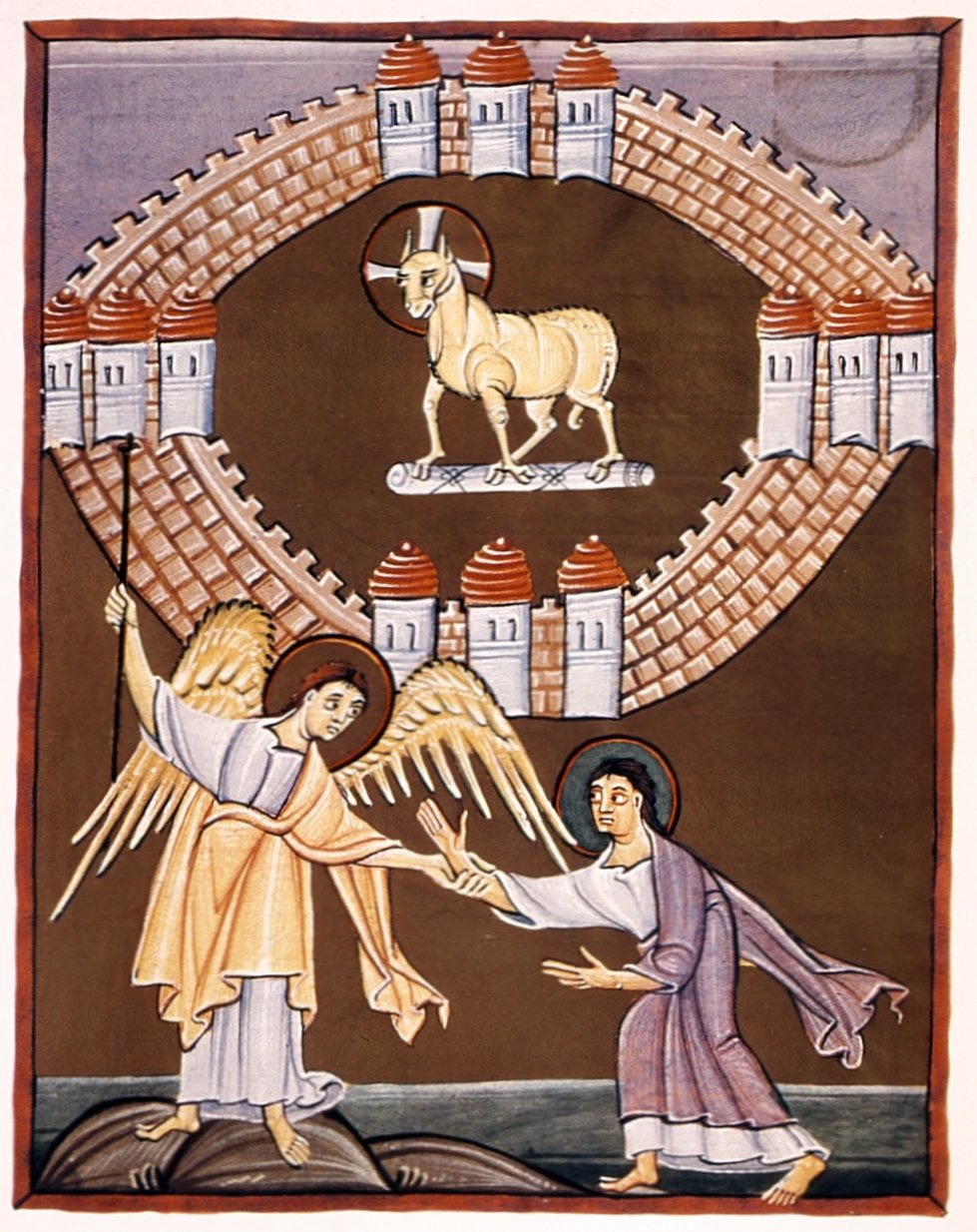
BambergApocalypseFolioAmong the symbolic women is one clothed with the sun; she has the moon under her feet and wears a crown with twelve stars. (For those who have seen some of the religious art of the Western Church, you will remember a picture of Mary the Mother of God which looks much like this image). She is pregnant and about to give birth, and a dragon waits to devour her child. Another, the great whore, is clothed in scarlet and purple and adorned with gold, jewels, and pearls. She rides on a red beast with seven heads and ten horns. Her name is Babylon the Great, and she is the great city that rules the earth.

The dating of Revelation is based on the fact that it refers to persecution. It has been commonly dated either in the mid to late 60s, shortly after Nero’s persecution, or in the mid-90s near the end of the reign of the emperor Domitian (d. 96 CE). But Nero’s persecution of Christians was confined to the city of Rome and did not affect Asia Minor, and the historical evidence for official Roman persecution under Domitian is very weak.

Moreover, the document itself does not indicate that large-scale persecution was already under way. The letter to Smyrna warns that suffering is imminent, but has not yet begun: do not fear what you are about to suffer. Beware, the devil is about to throw some of you into prison so that you may be tested, and for ten days you will have affliction. Be faithful until death.

This all tells us that Revelation was about things that were transpiring or about to transpire around the time of its writing. The book, however, has become for some Christians a prediction of things yet to come. If you haven’t, why not try reading Revelation – last book in the NT.

The Divine Liturgy and Our Worship of God – 20150614

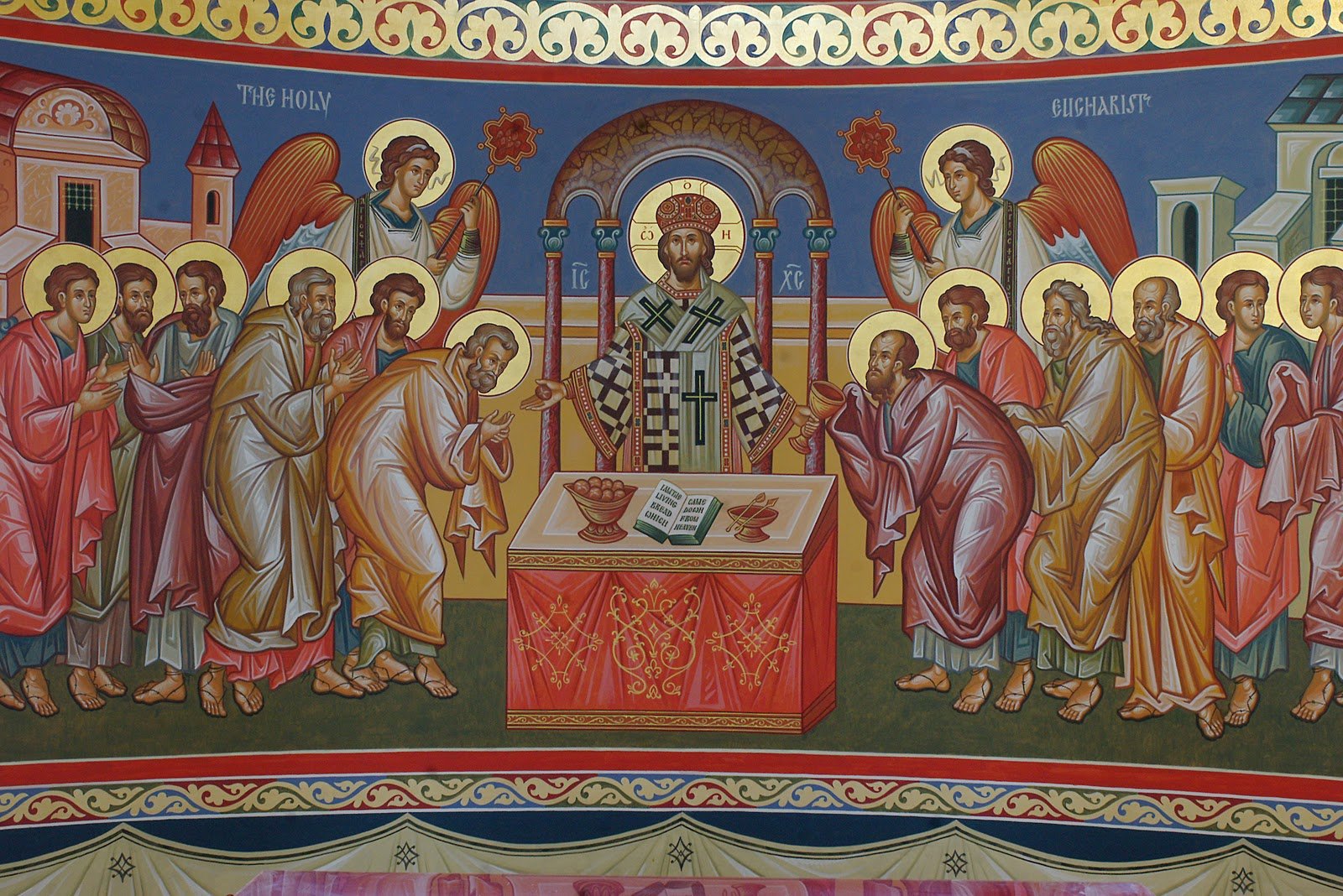
Holy Eucharist IconBefore my digression about the word mercy, which is so frequently used in our worship, I had reached a point in this article on the Divine Liturgy which is called the Liturgy of the Faithful. As I shared, non-initiated people were not, originally, allowed to participate in this part of the Liturgy. Only those who were baptized and chrismated – those who made a solemn profession of their belief in Jesus Christ as the revelation of God to mankind – were able to hear the words of the Creed and participate in the prayers that are involved in the transformation of the symbols of life into the very Body and Blood of Christ. A person’s profession of belief was contained in the reading of a statement which, years later, served as the basis for the Nicene-Constantinopolitan CREED which we now use in our Liturgy. It was the same creed that was used during the Baptismal – Initiation – ritual. There were a number of different baptismal creeds in existence in the early Church. Later, because of various heresies, the Church developed the Creed that we now use. It states literally all the basic beliefs of our religion. These are the common beliefs that all of Christendom at one time professed. Catholic and Orthodox faithful still profess, unchanged, the beliefs articulated in this Creed.

It is critical, I believe, that, when we say this Creed, we think about each of the statements and realize that they express what we believe. I sometimes think that we say the Creed too fast. We must say it conviction and reverence. It is a statement of all that we believe.

What is interesting is that while the Creed expresses what we believe, it does not mention anything about what we do in the Liturgy. What is does say is that we believe that God came into the world in the Person of Jesus Christ and, therefore, what He did is important. He showed us how to worship God.  We ask God to change food, which we say represent life, into the Body and Blood of Christ, indicating our desire to also personally change and become more like Christ. Asking God to do this is based on our belief that God is actually Three-In-One since the Creed addresses our belief in Father, Son and Holy Spirit.

So the Creed is the basis for our ritual action of offering our lives back to God in thanksgiving for the gift of life and for His loving revelation, in the Person of Jesus, of how to live this present life.

Let us truly believe what we pray!

CALLED TO HOLINESS — 20150614

The call to holiness is a call to bear witness to the revelation of God through the Person of Jesus. True evangelization, I believe, is all about bearing witness to this truth. It means living in such a manner that the words of John become true reality: If you make my teaching your rule of life, you are truly my disciples: then you will know the truth and the truth will make you free.

You and I are more slaves than freed persons. The call to holiness is a call to true freedom. Part of our slavery consists in having forgotten what true freedom as children of God means. We often are content to live in the narrow confines of our slavery, mainly because everyone else is in the same prison. Blindness would not be so great a suffering if all human beings were born blind and never could know any other possibility. But blindness would become unbearable for all if there were even one man among them all who really could see.

The way we perceive ourselves, God and the world is pretty much the same way others perceive the same relationships. That is precisely part of our slavery. But   Jesus Christ came among us with the eyes of God. He was one with the Father. He came to witness to the truth about God’s community of love and told us that the Father and Holy Spirit love us with as much passion unto death as He, the Divine Word incarnate, displayed when He was here on earth. He was the true light that enlightens all men.  That light shines in our darkness and cannot be overpowered by our darkness.

So the call to holiness, which is a call to witness to God’s revelation and evangelization, requires that we demonstrate to others our belief in Jesus as the true light. Again it is not by preaching that we do this but by the way we think and behave. God doesn’t force us to respond to His call. It is our choice.

10 stupid and 10 smart ways to think about God — 20150614

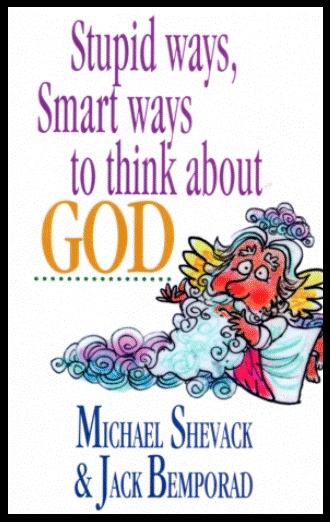
Picture1I think that it is very important to realize that most of us probably have some truly stupid ways of thinking about God, especially when we have to deal with life’s challenges. The word Stupid, which comes from Latin, means stop. Our ideas about God may have simply stopped growing, stopped maturing, stopped developing, and now seem stupid in the commonplace meaning of the word. The ideas we were spoon-fed as children we may now gag on as adults. The ideas that fired our imagination and inspired our reverence may now seem laughable. God may seem like little more than a human invention so cluttered with absurdities that He’s barely recognizable.

Even the truest believers have been plagued by doubts. Real doubts. Healthy doubts. Doubts that come from trying to approach God as whole people – doubts that come from trying to reconcile their intelligence and their sense of reason with what they learned about God in Sunday school.

For others, however, there may not have been a struggle. God has simply become too unbelievable to believe. But if you talk to these atheists and ask them why they can’t believe, you very quickly see the real problem.

Atheists seldom reject God – a credible God, that is. More often, they reject some stupid way of thinking about God. Some idea so ridiculous it isn’t worth believing. Some idea that causes so much personal guilt it is better off discarded. And rightly so.

For them, and indeed for all of us, the question is not if there is, or could be, a God, but what kind of god is God? What sort of God do we believe in? What kind of God is worthy of belief? Often we’ve pushed aside our confusion. In an attempt to feel whole, we’ve brushed it under a rug, written it off as mystery.

Most of the time we can get away with it, and our stupid ways of thinking go unnoticed. But many times we are confronted quite abruptly by our stupid ways of thinking. There is a senseless death; then the idea that God is perfectly good seems senseless. A woman is raped; then the stupid idea that God is male becomes poison. Divorce becomes a necessity; then a lifetime of faith is thrown into jeopardy. A child is diagnosed with cancer; where is a compassionate God? Indeed, life crises and faith crises always seem to go hand in hand.

Too frequently you hear when a person is facing a particularly difficult crisis, How could a loving God allow this to happen? Frequently we hear when people are confronted with very difficult challenges, Why is God punishing me? This reveals a stupid way of thinking about God. Is it not stupid to think that God is some Supreme Being just waiting to catch us doing something wrong so that He can punish us?

Understanding The Theology of Our Ukrainian Greek-Catholic Faith – 20150614

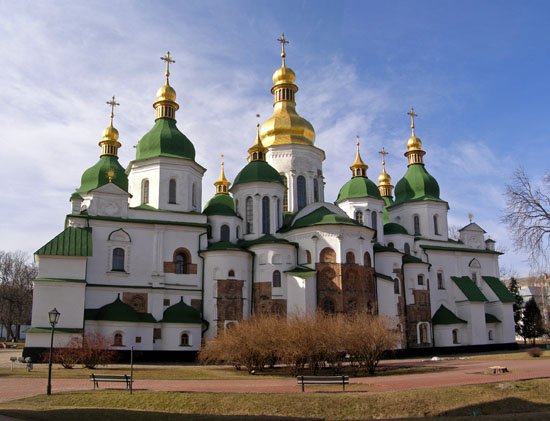
St. Sophia’s Ukrainian Greek-Catholic Church in Kiev, Ukraine

St. Sophia’s Ukrainian Greek-Catholic Church in Kiev, Ukraine

In this article I have been sharing the thoughts of the Greek Fathers about the Spirit of God in creation. It is based on a rather highly developed theology of the Holy Spirit and forms the basis for our beliefs about the work of the Spirit in creation. As I shared in the last issue, the “breath” that Genesis says God breathed into humanity, is none other than the Holy Spirit. St. Cyril says, A being taken from the earth could not be seen as an image of the Most High if it had not received the ‘breath’” of God. Thus this actual perfecting action of the Spirit is not something miraculous, but, rather, a part of the original and natural plan of God. From all eternity God has planned to fill creation with His Spirit, bringing all into existence and sustaining all in existence. In this sense, the Spirit is the very content of the Kingdom of God.

Gregory of Nyssa reports the ancient variant for the text of the Lord’s Prayer, Thy Kingdom come, as May Thy Holy Spirit come upon us and cleanse us. The Byzantine liturgical tradition, which is embraced by our Church, maintains this same tradition when it starts every single office with an invocation of the Spirit, addressing Him as Heavenly King.

The liturgical prayers of Pentecost, though centered mainly on the role of the Spirit in redemption and salvation, also glorify the Spirit as the One who rules all things, who is Lord of all, and who preserves creation from falling apart. The popular customs associated with Pentecost in our Church suggest that the outpouring of the Spirit is indeed an anticipation of cosmic transfiguration; the traditional decoration of churches with greens and flowers on that day reflects the experience of new creation. The same idea dominates the Great Blessing of Water, on the feast of Theophany. Water, the primeval cosmic compound, is sanctified by the energy of the Holy Spirit. The Spirit is seen as having a truly transforming function.

The universe does not change in its empirical existence through the energy of the Spirit. The change is seen only by the eyes of faith because man has received in his heart the Spirit which cries: Abba, Father. Man is able to experience through faith the paradisaic reality of nature serving him and to recognize that this experience is not a subjective fancy, but one which reveals the ultimate truth about nature and creation as a whole. By the power of the Spirit, the true and natural relationship is restored between God, man and creation.

This is the reason why the Epiclesis is so important and special in our Divine Liturgy.

Pentecost and the Time After Pentecost — 20150614

Pentecost, which is the final event in the history of our salvation (for the gift of the Holy Spirit will not be followed, in this world, by any superior or new dispensation) leads us into the heart of the mystery of the Trinity – that ocean which is both the sourced and the end of the flood of divine love which carries men towards God.

PentecostIn order to mark this, the Eastern Church calls the time after this feast Weeks after Pentecost and designates Sundays as the last day of the week (You will recall that during the time after Easter Sundays are thought of as the first days of the week. On Mondays the Tone of the week changes to further highlight this reality). When the liturgical year starts (September 1st) there results from a    curious split between the series of  Sundays which belong in a certain way to Pentecost – to the time of fullness – and the feasts of Our Lord (i.e., Advent, Christmas and Theophany) – which are times of waiting, of birth and growth. In fact, during the first five or six months of the liturgical year, believers will know how, in their worship, to relate the Sundays, spiritually, with the mystery of Christ awaited, appearing, and growing in the midst of men. On the other hand, it is good that we should know how to maintain the Sundays from Pentecost till the end of the liturgical year in the framework of the time after Pentecost, or rather, the time of Pentecost, which will last right up to the beginning of   September. All of these Sundays are celebrated in the spirit of Pentecost. At all the liturgies we hear episodes from the gospels which take place long before Pentecost, and belong to the earthly life of Jesus before His passion and glorification. We can interpret them in terms of the Spirit, for it is under the breath and through the power of the Holy Spirit that Jesus spoke and acted.

The theme of light is underlined in the Byzantine liturgical year. This divine light first appears with the birth of Christ; it grows with him; it triumphs on Easter over the darkness;  and at Pentecost it reaches its full zenith. Pentecost is the midday flame. But this development, expressed during our liturgical year, must correspond to a growth in the inner light in our souls. The riches and symbolism of the liturgical year are worth nothing if they do not help this inner light to guide our lives.

Even the sequence of our liturgical year calls us to grow in our faith and our relationship with God.

Ask God to let your inner light grow!

June 7, 2015

One day as He was walking along the beach beside the Lake of Galilee, He saw two brothers – Simon, also called Peter, and Andrew – out in a boat fishing with a net, for they were commercial fishermen. Jesus called out, “Come along with me and I will show you how to fish for the souls of men!” And they left their nets at once and went with Him.

firstcallMatthew’s description of the calling of the first apostles, which we hear this weekend, depends on Mark’s version, even though he has slightly rewritten it. Luke, rewrote the story more extensively and added the miraculous catch of fish. John, on the other hand, has quite a   different account: Andrew and another disciple (not named, but presumably John himself) were disciples of John the Baptizer, who introduced them to Jesus; and Andrew introduced his brother Simon to Jesus.

The point of the story in Matthew and Mark is that the four, (i.e., Peter, Andrew, James and John), dropped everything and followed Jesus immediately even though they did not know him. They dropped their jobs, left their families and became disciples. None of the gospels give any implication that they returned to their homes and their livelihood. Three of the first four – Peter, James and John – formed an inner circle that witnessed incidents not seen by the other disciples. The promise to make them fishers of men is an intimation of the apostolic office. A similar urgency is expressed in the call of Levi (i.e., Matthew) who collected taxes.

Our Church, in presenting this story of the call of the first disciples on the second weekend after Pentecost, reveals to us that saints are people who witness to God’s revelation about how humans are to live by following the Way of Jesus.

This message is reinforced by the passage that we read from Paul’s Letter to the Romans. He says that those who follow Jesus show that the demands of the law are written in their hearts. Saints try to live like Jesus, a living model of how humans are to live, because they know that by living like Him they can become what God intended when He created them.

It is extremely important that we understand that all of us have been called to be followers of Jesus, not just those few who have taken religious vows. All of us are called to be witnesses to God’s presence within us. The way we demonstrate our understanding of this call us by the way we voluntarily choose to live and treat others