Understanding The Theology of Our Ukrainian Greek-Catholic Faith — 20150531

holywisdomIn this article I will be looking at the basic theology (i.e., study of God) that serves as the foundation of our Church. It is the theology of the Eastern Church which is, I would suggest, different than that of the Western Church, finding its foundation in our liturgical life. It is as catholic as that of the Roman Church but it is different.

The early Christian understanding of creation and of man’s ultimate destiny, which is the understanding of our Church, is truly inseparable from our understanding of the Spirit of God or, in theological terms, pneumatology.

The term pneumatology comes from two Greek words namely pneuma, which means wind, breath or spirit, and logos, which means word, matter or thing. As it is used in Christian theology it refers to the study of the biblical doctrine of the Holy Spirit. Generally this includes such topics as the personality of the Spirit, the deity of the Spirit, and the work of the Spirit throughout Scripture.

But the doctrine of the Holy Spirit in the New Testament and in the early Fathers cannot easily be reduced to a system of concepts. The fourth-century discussions on the divinity of the Spirit remained in the context of salvation. Since the action of the Spirit gives life in Christ, He cannot be a creature. He is indeed consubstantial with the Father and the Son. This argument was used by both Athanasius and Basil. These two patristic Fathers remained, throughout the Byzantine period, the standard authorities with regard to the Holy Spirit. Except in the controversy around the Filioque – a debate about the nature of God rather than about the Spirit specifically – there was little conceptual development about pneumatology in the Byzantine Middle Ages. This does not mean that the experience of the Spirit was not emphasized with greater strength than in the West, especially in hymnology, in spiritual literature and in theology about the sacraments or mysteries.

We must remember that the debate about the Filioque was this: did the Spirit precede from both the Father and the Son or only from the Father. The Eastern Church’s belief and understanding about the Trinity says that both the Son and the Spirit proceed from the Father – He is the source of all existence. The Western Church changed the wording of the Creed to read that the Spirit proceeded from the Father and the Son, which would, according to Eastern theology, make the Spirit less equal and not consubstantial with the Father. This is why our Creed is different from that of the Roman Church.
The Spirituality of the Christian East — 20150531

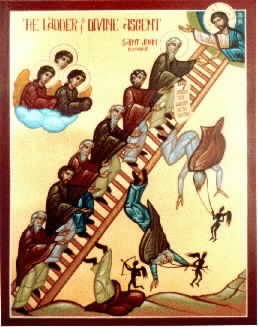
Ladder of Divine AccentStep four on St. John’s Ladder of Divine Ascent, as I began sharing with you in the last issue of the article, is the first of several fundamental virtues: obedience. The virtue of obedience is a state of mind, a condition of the heart, and a way of acting that is rooted in humility. It is self-mistrust up to one’s dying day, in every matter, even the good. But to whom are we to be obedient? It may seem blindingly obvious, but we are obedient, above all, to God. And this is expressed not only in living like Jesus lived, but also in the action of prayer.

Only an obedient heart can truly pray, for the end of prayer is not speaking to God, but hearing and heeding what He is saying back to us. Furthermore, only a humble person can really pray, because only when we are humble do we not rely wholly on our own judgments, actions and capabilities.

During my almost fifty years as a priest I have found that this is one of the most difficult things for people to learn how to do, even the well-intentioned people who desire to grow in their faith. Learning how to listen to God is so very difficult. Most people tell me that they try speaking with God but never hear anything back from him.

I believe that the problem is that when we typically pray we tend to be asking for something and we desire a certain outcome. Seldom do we really pray for whatever life delivers to us. Jesus taught us on the night   before He died that the key to hearing God’s response to our prayer is making sure that we are ready to accept whatever life delivers to us. This also takes a deep belief that God designed life to deliver those unique challenges that can help us to grow. This also requires us to believe that challenges are neither good nor bad. They are just challenges which can help us to grow.

Learning Our Faith From the Greek Fathers of the Church — 20150531

In this article I have been attempting to present what the Greek Fathers have said about the true goal of this earthly life. Personal transformation is the goal of life, not heaven. This transformation is only brought about when we engage in metanoia or repentance. So it is critical that we come to a real understanding of this process.

One of the Fathers, when speaking about repentance, put is this way:

In heaven everything has life through the Holy Spirit and the Lord has given us on earth the same Holy Spirit; in desert, cave and mountain, in every place, Christ’s warriors who fight the good fight live by the Holy Spirit. If we preserve the Holy Spirit we shall be free of all darkness and life eternal will be in our souls.

If all men would repent and keep God’s commandments, there would be paradise on earth, for ‘the Kingdom of Heaven is within us.’ The Kingdom of Heaven is the Holy Spirit and the Holy Spirit is the same in heaven and on earth.

Even though we all probably know this intellectually, even though we hear this at every Church service, yet we usually resist the challenge of Christ’s first call to repentance, because we fear that we shall in some way loose our freedom; when, in fact, true freedom comes to him, says St. John of the Ladder, who voluntarily delivers himself into servitude – servitude, that is, to God.

Based on the tradition of the Fathers, we can say that there are two basic ways by which one may arrive at the realization that a fundamental change of life must take place.

First, there is what we might call the way of light, and second the way of darkness. By the way of light we refer to such exceptionally rare occasions as when Christ Himself makes Himself known to us in some way so that we recognize how far we stand from what we have been called to become. This causes us to beseech Him to help us to change.

By the way of darkness we refer to the more common way by which the chasm that divides us from Christ is revealed to us. God, in His mercy, allows us to see ourselves as we really are. He allows us to come to the realization that without Him we cannot do or even think any good thing. And the soul, seeing this, begins to cry out for help, asking Christ to enlighten, to illumine our darkened soul. This usually takes some kind of crisis in our lives during which we begin to realize that our old way of thinking is ineffective in helping us deal with life as it is. We come to an awareness that we need God to get through life!

The Divine Liturgy and Our Worship of God — 20150531

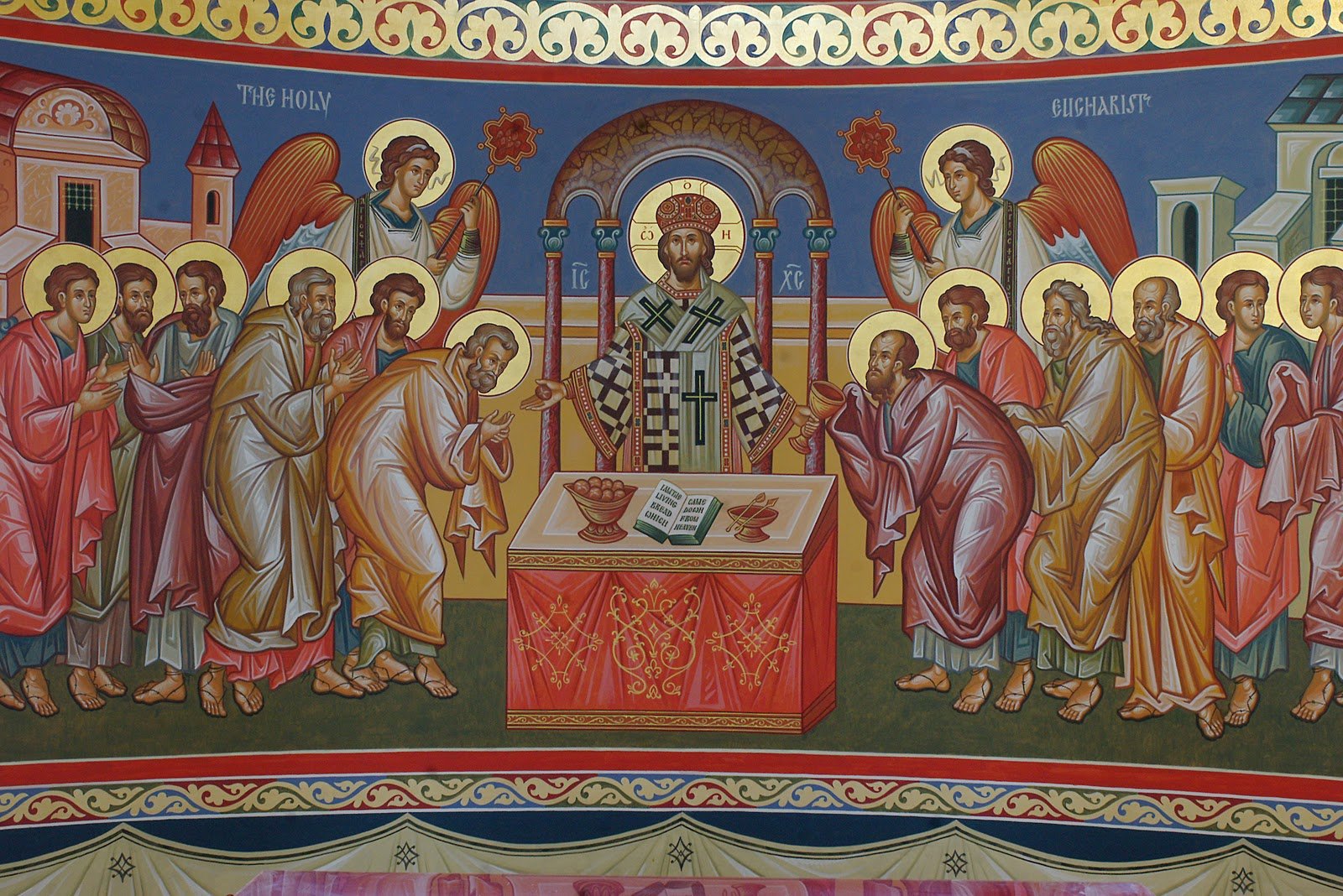
Holy Eucharist IconAs I shared in the last installment of this article, the Liturgy of the Faithful begins with an Intercessory Prayer. Like all prayers, the formula used was similar to that which people used to petition a favor from the emperor. The Greek Church saw God as the true emperor of the Kingdom and so addressed God in a fashion similar to that which was used in the Imperial Court. There is always a recognition of God’s true greatness and generosity before a request is made.

One of the characteristics of Byzantine worship is that is filled with the use of the word mercy. It is based on the biblical Hebrew word hesed which was translated in the Septuagint (the Greek version of the Bible) as eleos and in the Vulgate (the Latin version of the Bible) by the word misericordia. It has been rendered as mercy in most English editions. The translation mercy is unfortunate; but scholars are not agreed on the proper translation of hesed. They are agreed, however, that there is no single English word which is an adequate translation. They agree also that the divine and human attitude designated by hesed is basic in Hebrew religion and morality.

The meaning of hesed is seen most clearly by studying the words with which it is associated. Perfect consistency should not be sought, since there is a development of the term over the centuries of its usage; a basic meaning does appear, however, which is modified by not substantially changed. The most common word used with hesed is ‘emet which signifies solidity, steadfastness, loyalty; and thus hesed is associated with the quality which makes another person dependable and worthy of faith. When the two words are joined they signify dependable hesed. Hesed is something which one can “do” for another, either God or man; in each of these instances the person who does hesed is in a superior position. Hesed is   expected as a normal part of good human relations. When the Psalmist curses his enemy he wishes that no one will show him hesed because the enemy himself has not shown it. The wisdom literature praises hesed as the thing which wins hesed for oneself and assures success.

There is much more about this word hesed, which we translate as mercy, which I think is important to share. Why? Because it believe that it brings a different nuance to our worship since the word is used so frequently. I would, at this point, ask you to think about what the word means to you when we use it in the Divine Liturgy?

CALLED TO HOLINESS — 20150531

We cannot receive salvation from Christ and His Spirit unless we discipline ourselves by an inner attention over the elements within us that tend to hold us in bondage and disintegration. Or, more simply said, we can only receive salvation from Christ and His Spirit if we develop inner control and discipline over our attitudes, thoughts, emotions and, of course, our behaviors. We must come to realize that our behaviors are totally controlled and dictated by our attitudes and, thoughts and emotions.

We need, by God’s grace, to come into that critical awareness which the Greek Fathers called nepsis. This means a sober vigilance, an inner attentiveness to God’s presence and a passionate indifference so as to seek always only what is pleasing to God. It is a mental balance, an internal vigilance and awareness of the movement of God’s Spirit, leading us to true discernment of how we should react to any given situation or temptation according to our true dignity as God’s loving children. This means, therefore, that if we wish to be true Christians we must be reflective people, that is people who reflect upon their behaviors and attitudes and make them conform to the Way of Jesus.

May 24, 2015

O Heavenly King, Comforter, Spirit of Truth, You are everywhere present and fill all things.
Treasury of Blessings and Giver of Life, come and dwell within us,
cleanse us all stain and save our souls, O Gracious Lord.

Pentecost

This weekend we celebrate the glorious feast of Pentecost. This is one of the greatest feasts of our Church and replaces the Jewish feast of Pentecost. The descent of the Holy Spirit is, as it were, the seal on the world of the salvation of the human race accomplished by Jesus, the Son of God. It not only commemorates God’s work of filling the Apostles of Jesus with the courage to preach the Good News but also celebrates the gift of His indwelling Spirit to us.

Like the Jewish feast of Pentecost, which marks the fiftieth day after Passover, the Christian feast of Pentecost marks the fiftieth day after Pascha (Easter), which has become the New Passover. Indeed we believe that Christ is the new Moses who has freed us from the captivity of sin and death. He accomplished this by His life, death and resurrection.

The Church celebrates this feast as the beginning of the Church as we know it. The Pentecost event, recorded in the Acts of the Apostles, tells us that suddenly the apostles were no longer afraid to publicly bear witness to their belief in Jesus Christ and to proclaim the Good News that He brought to the world. We recall that immediately after the death of Jesus the Apostles were afraid and hid in the upper room since they thought that the synagogue authorities would also have them killed. Then something happened. All of a sudden the Apostles were no longer afraid and actually began to preach in public. All of a sudden they realized that what Jesus had taught them made sense and they felt free and liberated from their fears. They were no longer afraid to profess that they were followers of Jesus! In a single moment they became Christians.

Through this feast our Church calls us to become authentic followers of Jesus and not fear to profess to the world that we are Christians. We are called to witness to the Good News Jesus taught.

Sometimes modern Christians find it difficult to witness to Christ for fear of ridicule and also fear of being identified with fundamental Christians who, it must be admitted, can be judgmental of others who do not embrace the same type of Christianity. It is extremely important, I believe, that our modern world sees that Christians can be non-judgmental, thoughtful and respectful of others while still believing in Our Lord Jesus Christ. This is what we are called to do – to bear witness to Jesus in an   intelligent manner without judging others who do not believe like us.

Know that you are called to witness Him!

The Spirituality of the Christian East — 20150524

In this article I have embarked on presenting the 30 steps or rungs of St. John’s Ladder of Divine Assent. The first three rungs deal with breaking with the world and are within the first part of his book. The second part deals with the fundamental virtues. The first fundamental virtue that John suggests is one which too often we think of as pertaining only to people who have entered the religious life. That virtue is OBEDIENCE. This is not a virtue for only those who have entered the religious life. St. John describes obedience in this manner:

Obedience is unquestioned movement, death freely accepted, a simple life, danger faced without worry, an unprepared defense before God, fearlessness before death, a safe voyage, a sleeper’s journey. Obedience is the burial place of the will and the resurrection of lowliness.

Why is obedience a virtue? Many regard it as something for the weak, something that does not become a “real man.” The only time it is tolerated is when it is considered a necessity. If soldiers did not obey their commanding officers, the army would be a shambles, and this in turn would threaten national security.

This is not the obedience that St. John was talking about. The virtue of obedience is rooted not in fearful pragmatism, but in true humility. True obedience, like true love, cannot be forced – it must be free. Obedience and humility go hand in hand. They feed and nourish one another. We cannot learn obedience without real humility and we cannot acquire humility without obedience. Together these two virtues can take us to the very heights of spiritual perfection.

Take courage from this. For if you are able to do something as basic and simple as to obey, then you are already on your way to learning one of the greatest virtues of all: Humility.

Why do we need obedience?

CALLED TO HOLINESS — 20150524

Throughout his Gospel, St John focuses on this great pivotal truth: humans are truly helpless to make themselves whole. It is only through Christ, who is The Way, the Truth and the Life, that we can become who God intended when He created us – that we can fulfill what God said at creation: Let us make man in our own image, in the likeness of ourselves (Genesis 1:26). According to John, no one came come to the Father except through the Word incarnate (Jn 14:6). This makes perfect sense if you accept that Jesus, the Christ, is the archetype of what humans should be like.

It is He, Christ Jesus, who gives us the power to become children of God through the power of the Holy Spirit. He, who is God’s Son by nature, through His Spirit released in fullness only when Christ died out of love for each of us, makes it possible for us to really become God’s children by grace (God’s help).

The Incarnation for John is never considered and afterthought of God that attempts to save something of God’s original plan which was frustrated through the sins of human beings. It is, rather, the culmination and visible peak of God’s self-giving, passionate love unto death for each of us. This is, therefore, the Way to reach integration and fulfill God’s plan for us, His children. The Word made flesh, true God and true man, pitches His tent among us only that we might accept His suffering, out-poured love, His Spirit, and receive in that infinite love the power to become children of God (Jn 1:12). This is the basis for our understanding of Theosis. God didn’t have to repair a plan that was botched up by humanity. His plan has always been to provide humankind with the opportunities to truly become His children, people in His likeness, by voluntarily imitating the model that He gave us in the Person of Jesus, the only-begotten

Understanding Our Ukrainian Greek-Catholic Faith — 20150524

One of the ritual actions that we perform on the feast of Pentecost is to kneel for the first time in 50 days. Kneeling takes on a new meaning on this feast. It signifies that we understand with deep humility the gifts of the Spirit which God has bestowed upon us. These gifts are permanent dispositions that move us to respond to the guidance of the Spirit. The traditional list of these gifts is derived from, Isaiah (11:1-3) and include:

wisdom, understanding, knowledge, counsel, fortitude, reverence or piety and wonder and awe in God’s presence (fear of the Lord).

These are all powers that we say God possesses. He shares them with us if only we open ourselves to the Spirit within us.

The practice of kneeling especially during portions of the Divine Liturgy then continues through the remainder of the Church Year. In many Eastern Churches kneeling is not necessarily one of the ordinary ritual practices.

A second unique ritual practice that is observed with the Feast of Pentecost is that beginning with this feast, Sundays return to being the end of the week and not the beginning of the week as they are during the days after Easter.

Pentecost is frequently misunderstood to be a feast focused on the worship of the Holy Spirit. Actually Pentecost commemorates the event itself of the descent of the Holy Spirit while             Pentecost Monday is dedicated to paying special worship to the Holy Spirit as the Third Person of the Trinity. So Pentecost truly celebrates the impact of the gift of God’s Spirit. It is the Divine Force which forms us into the Church. The prayers of Pentecost Monday actually say this:

On this day we honor that all-holy and life-giving and all-powerful Spirit, one God in the Holy Trinity, one in dignity, one in nature and one in glory with the Father and the Son.

The Synods of Zamost and Lviv call Monday the feast of the Holy Trinity. An Ukrainian Typicon (i.e., a book which indicates how services should be taken), indicates that the feast can be considered a feast of the Holy Trinity. It would seem that it is more properly considered the feast of the Holy Trinity since it is by the work of the Holy Trinity that humankind has been granted the gifts of the Spirit.

The special kneeling prayers that we use on our celebration of Pentecost are, in reality, a part of the Vespers service and St. Basil the Great is the person who directed that these prayers be said while kneeling as a sign of respect. We now say them during the Divine Liturgy

CONGRATULATIONS AND BEST WISHES

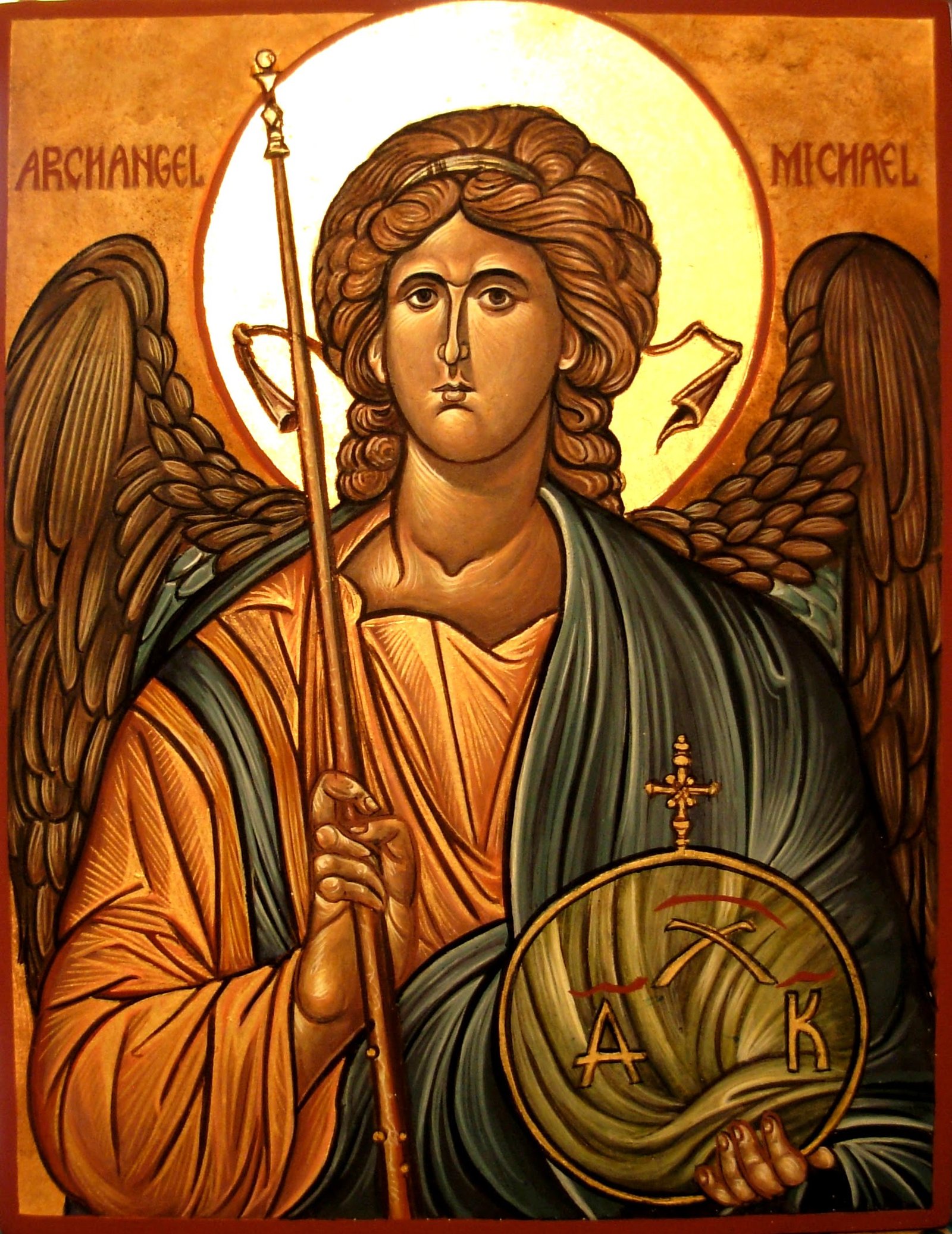
Archangel Michael

Archangel Michael

CONGRATULATIONS AND BEST WISHES
are extended to

Drs. Tony and Christie (Krokosky) Grech
and their families
on the occasion of the
Initiation of their son

WILLIAM MICHAEL GRECH

into the Church
God Grant Him and Them Many Years