
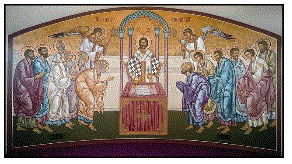
Mystical Supper
CONGRATULATIONS
are extended to
Aubrey Borodich
as she solemnizes
her reception of the
Holy Eucharist
God Grant Her Many Years!
Mnohaya Lita!
Mystical Supper
CONGRATULATIONS
are extended to
Aubrey Borodich
as she solemnizes
her reception of the
Holy Eucharist
God Grant Her Many Years!
Mnohaya Lita!
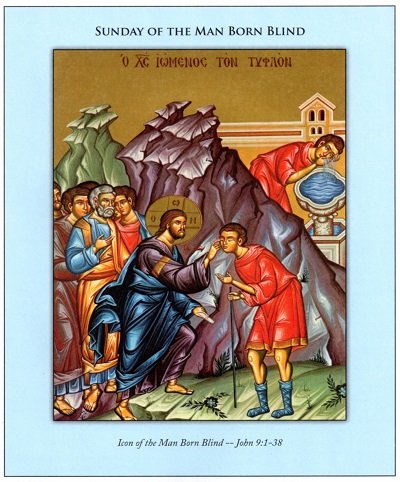 The Church adeptly ends our forty-days of celebrating the Resurrection of Our Lord by remembering, on the very last weekend, the cure of the man born blind and the clairvoyant girl who exclaimed: These men are servants of the Most High God: they will make known to you a way of salvation.” It is my hope that all of my readers will immediately put together a message from the combination of these two stories that will help them to more effectively live their daily lives.
I would encourage all who are reading this to stop, before completing this article, and reflect upon the message they have derived from combing these two stories. I truly believe that you can find a message by combining these stories.
Now that you have thought about it, I would share the message I received.
First, I think that the combination of these two stories tells me about life. We are all born blind to the true and real meaning of life. The journey of earthly life is, I believe, about learning the true meaning of human life. The man’s blindness tells me that life presents to all of us certain challenges and we learn about life’s meaning by meeting these challenges in a positive manner. I also truly believe that when we see life’s challenges in a negative way, we never learn the lesson that life is designed to teach us.
The passage from the Acts of the Apostles, the Epistle, tells us that, if we truly believe our God became Incarnate as a human person in order to reveal how to live this earthly life, we will learn the lessons that life is designed to teach us. This requires us, however, to ask ourselves two very important questions: (1) What are the particular challenges that my life is delivering, or has delivered, to me? and (2) What are they trying to teach me about the meaning and purpose of life and how to live life? I truly believe that we must remember that God allows life to deliver the unique challenges which can, if we respond to them in a positive way, change our attitudes and behaviors so that we can live more like Jesus – life is meant to help us not be blind to life’s lessons!
Hopefully you will ask yourself these questions!
 In this article I have begun sharing thoughts about Paul’s Letter to the Ephesians. Though the imagery is drawn from warfare, it is clear that it is metaphorical: the armor of God and Christians is truth, righteousness or justice, faith, salvation, the Spirit and the word of God. Many of the people who read letter clearly understood this type of military language.
Ephesians also includes rules or directives for the structuring of Christian life. The household code for Christians that appears for the first time in nine verses in Colossians (3:18-4:1) is expanded in Ephesians (5:21-6:9) to twenty-two verses. Some of its language is familiar from its use in Christian marriage rituals:
Wives, be subject to your husbands as you are to the Lord. For the husband is the head of the wife just as Christ is the head of the church, the body of which he is the Savior. Just as the church is subject to Christ, so also wives ought to be, in everything, to their husbands. Husbands, love your wives, just as Christ loved the church (5:22-25)
Though these verses affirm that both wives and husbands have obligations to each other, they are not equal: wives are to be subject. This is quite different from the equality and mutuality recommended in Galatians 3:28 and 1 Corinthians 7.
The household code continues with an admonition to children to be obedient to their parents. The Paul of the seven genuine letters would not have opposed this – but he never mentioned it. His passion was not for reinforcing conventional patterns of behavior, but proclaim Christ crucified, Jesus is Lord and the new creation.
The household code concludes with the relationship between slaves and masters:
Slaves, obey your earthly masters with fear and trembling, in singleness of heart, as you obey Christ; not only while being watched, and in order to please them, but as slaves of Christ, doing the will of God from the heart. Render service with enthusiasm, as to the Lord and not to men and women, knowing that whatever good we do, we will receive the same again from the Lord, whether we are slaves or free (6:5-8)
The letter takes it for granted that Christians may have Christian slaves, and this text has often been used in the history of Christianity to legitimate slavery. This does not truly represent the message of Christ!
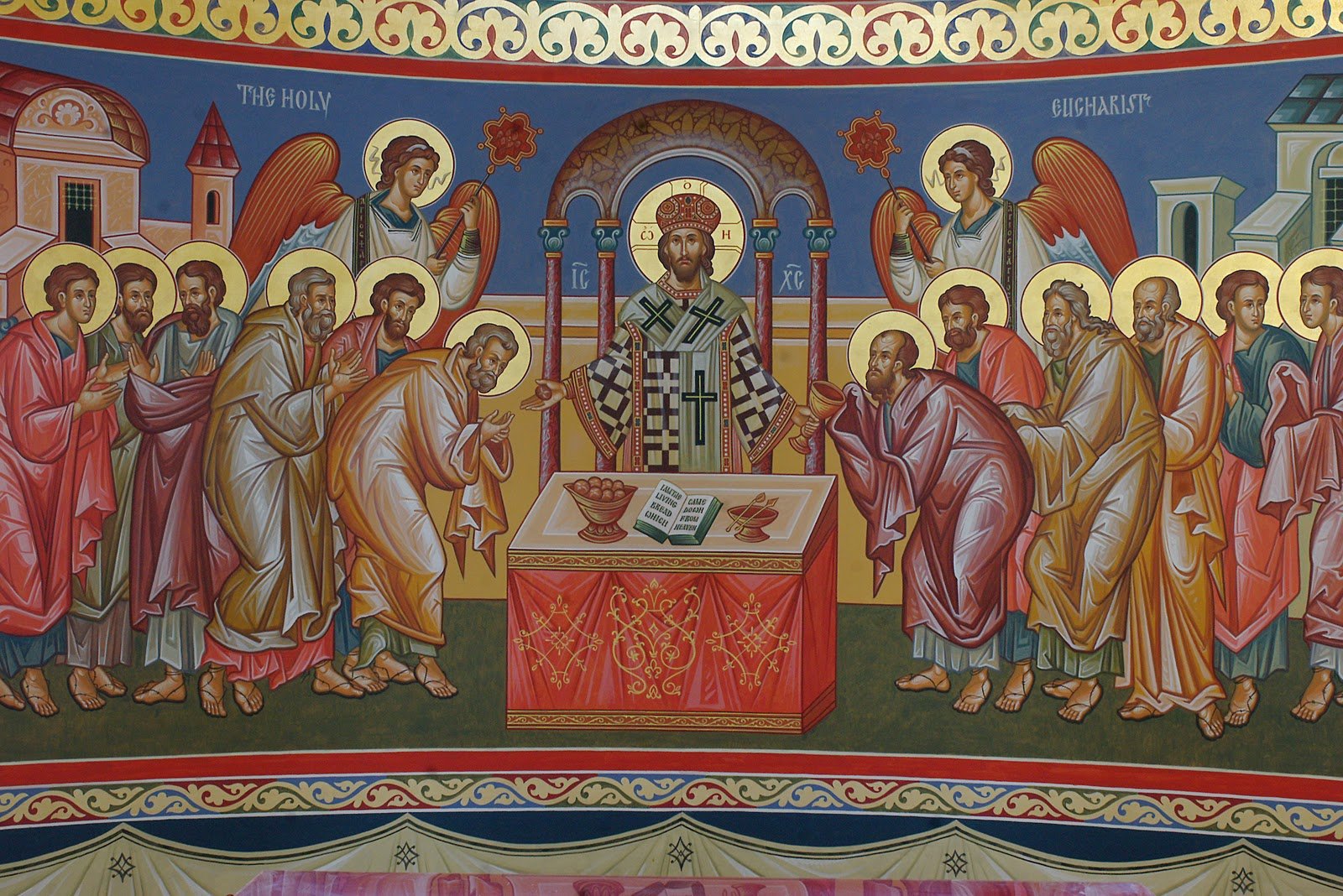 In this article I have been reflecting more intensely on the Divine Liturgy and its various parts. The Small Entrance is the first significant movement of the Divine Liturgy. It follows the primary liturgical action which is the gathering of the faithful into the one community of the Church of God. The Small Entrance is the movement of the entire Church through its Head Jesus Christ, in the person of the celebrant, to the altar which symbolizes the Kingdom of God. It is the movement made possible by the Gospel of Christ, the Way to the Kingdom. It can only be accomplished by following Jesus, the Living Word of God in human flesh. (John 1:1-18)
There can be no approach to God the Father but through Christ (John 14:6). There can be no communion with God the Father except by the fulfillment of His commandments, given to us by Jesus and proclaimed in the words of His Gospel. Thus it is the Gospel of Christ takes us into the realm of the Father and into the eternal life of the Blessed Trinity whose Kingdom we enter and experience in the Divine Liturgy.
The Small Entrance, technically, is not completed when the clergy enter the sanctuary and stand before the Holy Table. It is completed only with the singing of the Thrice-Holy Hymn, during which the clergy proceed to the place behind the altar table (called the High Place), that it is completed with the celebrant proclaiming the solemn biblical greeting: Peace be with all!
After this first blessing, the people say the appointed Tropars and Kondaks of the day. These are hymns which praise the saving events or holy persons celebrated liturgically at the particular gathering. On Sundays these songs always praise Christ’s resurrection.
While these hymns are being said, the celebrant begins the prayer which introduces the Thrice Holy Hymn. He intones the ending of the prayer which asks God to forgive us every voluntary and involuntary offense. The singing of the Thrice Holy Hymn then follows. This is the prayer which Isaiah (6:1-5) envisioned the entire angelic host singing constantly before the throne of God. Holy God, Holy and Mighty, Holy and Immortal have mercy on us!
This Hymn is of very ancient origin. It is a hymn to the Holy Trinity in whose very presence we believe we stand as we celebrate the Divine Liturgy – the prayer that incorporates and ritualizes the life-prayer of Jesus Himself, bringing us into communion with the Trinity.
I have already shared with you the first two rungs or steps on Climacus’ Ladder of Divine Ascent. They are: Renunciation and Detachment. Hopefully they have made sense to you. If they have not, think about them again and come up with what they mean to you.
The third step on John’s Ladder is Exile. If we have renounced the world and detached ourselves from worldly ways, we see ourselves as spiritual and material beings that live on this earth as exiles. We see ourselves as beings who are here to learn how to be Christ-like – to truly be God’s children. St. Paul wrote in his letter to the Hebrews (13:14): For here we have no continuing city, but we seek the one to come. St. John Chrysostom writes:
If you are a Christian, no earthly city is yours. Of our City “the Builder and Maker is God”. Though we may gain possession of the whole world, we are withal but strangers and sojourners in it all. We are enrolled in heaven: our citizenship is there!
I realize that it is difficult for most people to think in this manner. We only know this earthly existence and it is hard to conceive anything other than this existence. Further, I believe that it frightens most people to think about being detached from the things of this world and to stop putting all of their trust in this world. The things of this world are tangible. The things of the next world are intangible! And, is the next world real? I cannot prove its existence. I can only believe that it exists.
So the challenge is to develop the faith in God’s revelation about the next world to such a degree that I can detach myself from this world and sense that I am living in exile!
Ask yourself: How attached am I to the things to this world? Do I really believe there is a world to come? Can I trust and believe in the God I think exists?
I am attempting, in this article, to stress what the Greek Fathers have said about the primary, spiritual idea that distinguishes the Eastern Church from the Western Church. That idea, as many already know, is the idea of Theosis. While many of the Fathers did not actually use this term, the deification of the human person in Christ is certainly a golden thread which may be traced throughout the writings of the Fathers. One of the fundamental criteria that the Fathers use to measure the likeness to Christ which is found in people, is love for our enemies. One later day Eastern saint, Silouan, says this:
Christ prayed for them that were crucifying him: “Father, forgive them; for they know not what they do.” Stephen the Martyr, prayed for those who stoned him, that the Lord “lay not this sin to their charge.” And we, if we wish to preserve grace, must pray for our enemies.

Fathers of the first Six Ecumenical Councils
Herein lies the mystery of the divine “mode of being”, God’s very way of life: humility. Humility on the ascetic plane, is manifested as regarding one’s self as the worst of all sinners, while on the theological place, humility is revealed as love, which is given unconditionally, freely and completely.
I have found, after all the years of my priestly ministry, that this is one of the greatest of all the Christian challenges, namely to truly love our enemies and those who hate us. St Silouan, who was possessed of this divine love, humbly warns us to be watchful:
If you do not feel pity for the sinner it means that the grace of the Holy Spirit is not in you, but an evil spirit. While you are still alive, therefore, strive by repentance to free yourself from the spirit.
The struggle for Christ-like love for one’s enemies and humility, and against pride, is a very great one indeed; and that is why the saints, the true imitators of Christ and sharers in His love, are great indeed. Indeed one of the true characteristics of a saint is the person’s ability to love one’s enemies with true humility.
Where does this Christ-like love lead? It leads to a fuller life, a life wherein the persons experiences the fullness of life. When we make an attempt to love others, even our enemies, as ourselves, something happens to us. We begin to experience life in a different way and begin to understand that the true meaning and purpose of life is to help us become more Christ-like – to become a child of God.
What is the meaning of this earthly life?
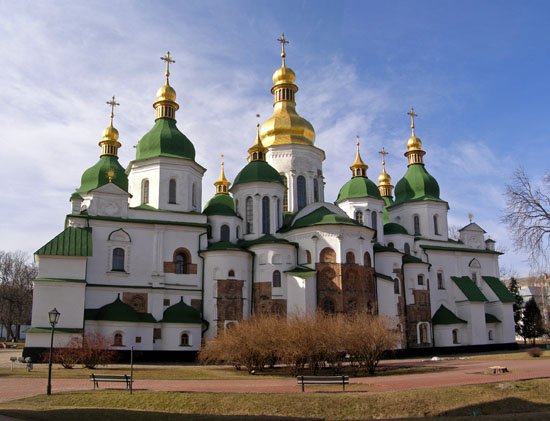
St. Sophia’s Ukrainian Greek-Catholic Church in Kiev, Ukraine
It is my thought that those who are reading this Bulletin have, at some level, embraced the Eastern Catholic way of thinking which, I firmly believe, is very different from the Western Catholic way of thinking. Why? Because our worship and the theology which flows from our way of worship is different! While both are equally true, they are not the same. It is critical, I believe, that we embrace the Eastern Catholic way of thinking because it flows from the way that we worship God. If you have experienced the Roman Catholic way of worship, think about the differences! Our worship is, I truly believe, much more experiential since it responds to all of our human senses. Our ritual is much more sensual, in the good sense of the word! Just recall how we celebrate the Great and Holy Week and, of course, Easter.
One of the aspects of our Easter worship that always impresses me is that we clearly see the connection to our Judaic roots. Our Church clearly states that Jesus is the new Moses who frees us from the captivity of our human limitations. Easter is the new Exodus – Christ leads us to a new freedom and the Promised Land. Christians have a New Jerusalem and are told that all humans have been chosen by God to be a part of His Kingdom. Our Church never tells us that God excludes others, even those who may not believe that Jesus is God incarnate. It clearly tells us that God calls all humans to His Kingdom.
Our Church abounds in images and rituals which attempt to have us experience what we believe. Again, think about how we have tried to worship God during this special time of the year. We tried to make it truly real with our Great and Good Friday burial of Christ. We tried to make it real by our glorious celebration of Easter.
One of the real testimonies of this fact is the way we celebrate Easter Matins. It is called the Rush Service. We try to put a lot of energy into the service by making sure that we sing more rapidly and, when the incensation is done, that it is done rapidly and with energy.
Again all of this creates a milieu that tells us, or should tell us, that we are experiencing these things in the present moment. We do not profess that the life of Christ is just a past memory. Since there is no time in God, all the things that Jesus did are things that He is also currently doing.
I know that this is difficult for some to intellectually grasp. Our Church sees and celebrates salvation history as taking place right now!
Hopefully all who read this will come to realize that salvation is a present experience!
The Deacon is the “waiting-man or servant”. The Church defines a deacon as men ordained by the bishop to serve. They receive the Mystery of Holy Orders but not the ministerial priesthood. Through ordination, a deacon is conformed to the Christ who said He came to serve, not to be served. They can assist a priest in all of the liturgical services and were and are asked to dedicate themselves to all the charitable endeavors of the Christian Community in which they serve. This was their primary ministerial role in New Testament times. We hear in the Acts of the Apostles that this was the original reason why the order of deacon was first founded. The first task of a deacon was and still is to oversee the charitable works which, from the beginning of the Church, are seen as an integral part of the Jesus WAY – the works of mercy. As the Church grew, the function and role of deacons expanded.
Another primary task of a deacon is to witness to Jesus Christ. Stephan, one of the first seven called, witnessed to Jesus during his trial before the Jewish Sanhedrin. This witnessing lead him to becoming the first martyr of the Church and with this event we see the start of the persecution of the Church.
Another of the seven first deacons, Deacon Philip, went to Samaria and preached the Good News there. From there he was led by The Spirit to go down to Gaza where, in Chapter 8 of Acts, we hear of the conversion of the Ethiopian by Philip’s teaching and witnessing. Philip then ends up baptizing the Ethiopian.
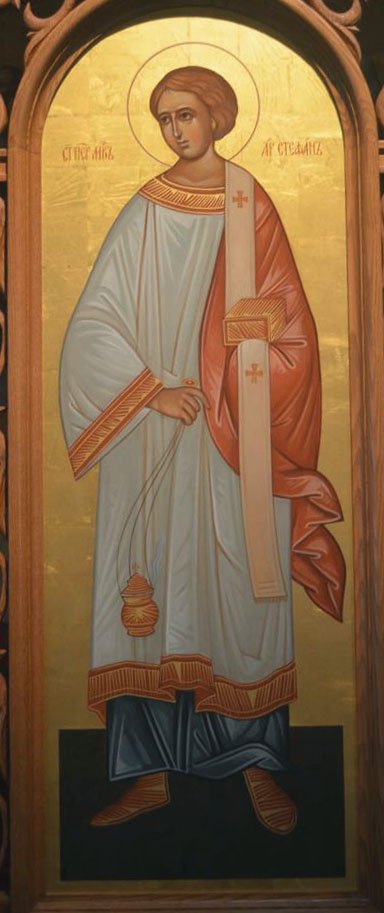
Deacon Stephen
Preaching and witnessing is the second task assigned to a deacon. Today it is seen by his major role in the liturgy. His proper role is the proclamation of the Gospel and, with the permission of the presiding priest, to preach on occasions.
By extension this is also a call to teach and instruct outside of liturgy. Further, a deacon is also a messenger or instructor during the liturgy, calling the congregation to prayer. Because our present service books were written for celebrations without a deacon, the role of a deacon is not as evident.
It is the role of the deacon to call the congregation to prayer with various directives, like: Wisdom. Be Attentive!
During liturgical services a deacon is called upon to lead the congregation in prayer – he sings all of the litanies and asks all to respond, beginning with the petition: “In peace let us pray to the Lord”. A deacon is the person who proclaims, “Master, Give the Blessing” as he raises his orarion, the unique vestment of his office, and asks the priest to begin the celebration. In effect, a deacon is truly like a master of ceremonies, his primary role is to keep the liturgical actions moving and to be the leader of the prayer of the faithful.
A deacon in the Eastern Church, unlike his Western counterpart, only leads, assists and directs, he never performs any of the sacred mysteries on his own. This lack of being a presider in the liturgical assembly only reinforces the role of a Deacon’s role as servant. Something truly unique and wonderful in the Churches of the East.
It is my hope in future installments to relate stories about some of the great deacons in the Church because their core role and service to the church crosses the boundary of East and West and because their ministry is core to work of the Church. This is what Father Wayne so eloquently preached on the Sunday of the Paralytic Man. Deacons are ministers of the works of mercy.

ASCENSION OF OUR LORD
We celebrate the great feast of the ASCENSION OF OUR LORD. This feast is celebrated 40 days after the feast of the resurrection of the Lord. The number 40 has great significance throughout the Torah and the Talmud. The number 40 represents transition or change; the concept of renewal; a new beginning. The number 40 has the power to lift a spiritual state. According to the Talmud, at age 40 a person transitions from one level of wisdom to the next. After Moses led the Jewish people for 40 years in the wilderness, he told them: “God has not given you a heart to know, and eyes to see, and ears to hear, until this day”. From here we see that it took the Jewish people 40 years before reaching a full level of understanding.
(Remember to keep holy the Feast of Ascension)
Throughout the Old and New Testaments, including the writings of John, the theme of light is used in three ways.
First, light designates an essentially moral reality, a manner of upright living. John seldom uses the image of light in this sense. Except for a rare text, such as John 3:20, he is much too occupied with Christ as the light.
Second, light designates an extrinsic rule of conduct, a norm for human actions. This is the usual way of referring to the Mosaic Law in the Old Testament.
Third, light designates Christ as the Messiah bringing salvation to those sitting in darkness or death. This third theme John employs in his frequent use of the world light. He applies it to Christ in His function as Savior, God’s healing power among His children who live in darkness or the lack of God’s life.
Christ in John’s Gospel calls Himself the Light of the world, meaning primarily the one sent by God, who is God also, to bring us salvation: I am the light of the world. He who follows me will not walk in the dark but have the light of life. Also, I have come into the world as a light, so that no one who believes in me might remain in darkness.
In the Prologue of his Gospel, St. John presents God’s Word as Life that gives light or salvation. But sin has disrupted the plan of God. Not only mankind but the entire world is immersed in darkness. It is more than a mere absence of light. The darkness possesses an inimical force that rises up to extinguish the light. But already in the Prologue St. John predicts the victorious outcome of the Light conquering the darkness. The light shines in the darkness, and the darkness did not lay hold of it.
Nonetheless the fact that human beings failed to receive the Light did not lessen Christ’s activity. He still remained the true light. Only Jesus Christ, not John the Baptist or anyone else, is the true light that illuminates all men. He is the true light because He is the Son of God, the true Messiah, the Anointed One, who brings eternal life and truth to all who accept Him, His teachings and His person.
By use of the rich symbol of light, John pictures Christ not only as an illuminator, a teacher, but as the one who actually effects salvation. He who follows me does not walk in darkness but will have the light of life. The Light is at one and the same time the effect and the cause of the life.