The Spirituality of the Christian East — 20150503

The second rung on Climacus’ Divine Ladder of Ascent, is Detachment. This is closely allied to his first rung which, as I have shared, is Renunciation. While truly detachment involves letting go of our need for self-gratification, it is also more than this. It involves detaching ourselves from our ego, our pride. For it is pride that fills us with anger when we are wronged. It is pride that makes us think, I don’t deserve to be treated like this! How dare they speak to me that way!

Detachment from pride is the imitation of Christ, because if anyone did not deserve to be derided, mocked, jeered, beaten and put to death, it is Christ. Who are we to think we deserve better than He? Yet our pride makes us think we deserve respect, dignity, and comfort. And if we think as the world thinks, we may be right. Wicked people do wicked things and get everything they want, while good people suffer. Where is the justice in that? But as Christians who have renounced the ways and, indeed, the justice of the world, we are to compare ourselves not to others but to Christ alone. He is our true model. It is He who we are called to imitate, not our fellowmen.

This is why so many saints of the Church faced martyrdom with joy, for in that martyrdom they knew they were following Christ crucified and did not give a thought to What did I do to deserve this?

If we are persecuted and hated for no good reason, even if it is not for our faith, it is a blessing in disguise. For in that moment, we have been given an opportunity to imitate Christ to the full, to truly be His disciples.

Perhaps the most effective way to begin developing this important attitude of detachment is to first discover to what we are truly attached. There is nothing in this world that is more worthy of attachment than God Himself.

May 3, 2015

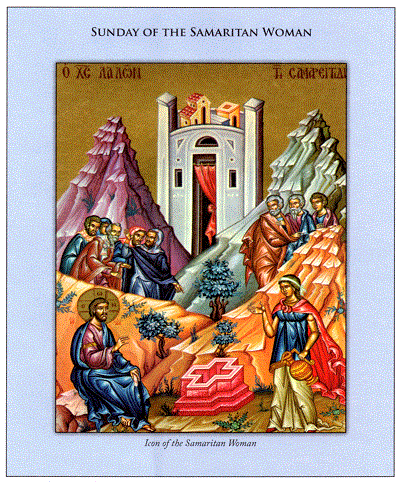
When the Samaritan woman came to the well with faith,
she beheld You, O Water of Wisdom.
You allowed her to drink in abundance and glorified her eternally,
for she inherited the heavenly kingdom

womanatwellOn this fourth weekend after Pascha, the Church would have us reflect on two readings. The Epistle, taken from Acts, shares the fact that it was in Antioch were the disciples were first called Christians. The Gospel, taken from the fourth chapter of John’s Gospel, shares the story of Jesus’ encounter with a Samaritan Woman at Jacob’s Well. The challenge is to find a coherent message from the two readings.

As I reflected upon these two readings, it became obvious to me that the message is simply this: to be truly called a Christian one has to be an authentic worshiper who worships the Father in Spirit and truth. This insight, of course, only led me to yet another question: What does it mean to worship God in Spirit and truth? This, I must confess, was a much more difficult question to answer.

I found an answer that I felt was truly appropriate for me by looking again at the life of the man Jesus and how He worshiped God. Although He followed all of the rituals of His religion, Judaism, He also showed us how to worship God by literally and symbolically offering His very own life to God in thanksgiving for the gift of life. He focused all of His energies on making God’s Kingdom real. He worshiped God by how He lived. He was God-centered and made sure that all who came into contact with Him received unconditional love. He showed us that true worship of God is accomplished by living as a spiritual person who finds God’s presence in each and every other human being. He provided us with an image of how He worshiped by taking bread and wine, the symbols of life, and offering them to God with the statement that they were His own Body and Blood.

To accomplish this type of worship a person must allow God’s Spirit to direct his/her life. His Spirit provides the strength and power for us to love others, even our enemies, as ourselves. When we recognize that God’s Spirit is within us and that we can draw upon it to help us live a God-centered life, we can then worship God in Spirit and truth.

This approach to worship doesn’t happen just because we are baptized. It only happens when we voluntarily decide to live as Jesus lived. Let us truly decide to worship God in Spirit and truth, following and imitating Jesus!

CALLED TO HOLINESS — 20150503

CaptureKnowing God is to enter into a whole way of life. It is the perfection or the completion of all other     levels of human life, physical, emotional and intellectual. It is being caught up in the liberating, tender love of God toward each of us. This life is revealed to us through the spoken Word of God made flesh, Jesus Christ. We can be sure that we know God only by keeping His commandments…. But when anyone does obey what he has said, God’s love comes to perfection in him. We can be sure that we are in God only when the one who claims to be living in him is living the same kind of life as Christ lived (1 John 2: 3-5).

To be in God is to accept Jesus Christ as God’s loving presence, which speaks continually – through His indwelling Spirit abiding in us – of the Father’s infinite love for us, even unto becoming a human. God’s life becomes our life in a prayerful experience of God’s enormous love that frees us from narcissism and anxiety. Christ lives in us to the degree that we live as He lived, in self-emptying love for others.

St. Paul summarizes for us this new life that Christ brings us:

As for me, by the law of faith I have died to the Law that I may live for God. With Christ I am nailed to the cross. It is now no longer I who live, but Christ lives in me. The life that I now live in this body, I live by faith in the Son of God, who loves me and sacrificed himself for me. (Galatians 2:19-20)

God’s Word brings us God’s life and divinizes us. It makes us children of God (1 John 3:1). To live in God’s life is to live in the light of Christ’s resurrectional presence and to be obedient to His inner direction, recognized by the indwelling Spirit.

One of the true meanings of salvation is to be filled with the light or knowledge about life that God revealed to us through the Person of Jesus. The light that God has shared with us through Jesus is the true meaning and purpose of this earthly life. What, in your estimation is the meaning and purpose of life?

Gaining a Deeper Understanding of the New Testament — 20150503

Saint PaulThe letter to the Ephesians, which I am now considering, is unlike the seven genuine letters of Paul. In this letter there are no real references to the circumstances of a particular, special community. Instead, it seems to be a general or circular letter meant to be read and heard within many Christian communities. The use of the Greek word translated into English as church, also suggests this. In Paul’s genuine letters, the word always refers to a specific local community. In Ephesians, it refers to the church in general, the household of God, which is often called and thought of as the church universal. The framework for dating this letter is created by its close parallels to parts of Colossians which indicates that Colossians is earlier and it seems to have been known by the   Christian author Ignatius around the year 100. This suggests a date around 90.

The central theme of Ephesians is the unity of Christian Jews and Christian Gentiles that has happened in Christ. The passage, Ephesians 2:11-20 should be read.

In the passage referred to above, the text treats the controversy about the full status of Gentile Christians as in the past, settled, and resolved. It does not argue for unity but celebrates a unity achieved. Note also that it refers to the apostles as if they were figures of the past.

The theme of Christian unity sounds again with the repeated use of one in another passage (4:4-6) well known to Christians:

There is one body and one Spirit, just as you were called to the one hope of your calling, one Lord, one faith, one baptism, one God and Father of all, who is above all and through all and in all.

Ecclesiology – a technical theological term for doctrine or teaching about the Church – is central to Ephesians. Its ecclesiology is as splendid as anything in the New Testament.

Another familiar passage in Ephesians uses the imagery of military conflict to describe the struggle against the rulers, against the authorities, against the cosmic powers of this present darkness, a term Paul uses in his genuine letters for this world.

Take up the whole armor of God…the belt of truth around your waist,…the breastplate of righteousness,…the shield of faith…the helmet of salvation, and the sword of the Spirit, which is the word of God. (6:13-17)

You are encouraged to pick up your bible and read Ephesians.

Learning Our Faith From the Greek Fathers of the Church — 20150503

holy fathers iconPaul writes in his letter to the Romans the following:

The Spirit itself bears witness with our spirit, that we are the child of God: And if children, then heirs, heirs of God, and joint heirs with Christ: if so be that we suffer with him, that we may be also glorified together. For I reckon that the sufferings of this present time are not worthy to be compared with the glory which shall be revealed in us (Rom 8:16-18)

Another Father also makes a very interesting and important observation concerning the example given by Christ and our own Theosis or deification. He points to the fact that even though the deification of Christ’s human nature was, as St. John Damascene says, effected from the very moment in which He       assumed our nature, nevertheless Christ as Man shied away from anything which might give the impression of auto-theosis, that is to say, self-deification or self-divinization. That is why we see the action of the Holy Spirit underlined at His Holy Birth: The Holy Spirit shall come upon you…therefore also that holy things which shall be born of you shall be called the Son of God; also, the Holy Spirit descends upon Christ at His Baptism in the Jordan; and concerning the Resurrection, the Scriptures speak thus:

God, that raised him up from the Dead, and gave him glory; and finally, Christ Himself, teaching us the way of humility and how always to ascribe glory to Our Heavenly Father, says

If I bear witness of myself, my witness is not true. There is another that bears witness to me; and I know that the witness which he witnesses of me is true.  

The same movement may be observed in the Divine Liturgy. The Words of Christ – take eat, this is my body, drink of this all of you, this is my blood – by themselves are not regarded as sufficient to effect the consecration of the Holy Gifts; they must also be accompanied by the Epiclesis, that is by the invocation of the Holy Spirit, precisely in order to avoid any notion of self-deification, to avoid, that is, giving the impression that simply by speaking the words which Christ spoke, we are able to transform the Holy Gifts into the precious Body and Blood of Christ. Of course, at the heart of this movement lies the truth that the action of Father, Son and Holy Spirit is always one and the same: the Three Divine Hypostases always act together, always act in unison, which is an expression of Their consubstantiality.

This is clearly represented in our Divine Liturgy!

Understanding Our Ukrainian Greek-Catholic Faith — 20150503

It seems that many people who are Greek Catholics, including clergy, feel that they have to embrace what is seen as Catholic without realizing that the   Roman Catholic Church embraces a very Western theology that fits their services. We must remember that all theology finds its roots in     the worship of the Church. Our Eastern form of worship is different from that of the Western Church. Therefore, if we are to have a true and real understanding of our faith, it must be through a theology that flows from our services.

For example, the Western Church does not have a sense of Theosis which is the foundation of Eastern Spirituality. When we truly look at our Eastern worship and the mysteries (i.e., sacraments) that we     celebrate, we see that they do not express Western Theology.

Now one theology is not better than the other. BUT, our theology must flow from our services.

hagiasophialastFor example, our Eastern approach to the worship of God is Trinitarian. We do not worship Jesus, the Christ, but rather our Triune God. While it is true that Christ is a part of our understanding of the Trinity, He, because He was also truly a man, calls us to worship God together with Him. So all of our prayers end with the doxology (i.e., praise) of God as a Trinity of Persons, Father, Son and Holy Spirit. We also know and believe that we cannot think of Christ as God unless we first embrace God as a Trinity of Persons who, through the Person of Christ, are joined to us through a sharing of Divine Life.

Further, our understanding of the death of Jesus is much different. We do not believe that He died for our sins but, rather, to reveal to us that the life that we experience is immortal. We do not believe that Adam and Eve, the first parents, gave us a defective nature. Humans are not born into this world as defective. Our initiation ritual, which includes the mysteries of Baptism, Chrismation and Holy Eucharist are given to infants to signify that they are born into a community that believes that earthly life is given to us so that we might learn how to be spiritual beings, children of God. We become spiritual beings when we learn how to be more like Jesus Christ.

The focus of our spiritual development is entirely different from that of the Western Church because our worship and theology are different. The word Catholic means universal, which means that the Catholic Church is composed of a variety of ways of looking at the faith. We are just as Catholic as the Roman Catholic Church even though we look at our spiritual life in a different way.

The Divine Liturgy and Our Worship of God — 20150503

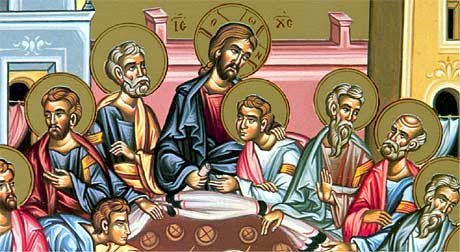
Mystical Supper

Mystical Supper

One of the things we know about the development of our Divine Liturgy is that it rarely eliminated things that became a part of it over the years. The prayers that follow the Great Litany, namely the First Antiphon, the Hymn of the Incarnation, the Small Litany and the Second Antiphon were all originally celebrated as a part of a procession to the worship space and the bringing of the Gospel Book from a secure location to the Ambon, the raised platform in the center of the church building where the clergy were gathered at the beginning of the Liturgy. It was only in Constantinople that the Great Litany was placed before the antiphons as a way to begin the   procession that brought the clergy and people to the worship space. The more ancient position in the Liturgy for the petitions was after the various scriptural readings and the sermon. The Eastern Church, as you know, loves processions and some sort of procession is integrated into most major services and feasts. As we know, there are still two major processions in the Liturgy, the Small and the Great Processions.

What is the meaning of these two processions? Think about how they are performed today. Both the Gospel Book and the Gifts are brought from the altar area, through the church and back to the Holy Table. These symbolize that both the Word of God (Gospel) and Life (food in the form of bread and wine) come from heaven (God) to us with the expectation that, if we believe, they have the power to lead us back to heaven and union with God. Remember that the nave, that portion of the church were   the faithful are during the Liturgy, symbolizes the earthly Kingdom of God.

The antiphons are really verses from various Psalms with a special refrains in between these verses. They are now standardized but, originally, any Psalm could be used. On major feasts the Tropar of the feast served as the refrain between the Psalm verses.

You will remember that the Hymn of the Incarnation was only added to the Liturgy by Emperor Justinian after the Councils of the Church defined the Incarnation and that Jesus is truly God and Man. It is important, as we sing this Hymn, that we think about what it really says and that we make it a moment when we make a profession of our faith that Christ is truly God and truly Man.

If you think about these things when we are celebrating them, it truly has the power to enhance our worship and our understanding of our faith.

April 26, 2015

With Your divine protection, O Lord, as You once raised the paralytic,
now lift up my soul paralyzed with all kinds of sin and evil deeds of wickedness,
so that, as saved, I may cry out to You:
“Glory be to Your might, O Merciful Christ!”

paralyticThe weekends after Pascha (Easter) are all given names which relate to the particular scriptural story that is proclaimed in the Gospel. It is the Church’s way to help us more fully understand what it means to be a follower of the Risen Christ. Each Gospel story shares with us another aspect of what it means to be a Christian.

The first weekend we remembered the Apostle Thomas who doubted the Lord’s Resurrection until he actually saw Jesus in person. In this story Jesus says: Blest are they who have not seen and have believed. This has a direct message for us who have not seen the Lord in person.

The second weekend we remembered the Ointment-Bearing Women. They performed one of the Corporal Works of Mercy, namely burying the dead. This story stresses the fact that as followers of Jesus we are called to be of service to others, that is perform Works of Mercy, as a way of making God’s Kingdom real in the present day. Such works make God’s love real in the world and brings us closer to Him.

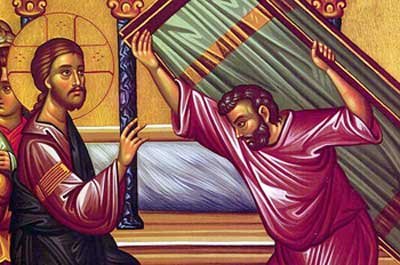
On this third weekend we recall the story of Jesus curing the paralytic man at the Pool of Bethesda. Followers of Jesus are reminded that we humans can easily become spiritually paralyzed, unable to be of service to others, when we allow anxieties or fears to dominate our lives. The story clearly tells us that Jesus knew that He would be criticized when he cured the man on the Sabbath. He did not allow Himself to be distracted from performing a work of mercy because of what others would say about Him doing this on the Sabbath. He knew that this would antagonize those who were sticklers about the Law and had little compassion for others. He, nevertheless, cured the man because He had compassion for him.

This story reminds us of how we must live if we are to be followers of Jesus. We must always be compassionate regardless of how others might judge our actions. It is more important to live like Jesus lived than to be afraid of being different from our peers. We are called to live in a manner which reflects what we believe. Compassion for others is the way we are called to live.