CALLED TO HOLINESS — 20160830

Being called to holiness means, I think, being called to accept the truth about our faith without proof. It means taking a risk and leaping into the unknown world of faith without even desiring any facts. It means believing that what our faith shares with us absolutely true.

I think that one of the problems is that in our modern world, where there is such divergence of thought, people are afraid to just believe. They want to be right. Of course when a person wants to be right it means that they want others to be wrong. This, of course, distorts what we believe. I think that the call to holiness makes it absolutely imperative that we choose to believe what we believe regardless of what others think or believe. I think that the call to holiness requires us to embrace this one truth: I cannot believe in things just because others believe in them. What I believe must make sense to me!

Obviously what others believe makes me think about my own beliefs and I assess the beliefs of those I feel are trustworthy. Nevertheless, I must assume responsibility for my own beliefs and, if I truly want to spiritually grow, I must embrace beliefs that come from a reliable source. The Church is such a source.

Why is the Church a reliable source? Because it has centuries of experience in coming to an understanding of the faith it professes. If I believe that the Church is founded by Jesus, truly represents His teachings and has consistently taught the same things over the centuries, then I accept what the Church teaches without just picking and choosing what I want to believe from her teachings. Of course this means that I have to know exactly what she teaches, remembering that everything that is said by a representative of the Church is not always the teachings of the Church. In reality there are very few beliefs that the Church professes with infallibility. These have all been declared as a result of decrees made by Ecumenical Councils!       What do you believe?   
Learning Our Faith From the Greek Fathers of the Church — 20160830

St. Cyril of Alexandria

St. Cyril of Alexandria

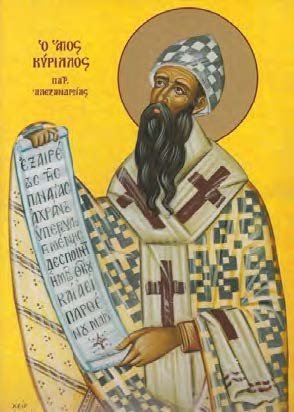
In this article I have presently been dealing with St. Cyril of Alexandria’s ideas about the resurrection of the human body. St. Cyril stated that the Lord’s Resurrection must have also   included His body since its very purpose was to release human flesh from the power of both death and corruption. Following the schema typical of the Eastern Church, Cyril says that “the power of death extended only over the flesh,” that is, over the humanity but not the divinity of Christ. For death and corruption could not be said to have any dominion over the Person of Christ, the divine Logos, who is by His very nature Life itself. Cyril describes the mystery in this manner:

If His dead body had not risen, what kind of death was vanquished, and how was the power of corruption rendered powerless? Not by the death of one of the rational creatures, by a soul, or by an angel, nor even by that of the Word of God Himself. Since, therefore, the power of death extends only over that which is by nature corruptible, it is with respect to this [the body] that the power of the Resurrection should reasonably be understood.

Hopefully this makes some sense. Christ rose bodily from the dead in order to crush death and corruption in human nature, which was the goal of His incarnation. The resurrection of the human flesh of Christ – soul and body – is thus an absolute prerequisite for the salvation of man.

That is what salvation means in Eastern thought, namely that neither death nor corruption have any control over human nature. In Cyril physical death is understood as “the exodus of the human soul from the body”, and as a result of this exodus of the soul, it is the body which suffers corruption. It is not the soul but the body which, being of its nature corruptible, is in need of being rendered and made incorruptible. Thus by the Death and Resurrection of the body of Christ, the power of corruption was “rendered powerless.” Hence, the Holy Body of Christ, which the Apostle Thomas was allowed to touch, bears witness to the future resurrection of our own bodies in incorruption.

The glory of the body of Christ, as shown at His Transfiguration, revealed to us that Life, because it is a sharing in God’s own life, is free from corruption and death. Since Christ rose bodily from the grave, death has no sting!

Understanding Our Ukrainian Greek-Catholic Church — 20160830

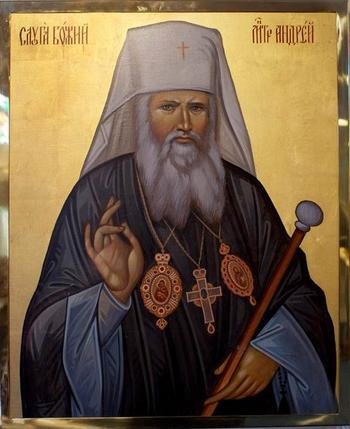
Venerable Andrey Sheptytsky

Venerable Andrey Sheptytsky

I would continue sharing more information about Metropolitan Andrey Sheptytsky. His concern for the Jewish people did not go unnoticed. The Galician-Jewish newspaper, Chwila, in July 1935, celebrated the Metropolitan’s 70th birthday, with a personal greeting from L’viv’s Chief Rabbi, Dr. Ezekiel Lewin.

Sheptytsky’s special relationship with the Jewish populace meant that he had to face the brunt of chauvinism from certain quarters. In 1902 he was vehemently criticized by what he later termed anti-semitic Vieneese journals. His countering-comments provide the best rationale as to why a Catholic prelate should have been so welcoming to a people, who in Europe had traditionally borne such widespread mistrust.

In light of his positive regard for the Jewish people in Galicia, it cannot be seen as surprising that, during the Nazi occupation, he came to the defense of the Jewish population. One event in particular, may be singled out as a catalyst for his motivations. On July 2, 1941, he received at St. George’s Hill the Chief Rabbi of L’viv, Ezekiel Lewin. Perceiving Lewin’s life to be in danger he requested the Rabbi to stay under his protection. Lewin, however, declined his offer stating that he wished to return home to his family. That evening Ezekiel Lewin was apprehended and brutally murdered. On hearing the news of Lewin’s death, Sheptytsky responded by immediately granting Lewin’s two sons sanctuary in St. George’s Cathedral and several Ukrainian Greek-Catholic monasteries until the summer of 1944, when the Soviet forces arrived.

In February 1942 Sheptytsky took the audacious step of writing a personal letter of protest to the leader of the S.S. Heinrich Himmler. He later recollected that “the German officer who brought me Himmler’s reply intimated that, but for my age, I would have been shot for daring to intercede on behalf of the Jews. Sheptytsky’s protests did not stop with Himmler. Not intimidated by Himmler’s threats the Metropolitan directed a letter of complaint to Adolf Hitler in 1942 about the ill-treatment of the Ukrainian populace by the German occupying forces. The exact reason as to why Himmler only threatened Sheptytsky’s execution and did not act on his threat is unknown.

As some may know, the cause for his canonization is being renewed under our Patriarch. The Ecumenical Patriarch Francis, Bishop of Rome, has decreed him “venerable.”

Reflections on the Scriptural Readings for this Weekend — 20150823

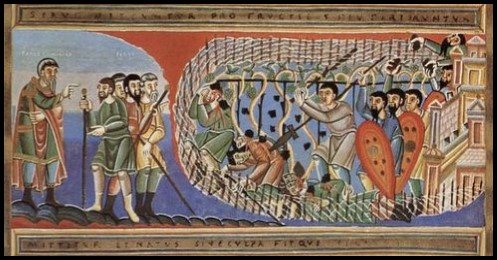
tenantsThe Gospel reading appointed for this weekend shares the Parable of the Tenants. Although the parable is not   obscure in Mark’s Gospel, Matthew somewhat expands it in order to make the point entirely clear. The description of the vineyard is given in words that closely echo Isaiah 5:2 where the vineyard symbolizes Israel.

The parable of Jesus has allegorical features. The owner is an absentee landlord and in the New Testament world such disputes between landlords and tenants were not unknown.

The allegorical significance of the son is not clear. No Old Testament figure can be intended nor the death of John the Baptizer. It seems quite unlikely Jesus would have made Himself a character in His parable.

Some scholars have suggested that the early Church expanded it to refer to what happened to Jesus. Most modern commentators do not favor this opinion in spite of the allegorical elements in the parable.

So what message can we glean from the parable that can help us to embrace the WAY of Jesus?

Perhaps the ending of the parable gives us a clue. Jesus asks those to whom He told the parable: What do you suppose the owner of the vineyard will do to those tenants? Of course the reply was: He will bring that wicked crowd to a bad end and lease his vineyard out to others.

The Church, that is we who believe in Jesus Christ, have been given charge of God’s vineyard, that is our lives. They are only leased to us and belong to Him. Our human lives have been designed to produce a good harvest, God’s Kingdom on earth. The fruit that is to be harvested is unconditional love.

Now, what, do you think will happen if we do not produce such a harvest for our God? We will come to a bad end. We will not, during this lifetime, come to a deeper union with our God. If we do not work to enhance and make more real His Kingdom right now, we are the ones who will lose.

Life, which brings with it the very Spirit of God, is given to us as a gift so that we might grow and become all that God conceived when He willed that we come into existence. It is our great loss if we do not do all within our power and ability to bring about His Kingdom right now. He gives us the gift and the power.

How we use these gifts is up to us!

Understanding The Theology of Our Ukrainian Greek-Catholic Faith — 20150823

Venerable Andrey Sheptytsky

Venerable Andrey Sheptytsky

In the last issue of this article, I began relating information about our blessed Metropolitan Andrii. He graduated as a lawyer in 1888 and sought dispensation to return to the Ukrainian Catholic tradition of his ancestors. It was at this point that the young Count, in a private audience in the Vatican, advised the Pontiff of his wish to enter the religious life. Pope Leo XIII encouraged him to follow this vocation and, to the chagrin of his father Jan, he entered the Ukrainian Greek-Catholic religious Order of Saint Basil the Great in May of that year.

Adopting the religious name, Andrii, (the first apostle and patron saint of Ukraine), he rose through clerical ranks in a spectacular fashion. Endowed with an above average intellect, he completed a second Doctoral degree and at the age of 31 and was then nominated Hegumen (Superior) of the Basilian monastery in L’viv. By the age of 34 he was Eparch of Stanyslaviv and, one year later in 1900, was installed as the Metropolitan of Galicia. Thus he became Head of the Ukrainian Greek-Catholic Church, the largest of the Eastern Catholic Churches.

For 44 years he was the most identifiable symbol not only of Ukrainian Greek-Catholicism but also of Ukrainian nationalism. He was a tireless and powerful force in the ecumenical movement striving for a greater degree of understanding between Catholic and Orthodox faithful. His defense of his Church and “his Ruthenian people” (as they were known by Rome) had seen him on a number of occasions and by various occupying governments: imprisoned, interrogated and exiled. The Ukrainian Greek- Catholic faithful thus saw in their Metropolitan a man who would risk his own life for the Gospels and for them.

He was also a great defender of marginalized peoples, in particular of the Jewish population of Galicia. The exact root and reasons for his great compassion for the Jewish people, a minority group in Western Ukraine, will probably never be known, yet some critical events can be highlighted. It was while during a period of convalescence in the Carpathian resort of Zakopane in 1885, that he began learning Hebrew, and quickly learnt how to read, write and speak this ancient language.

Therefore when in 1903 a Jewish group lobbied him to assist the Jewish poor, he lent support and, in a letter written in Hebrew, apologized that at the time he could do no more. He then established a clinic, called Narodna Lichnytsia, which treated all peoples.

More to follow!

The Divine Liturgy and Our Worship of God — 20150823

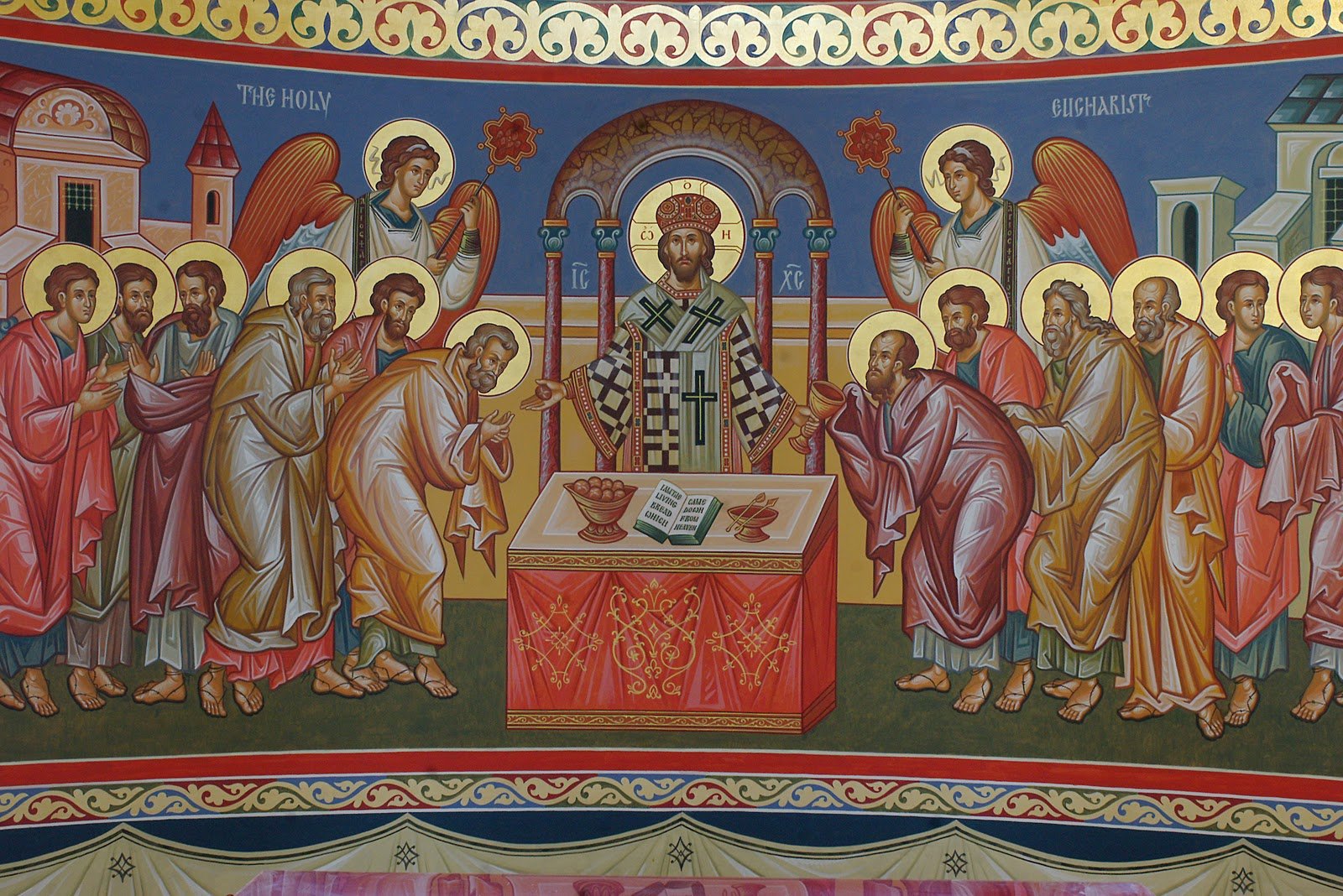
Holy Eucharist IconAt this point I’m not going to finish my thoughts on the Divine Liturgy but, rather, diverge for a short time on a topic that has come to my attention through my discussions with our deacon-to-be, Leonard. I truly believe that it fits in at this point since I have concluded my thoughts on the special portion of our Liturgy which is called the Anaphora – the act of remembering what Our Lord and God and Savior Jesus Christ established as worship of God before His death.

My conversation with Len focused on sacrifice. As we all know, the Church considers what we do during the Divine Liturgy as a spiritual and unbloody sacrifice. At the Last Supper Jesus revealed to us how to worship God and made it also possible that He would be with us forever.

As Len and I talked, my thoughts began to flow and I would like to share them with you. I do not present them as Church doctrine but, rather, as Priest Wayne’s humble thoughts on the subject. I think they are relevant.

I would begin this with my thoughts about worship. It is defined as: great honor and reverence paid to someone or something regarded as sacred. Also as religious ceremonies or services in which one expresses such honor and reverence, great love and admiration. It is also defined as an action to pay great honor and reverence.

Humans have, from the beginning of time, sensed that there is a being that is greater than humankind and that it is necessary to recognize that being and show that being honor. The reasons have varied through time but, initially, honor was shown to that being in order to gain the good favor of that being and to encourage that being to look favorably upon humankind.

This honor was shown by taking the best which humans had and destroying it so that no others could have the benefit of it. This included offering and destroying first fruits, the young and unblemished of flocks and even young virgins. The key to the honor that was paid was to offer the gift and then destroy it. The gift was always external to the humans offering it and was always what humans thought was the very best of what they had. The voluntary destruction of the gift was important since it meant that humans no longer had the benefit of the gift and this would honor the one perceived as more powerful.                     (To be continued)

Further Thoughts About the WAY of Jesus — 20150823

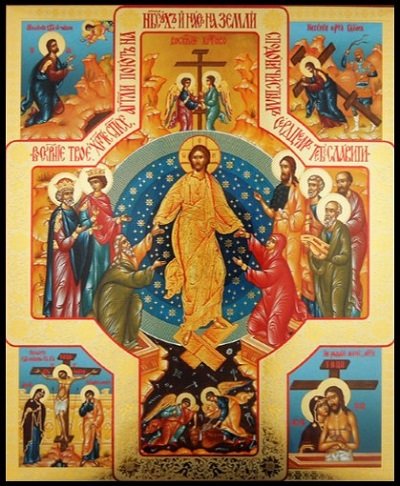
paschaThe WAY of Jesus calls us to become deeply aware of the fact that all we have and all that we are, belong to God. We thank God in the Divine Liturgy for every good gift and every perfect gift and we acknowledge that these are from above, coming down from You, the Father of lights. This is from the Ambon Prayer which is a prayer of thanksgiving.

Although we hear this prayed, I wonder how many times we think about what these words mean. Most probably think, I am, sure, that these words refer to the Holy Eucharist which they just received. While these words do include the gift of the Holy Eucharist, the prayer is thanking God for much, much more. It thanks Him for the gift of Life, the gift of Self, the gift of others and even the gift of creation. It thanks God for everything we have and are, even the struggles and challenges.

As you might immediately guess, in order to come to this conclusion a person has to think about God, life and all things in a different manner – in a God-like way.

Most of us feel, I suspect, that the things we have are things that we have earned because of our hard work. Oh contraire! All things, even those that we have purchased through our hard work, are gifts from our loving Creator-God. This is the mindset that we are called to develop when we embrace the WAY of Jesus. The WAY of Jesus calls us to think about things in a different way – to think about things the way that Jesus did. This, of course, means that we see all things as gifts from God.

In order to begin to think about things the way that Jesus did, requires that we first assess our thinking and our ideas or attitudes about things. We should not be ashamed or embarrassed if we don’t think about life and the things of life in this manner. We have been given life in order to learn how to think in this way. We are called by God, through the Person Jesus, to focus our efforts on learning how to think in this fashion. Life is given to us to learn how to be God’s children.

Ask yourself: Do I think about life in this way? Do I realize that I have been given life in order to learn how to be a true child of God? Do I realize that I will probably have to work at changing my way of thinking in order to see like this way?

I’m sure that most will probably immediately think: Why does life have to be so complicated. It really isn’t. When I don’t see like this way I must realize that I don’t want to change!

Learning Our Faith From the Greek Fathers of the Church — 20150823

In St. Cyrill’s Commentary on John, he refers explicitly to the reason for Christ’s appearance to St. Thomas and to all the apostles in His resurrected human body. He writes:

St. Cyril of Alexandria

St. Cyril of Alexandria

What need was there for the showing of His hands and side, if in accordance with the depravity of some, He did not rise with His own flesh? If He wanted His disciples to believe differently concerning Him, why did He not rather appear in a different frame, and by putting the form of the flesh to shame, draw them towards a different understanding? But it was most important that He show Himself carefully at that time so that they should believe in the future resurrection of the flesh; so important that even when the time seemed right to change the fashion of His body into ineffable and supranatural glory, He providentially deigned to appear once again as He was before, so that He should not be thought of as having any both than that in which He had even suffered death on the Cross. That the glory of the Holy Body could not have been borne by our eyes (if indeed Christ had wanted to reveal it before ascending to the Father), you will easily understand, when you consider the Transfiguration on the mount which was revealed to the holy disciples. For the blessed Evangelist Matthew writes that Jesus took Peter, James and John and went up to the mountain, and He was transfigured before them, and His face shone as lightning and His garments became white as snow, while they, unable to bear the vision, fell on their faces. Most prudently, then, our Lord Jesus Christ, not yet having transformed His Temple into its due and proper glory, still appeared in His original shape, wishing that the belief in the Resurrection should not be transferred to a shape or body other than that which He took from the Holy Virgin, and in which He was crucified and died according to the Scriptures; for the power of death extended only over the flesh, from which it had been set free.

The strong salvation perspective in Cyril’s Christology is more than apparent here. The underlying presupposition is clear enough: Christ could not truly be said to have redeemed mankind – human flesh, by which Cyril means human nature in its totality – unless He had also resurrected His own human body.

Christ, then, deigned to appear before His disciples still bearing the signs of corruptibility on His hands and side – marks which, properly speaking, should no longer have been present on His resurrected and therefore incorruptible body – so as to make it absolutely clear that He had risen with the very same body that He had received from the Holy Virgin Mary.

The Spirituality of the Christian East — 20150823

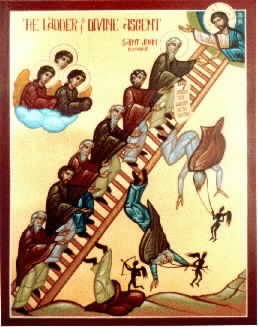
Ladder of Divine AccentI would finish these thoughts on the sixth step of the Ladder, Remembrance of Death, with these few additional comments.

When we remember death, life is put into perspective. We will not waste our time on things that are not good and profitable for our souls. We won’t sweat the small stuff, to use a modern idiom. This is why St. John wrote, No one who has acquired the remembrance of death will ever be able to sin. Our worldly desires are mortified when we remember that death is at the door. At the same time we seek all the more urgently to do good. When people know they have only so long to live, they begin to get their affairs in order: they prepare a will to dispose of their things and seek to be reconciled with those they have fallen out with.

The saints lived each day as though it were their last, and so they always sought forgiveness and reconciliation, they gave away their possessions to the poor, and they spurned the pleasures of life.

Thus the remembrance of death does not mean giving up on life, but living life the way we ought to. It pushes us to do good, and it keeps us detached from the things of this world. Thus it liberates us from the shackles of earthly cares.

It has been said that the person who has died to all things remembers death, but whoever holds some ties with the world will not cease plotting against himself.

None of us knows the time of our death, yet we must always be ready for it. If we live as though we are going to die tomorrow, we will be ready. We will carry out God’s teachings every day and will always be prepared for our departure from this world. We can hope that, like the Righteous Symeon, we shall meet our death with hope and joy: Lord, now You may dismiss Your servant in peace.

Called to Holiness — 20150823

As I have shared with my readers before, I believe that the call to holiness means a call to develop our spiritual life – called to develop the spiritual dimension to our personality. I also believe that this is closely connected to the development of our consciousness. Put in a simpler manner, true spirituality exists when we are deeply conscious of God’s presence in our life and in our world.

The next stage in the development of consciousness is Rational Consciousness. Rational consciousness is the dominant consciousness of the present age and is the level of consciousness attained more or less by the average adult in contemporary society. In order to be successful in our society, a person normally has to develop an ability to reason beyond the concrete or conventional rules and roles. A person has to learn to handle abstract ideas and grasp universal principles.

The rational level of consciousness is now so familiar to almost any well-educated person that there is little reason to describe it. Rational consciousness brings with it the ability to think abstractly, to understand general statement and principles and to think and write in accordance with the rules of logic. One can guess what this means to the development of spirituality! At this stage there is a real desire to rationalize the abstract ideas of religion. It seems that Western spirituality has gotten locked into this level of consciousness and spirituality while Eastern spirituality challenges us to not even attempt to rationalize the facts of our faith BUT to just believe. This seems to go against the grain of modern man who doesn’t want to just believe and be expected to just be led like a sheep. Modern man wants proof and evidence that his religion is not just a set of myths.

The problem is, true holiness and spirituality cannot develop with such a mindset since the things of faith cannot be proven. In fact faith means accepting things without proof. What is your definition of faith?