The Divine Liturgy and Our Worship of God — 20150802

After the sequence of prayers in the Anaphora that directly address the Holy Trinity to transform the gifts and us, we pray what is called the Anamnesis. Anamnesis (from the Attic Greek word ἀνάμνησις meaning reminiscence and/or memorial sacrifice), in Christianity is a liturgical statement in which the Church refers to the memorial   character of the Eucharist and refers to the Passion, Resurrection and Ascension of Christ as the key acts that we believe brought about salvation. It has its origin in Jesus’ words at the Last Supper: “Do this in memory of me” (Ancient Greek: “τοῦτο ποιεῖτε εἰς τὴν ἐμὴν ἀνάμνησιν”, which can be found in Luke 22:19 and 1 Corinthians 11: 24-25). In a wider sense, Anamnesis is a key concept in liturgical theology: in worship the faithful recall God’s saving deeds. This memorial aspect is not simply a passive process but one by which the Christian can actually enter into the Paschal mystery. Since there is no time in God, these acts are actually happening right now even though we think of them in the past. Our remembrance of these acts as saving us make Christ present to us in a real way. This requires, however, that we truly enter into the worship of God with Jesus Christ.
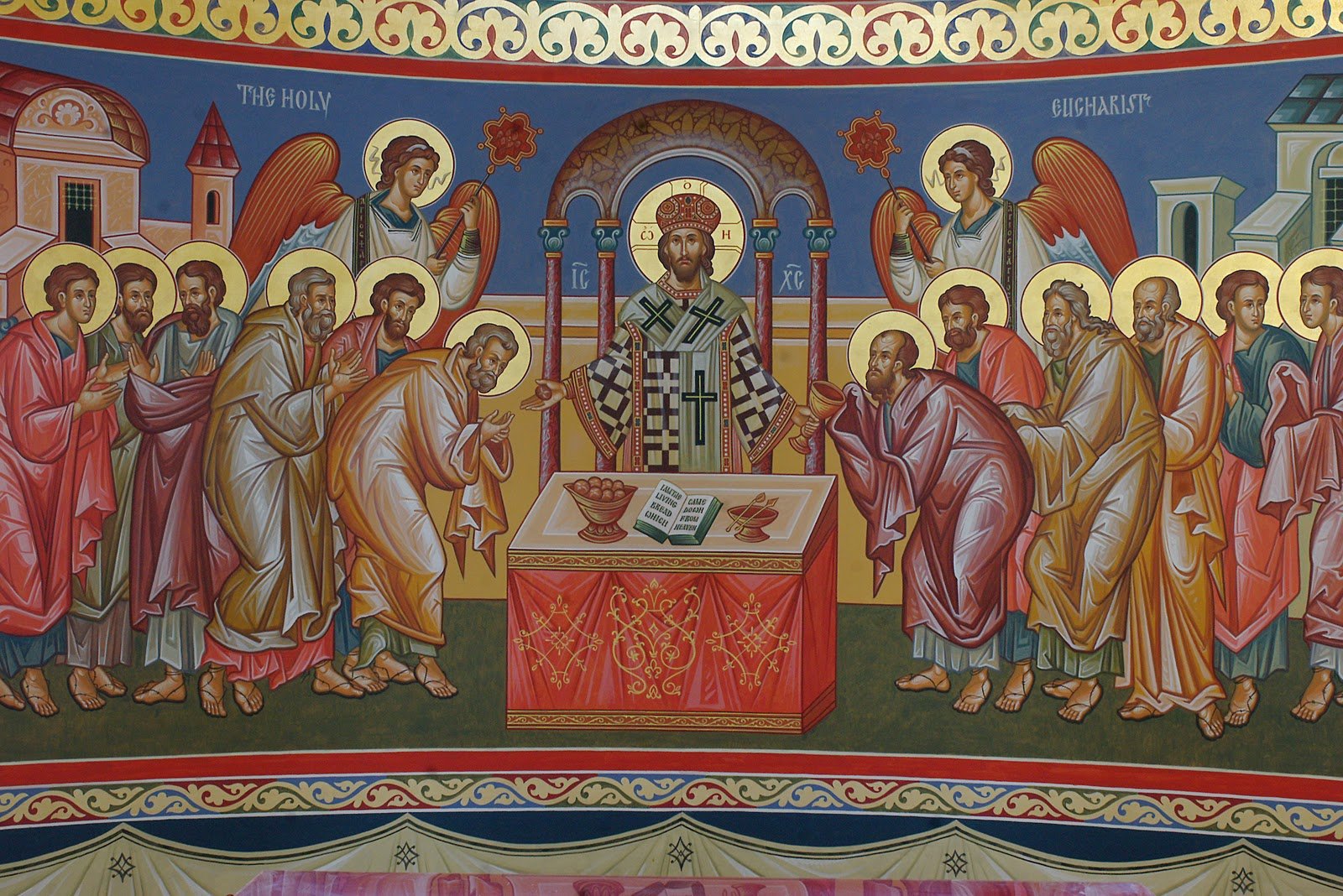
Holy Eucharist IconThe prayer that follows our recitation of these events is, for me, one of the most powerful of the prayers in our   Divine Liturgy. The priest says on our behalf: We offer to You, Yours of Your own, in behalf of all and for all. Then we all say together: We praise You! We bless You! We thank You, O Lord, and we pray to You, our God.

First, I would draw your attention to the fact that we say: We offer to You, Yours of Your own! That is a direct statement that we believe that the life we have, symbolically represented by food (bread and wine) is God’s own life. So we offer to back to God, together with Christ, the life He is sharing with us. We don’t offer God only something that we own. We offer Him the gift that He has given us, the most important   possession that we have – LIFE. There can be no greater gift that we could   offer to God than the life He is sharing with us. This means that we are willing, like Jesus, to empty ourselves of all that we have in order to praise Him and thank Him.

I don’t know about you but I feel this is an extremely powerful act if we truly mean it and understand what we do.
CALLED TO HOLINESS — 20150802

cross_vineAs I shared with you in the last issue of this article, the first real level of spiritual development involves a true lessening of egotism and self-centeredness. We know that we are beginning to become more spiritual when we think less of ourselves and more of others – when our main concern is not just for ourselves but for others.

We see this graphically portrayed in the Person of Jesus. His whole life was, after He began His ministry, directed towards helping others. He was not as concerned about Himself as He was for others.

It is the nature of infants to be only concerned about their own survival. They only seek to ameliorate their own needs and desires. So there is a self-centeredness that directs all of their actions.

When we get to a point in our own lives where we are not only concerned about ourselves and begin to think about others, we know that we are beginning to become spiritual beings in the true sense of the words. We are becoming more like Jesus Christ.

The process of spiritual development is to move from self-concern to concern for the happiness and well-being of others. This is made possible when we begin to truly trust that God will provide for us.

This begins when we truly know in our heart of hearts that we are loved by our Creator and that, if we place our hope and trust in Him, He will see that we have all that we really need.

This also means that we reach a point where we trust that God will provide all that we need and we don’t think about all that we want. This happens when we understand that what we want may not be what we need and we trust that life, which is inspired by God’s Spirit, will give us what we need.

True spirituality begins when we surrender our thoughts and desires for what we want and know that God, through life, will provide us with what we need to become true children of God.

Learning Our Faith From the Greek Fathers of the Church – 20150802

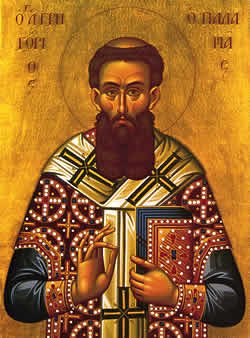
St Gregory Palamas

St Gregory Palamas

In the last issue of this article, I shared with you this thought of Gregory: if we wish to be with Christ, then we must become like Him. As St. John, the most theological of the evangelists, instructs us, “God is love (I John 4:8, 16). And so the criterion of whether we are truly following the WAY of Christ is love; but not just any love – divine Love. In the Sermon on the Mount, Christ Himself exhorts us to love even our enemies, which is humanly speaking impossible. But by this exhortation, He reveals to us the all-embracing character of His love – of how He is; and how we must exist, if we would be like Him and with Him.

The Fathers of the Church teach us that the root of all evil is pride, otherwise referred to as “self-love”. Self-love is the refusal to   relate to those who are different than us and to embrace them. Love of one’s self places man at the center of the universe and hence seeks to usurp that which belongs to God alone. This was the sin of Adam and before him, of Lucifer. But love of enemies, the opposite of self-love, is divine because it is the way that God exists. His love for us is unconditional love – unconditional and infinite personal love and care for each and every one of us, no matter how different from Him we may be, no matter how sinful we may be. God’s love, by which death itself was destroyed, is able to forgive all, accept and embrace all.

This is the great discovery St. Gregory tells us that the Mother of God made when she entered into the Holy of Holies at the tender age of three. In her diligent practice there of “holy stillness”, she arrived at the knowledge of the vision of God, where she discovered her kinship with the whole of creation and so began to intercede for the whole world. Gregory explains it in this fashion: “She found that the purest thing in us is precisely intended by nature for this holy and divine love.” The result of this communion of divine love is prayer for the entire world, which is the prayer and longing of all the saints, of all those who have truly become like Christ, of all those who can say, “His Life is mine”. This is the unceasing prayer and inner life of the Holy Church which has, as its head, Christ Himself.

Is it possible to unconditionally love others like Christ did? We know that with His help and our own prayer and fasting we can accomplish it.

The Spirituality of the Christian East — 20150802

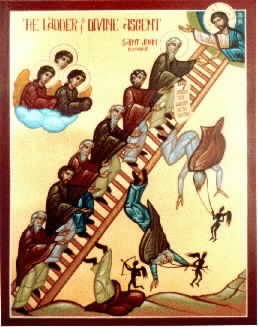
Ladder of Divine AccentThe sixth step of Climicus’ Ladder, is, as I have already shared, Remembrance of Death. As I was thinking about this, this question came to mind: How would I live this day if I knew it was my last? I would ask my readers to find an answer to this same question.

Although I know that different people would answer this question in different ways, this is the answer I came up with: I could keep doing just what I am doing now! I have read about people who have had near-death experiences and many say that it changed their perspective on life, inasmuch as they         decided from then on to enjoy every minute.

I have suggested several times to you, my readers, that I believe that it is critical to live in the present moment, especially since the present moment is the only thing that is real in life.

Now this raises another question. If there is no such thing as eternal death, than how should we live our last day? Some say that we should pray, repent, give our belongings to those who need them, be reconciled with all those who have wronged us, and ask forgiveness of those against whom we have sinned.

However, this is how we should be living as Christians every day of our life. We must pray, forgive, be generous and live a simple life. We should confess our sins and endure all things with patience and humility and show love to all.

Living in the present moment allows us to truly live this way because there is no past and no future and so we must be as much like Jesus right now as we possibly can. If we haven’t made such an effort in the past, we can’t change that. Therefore it doesn’t matter. If we think that we will try to live like Jesus in the future, we cannot be assured that we will be alive in the future. So, all we can do is make a sincere attempt to live like Jesus in the present moment. Now is when we can experience God.

Smart and Stupid Ways to Think About God — 20150802

I have already shared with my readers three stupid and two smart ways to think about God. The general ideas about each of these ways is taken from the small book by Michael Shevack and Jack Bemporad. I have modified the different ways for you, my readers.

The third smart way to think about God is GOD IS THE CREATOR. This, I am sure, is how many, if not most, of us think about God.

One thing is certain: any Spirit with this kind of awareness had got to have one heck of an I.Q. He’s surely got to be the Ultimate Prodigy.

God must be supremely intelligent to be God. Why?” If we look at His creation, we should be able to see this ultimate intelligence at work. We should be able to see it in the ingenious sequencing of amino acids that are DNA. I have often shared this with you in the past. We should be able to study it in the         structure and movement of subatomic particles. We should be able to witness God’s intelligence on a cosmic scale. From quasars and pulsars to the simple rotation of our troubled little planet. Everything in the universe seems to vibrate with this intelligence.

Our ever-increasing understanding of nature and the mechanics of Creation should not encourage atheism. On the contrary, it should discourage it. It only confirms that there is some intelligence that has organized and designed reality as a singular, integrated whole. This intelligence is not a religious myth.     Indeed science has shown us that there is great intelligence in the design of our universe. And more than that, we are now discovering that our universe is not the only universe in existence. There are not only multiple galaxies but multiple universes. Truly, the whole creation seems to be thoroughly thought out.

As we explore the universe, we find that God is not just an Intelligent Spirit, but a Creative Spirit.

God’s creativity does not end with a singular act of Creation. A Living God must always live to create. He has not faded away like an old vaudeville star.

New galaxies, new phenomena always arise. The universe doesn’t just stay the same. It is constantly in flux. Like God Himself, all of creation is constantly changing. It is dynamic!

Evolution is, probably, the most definite proof of God’s creativity. There seems to be a plan in the evolution of all of creation.

Life was created out of matter. But matter, and the universe, were created from Living Spirit.

Over the eons, matter has arranged itself ever more ingeniously until it possessed a consciousness that seems independent of everything around it, and it continues to evolve into something ever new. This process is, indeed, the product of an intelligent Spirit.

Further Thoughts About the WAY of Jesus — 20150802

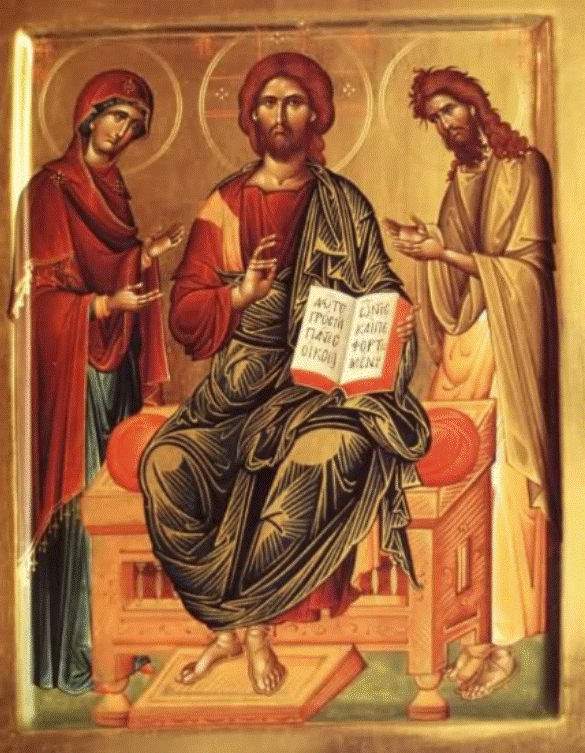
deisisOf all the events in the life of Our Lord, His transfiguration on Mount Tabor IS the event which, I believe, truly conveys the real meaning and purpose of human life. The WAY of Jesus reveals to us how we can become more like Him, Who is God incarnate. Since we have been made in the image of God, earthly life has been given to us as an opportunity to grow in His likeness. When Jesus was transfigured, He revealed the God-life that is within all humans. He was joined by Moses and Elijah. Moses is the Old Testament prophet who was inspired to write that we humans were made in God’s image and in His likeness. Elijah further revealed this truth by his own deathless ascension (in his fiery chariot) into the afterlife. The three disciples, Peter, James and John, were given this vision so that they might truly understand the WAY of Jesus and be able to lead the Church in her preaching of this message.

I am sure that I have probably shared this with those who know me, it is our tradition to bless fruit on the feast because at the center of fruit is usually some sort of seed(s) or pit which, of course, represents the seed of life within us that is God’s own life-force.

All different ethnic groups within Eastern Christianity seem to bless different fruits. It is not so important what type of fruit we bless. What is important that we bless fruit and realize the symbolism behind the blessing. In Rus-Ukraine, grapes of the vine were   replaced by apples and other fruits.

Some of the Fathers of the Church call the feast of the Transfiguration the second Theophany. Its observance goes back to the fourth century. It was originally celebrated in February but, because it fell during the time of the Great Fast, its celebration was changed to the 6th of August. The historian   Eusebius and St. John Damascene were of the opinion that the Transfiguration took place forty days before the death of Christ. The feast now takes place 40 days before the feast of the Exaltation of the Holy Cross (September 14th).

Further, the feast now takes place during what is usually harvest time for various fruits. It probably also replaced a pagan feast of the harvest. The custom of blessing the first-fruits in church was prescribed in the Canons of the Holy Apostles at the end of the third century and in the fourth century the Apostolic Constitutions actually contain a prayer for the blessing of fruits.

Gaining a Deeper Understanding of the New Testament — 20150802

I would conclude these remarks on the Letter of Judge by sharing with my readers that Jude is distinctive in several different ways. It is the only New Testament (NT) document that clearly echoes non-biblical Jewish sources. For example, Verses 6, 14-15 refer to 1 Enoch, a clearly Jewish document not included in the Jewish Bible. Verse 9 refers to the archangel Michael and Satan disputing about the burial of Moses, which may come from another non-biblical Jewish text.

Finally, it is the most judgmental and really condemnatory of all the NT documents. Of course these themes are found in other places in the NT, but even Revelation is not as consistently judgmental and clearly condemnatory. Perhaps we should be grateful that it was not written by the brother of Jesus and James.

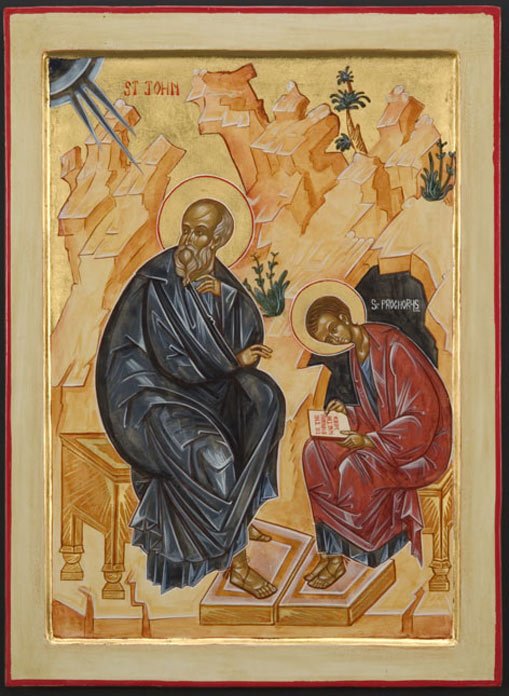
The Letters of JohnJohn the Theologian

After considering the Letter of Jude, I would, in presenting this chronological approach to the NT, present remarks on 1 John. Three letter are attributed to “John” in the NT. The first is the most substantial and important. Five chapters long, it emphasizes love as much as any document in the NT. The other two are less than a page long and are among the shortest documents in Christian scripture.

Who wrote these letters is unknown, even though they are attributed to John the Evangelist. A true consensus of mainstream biblical scholars agree that the author was neither the John who was one of   Jesus’ twelve disciples nor the same person who wrote the gospel of John. The author’s name could have been “John”, even if not one of the twelve. Or it could have been someone writing in the name of “John.”

There are strong similarities between 1 John and the gospel of John, but also differences. The clear similarities are best explained not by common authorship, but by supposing a “Johannine community” – that is a community (and probably communities) out of which both the gospel and the letters of John came.

There is no consensus about whether the author of 1 John also wrote 2 and 3 John. Some scholars think so, but some don’t. But all agree that 2 and 3 John came out of the same early Christian milieu as the gospel and 1 John.

The three letters that bear the name of John are short and easy to read. I would suggest that you pick up your NT and read them.

Understanding The Theology of Our Ukrainian Greek-Catholic Faith — 20150802

In the last issue of this article, I pointed out that St. John Paul II wrote two documents that have had a very explicit impact on our Ukrainian Greek-Catholic Church (UGCC) and all Eastern Catholic Churches. These two documents, in the context of encouraging real ecumenical dialogue between the Catholic and Orthodox Churches, elaborated John Paul’s succinct statement of 1985 when he said that the Church needs to learn to breathe again with its two lungs – its Eastern one and its Western one. More significantly, John Paul exhorted the Eastern Catholic Churches to return to their roots.

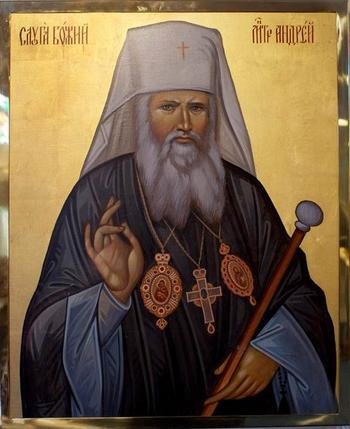
Venerable Andrey Sheptytsky

Venerable Andrey Sheptytsky

In the light of the Union of Brest-Litovsk, this can only mean that the UGCC must recapture its entire Christian life of prayer, as it is found in the Patristic roots of Eastern Christianity. Yet, while the Second Vatican Council and the writings of Pope John Paul II provide a unique opportunity to all Eastern Catholic Churches, the lengthy absence of any work free of a heavy Latin Catholic scholastic influence has made it difficult to return fully to Eastern Christian spiritual and liturgical practice, and even more difficult to begin the difficult work of a Patristic-based moral theology specific to the UGCC. Difficult though the task be, however, it has begun, and the current hierarchy of the UGCC is both defending the need for and developing the scope of an authentically Eastern Christian moral and spiritual theology. Much   remains to be done to make it fully authentic. The UGCC promulgated recently the first ever catechism of moral theology based upon Eastern Christian Patristic tradition. It assumes that there is no distinction between spiritual, liturgical and theological life in the Eastern Christian tradition, an assumption that needs little proof, so evident is its truth in every aspect of   the ecclesiological life of the Eastern Christian Churches. As such, it does not attempt to establish the link between the spirituality, liturgy and theology in the life of Eastern Christianity, which was assured to the UGCC by the Union of Brest-Litovsk, nor does it attempt, on the basis of such an assumption, to set out a fully developed and authentically Eastern Christian moral theology for the UGCC. Rather, while advocating the need for such a moral theology, it considers an aspect of the work of the only Ukrainian Catholic hierarch since the Union of Brest-Litovsk to attempt to develop an Eastern Christian moral theology for his Church: Metropolitan Andrei Sheptyts’kyi.

The Divine Liturgy and Our Worship of God — 20150726

In the last issue of this article, I began to share thoughts about the Anaphora, the most solemn part of the Liturgy. It is important to note that the Eastern Church never poses the question: When and at what moment do the bread and wine become the Body and Blood of Christ. This is a mystery. The only thing an Eastern Christian dares to say is that when we truly pray to the Father, remember the words of the Son and invoke the Holy Spirit to act, do these gifts become the Body and Blood of Christ. It is the Holy Trinity that truly transforms the gifts and it is not for us to question when.

Holy Eucharist Icon

The only reason why the Western Church has defined when this change occurs is because of a posed hypothetical question: What must be done if a priest should drop dead during the Mass. What should be done if we believe the gifts have been changed! Sacramental theologians argued that you have to know exactly when the gifts are changed so that you can take the appropriate action to deal with the gifts if a priest should die during the Mass.

The Western Church has posited that the bread is changed when the AMEN is said after the words of Jesus about the bread and the wine is changed when the AMEN is said after the words of Jesus about the wine. This is why the words of Jesus are commonly called the Words of Institution!

The Eastern Church never got into considering hypothetical situations. Of course con-celebration was more     common in the Eastern Church and so there were always other priests present who could continue the service. Further, the Eastern Church and its theological approach would never dare to suggest that it knows exactly how God acts and when He acts. This is a much more mystical approach. The same is true when thinking about possible particles of bread that might fall from the bread after it is changed. A very simple answer is given in the Eastern Church: God will have the angels deal with bread particles. In saying this I am not suggesting that any less reverence should be given to the transformed gifts. As priests we do our best not to be slip-shod about the gifts or particles.

As you can tell, our Eastern Church takes a much different approach to sacramental theology, something I will take up after I finish with the Divine Liturgy.

You will note that I only make a profound bow before the gifts after our sequence of prayers to the Father, Son and Holy Spirit.

Watch Sometime!

Smart and Stupid Ways to Think About God — 20150726

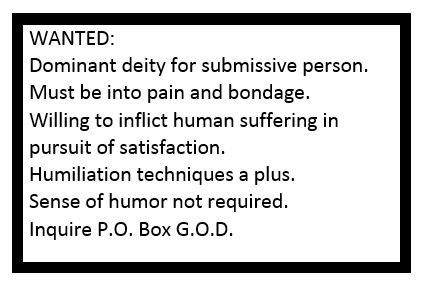
Picture1The third stupid way to think about God is truly interesting. The authors prefaced their presentation of this third way by this advertisement:

Yes, this is the proverbial god of wrath. Ready to show you how much he cares by punishing you. There is no end to the playful little tools in his pleasure arsenal. In a moment of rage, continents convulse with seismic activity. In a fit of moral indignation, he demonstrates the latest craze in viral mutations. And his skill with floods is legendary. This way of thinking about God makes Him a deity who despises sin and sinners with such passion that he’ll murder in order to exterminate them.

If this is the only way you want to think about God, you have no other choice. He forces his noblest creation to dance   like a trained poodle on the brink of annihilation. Grace, like a dog biscuit, offered or withdrawn, depending on performance.

Capture

But let’s play fair. The Marquis de God may be an old grouch. He may be cruel and despotic. But he does have a good side. He knows how to keep mankind humble. And let’s face it, that’s quite an accomplishment.

For the upside, the Marquis de God is a testimonial to divine power, of sorts. We have created a god we can revere because we have truly made ourselves powerless to do otherwise.

But this is not a true God at all. He is all too human. He behaves as if he had our ego. He loses his temper as we would. This is a childish projection of fear. For not of God, but of our own inner savageness. We externalize it. Place it outside, so we don’t have to admit to it inside.

Our making evil an act of retribution by a wrathful god does not explain evil. All we do is take it out of context. We create a duality out of a singular fabric that weaves light and dark, good and evil.

Can we not stop turning paranoid delusions into spiritual revelations? Can we not stop invoking God’s vindictiveness for everything that goes wrong in the world? And start blaming the consequences of our own moral decisions?

The alternative is a faith that worships punishment. And as a stupid way of thinking, the Marquis de God is a solid 10 on the Richter scale.

How do you think about God?