The Spirituality of the Christian East — 20150719

As I continue to share with my readers the 30 steps that Climacus devised to help us monks spiritually grow, I would remind my readers that this is truly a developmental approach to reaching holiness. We do well to reflect upon these steps. They are a great assistance to those who desire to spiritually grow. Each step builds on the previous step. It is a unique contribution to spiritual development literature and can help those who are desirous to spiritually grow.

The sixth step on John Climacus’ Spiritual Ladder, is, as I shared in the last issue, the Remembrance of Death. If death is the end of  human existence, then what’s to fear? Why should anyone be afraid of death? Eternity is a far more scary thing than death. But it can also be joyful. Many saints longed for death, not because they had no desire to live but because they longed to be with God. Those who believe there is nothing beyond death may long for it simply because they hate life or want the pain to end.

I find that many people fear death only because they can’t control death and death represents the unknown. So many of us humans want to control life and, at some deep level, we know that we cannot really control death. It comes when we least expect it, even when we expect it. For many the fear of the unknown is overwhelming. This is something we learn from life when we have had to deal with the unexpected.

Because the story of Jesus is at the very core of Christianity, we are told that there is life, albeit a different type of life, after death. The story of Jesus confirms this. He was both recognized and not recognized after His resurrection. There were, however, things that He did or said that allowed His friends to recognize Him. Christianity tells us that death does not destroy who we are!
Learning Our Faith From the Greek Fathers of the Church — 20150719

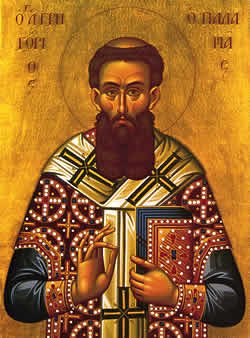
I have recently been sharing with my readers the thoughts of our Father among the Saints, Gregory Palamas. It just dawned on me that many may know nothing about him. So I thought that I would, in this issue, share some information about him before I resume more of his thoughts.

St Gregory Palamas

St Gregory Palamas

The Catholic Encyclopedia describes Gregory as a Byzantine mystical theologian and defender of Hesychasm even though the Western Church has had problems with his teachings. He is one of the truly great Eastern Church saints, although his thoughts and ideas are not always easy to comprehend. He was born around 1296 in Constantinople and died in Thessalonica in 1359. You will recall that our Church remembers him on the Second Weekend of the Great Fast. Born of a well-to-do-family from Asia Minor, he received a liberal education at the imperial university and eventually entered a monastery on Mt. Athos with his two younger brothers. When the Turkish invasions of 1325 threatened the monastic life there, Gregory migrated to Thessalonica where he was ordained a priest in 1326. He returned to Mt. Athos in 1331. He was appointed the hegumen (abbot) of the Grand Laura in 1335-36 but returned after a short while to St. Sabas.

At St. Sabas he became acquainted with the theology of Barlaam, a Greek monk from Calabria who was using the syllogistic method in his attempt to   refute the doc trine of the Latin Church regarding the procession of the Holy Spirit. He wrote two letters to Barlaam in which he defended the position that apodictic arguments were possible in theology and rejected the agnosticism implied in the extreme apophatic, or negative, theology of Barlaam.

Palamite doctrine on the divine nature of the light of Mt. Tabor and the visible presence of uncreated grace in the pure of heart has been totally misunderstood by Western theologians. His insistence that the whole man is engraced, body and soul, and the stress that he placed on the role of the body in prayer has been accepted by the West.

Most of his literary productions were devoted to defending his Hesychast doctrine using Greek philosophy. If you have been following this article, you are probably already aware that his ideas are complex and challenging.

Further Thoughts About the WAY of Jesus — 20150719

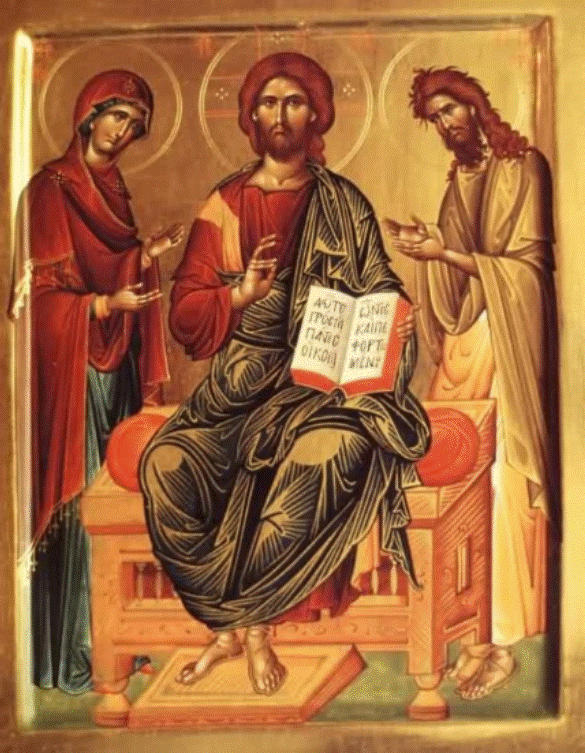
deisisThe readings prescribed for the last two weekends have truly been powerful in that they have presented the truth about our human existence. We are all, at times, paralyzed or blind with regard how we are to live in order to be true children of our God-Creator. We have been made in His image and likeness. Therefore, we must act like the One Who was truly God and Man, Jesus.

I would hasten to say that the paralysis and blindness that we experience is not something bad since they set the stage for us to be able to learn how to live as children of God and heirs of His Kingdom.

Like the two stories which presented the cures of paralysis and blindness, in both cases, the maladies that the cured people possessed were their greatest gift. Why? Because they occasioned the gift of cure from the God-Man Jesus.

So the weaknesses that we all have are also the wonderful gifts from God because they, if we seek a cure for our weaknesses, are the means that will help us to evermore become more like Jesus.

We must remember that all of the gifts of life, the good experiences and the struggles, are designed to help us to come to the fullness of life and to become all that we were created to be.

Again, it is important to reassert that all the experiences that life presents to us are meant to help us do one thing: spiritually grow. Life is all about learning to be a child of God.

I would like to share again the seven different ways that I feel that we may be blind and need to seek God’s curing help. We can be blind to:

  1. the real needs and
  2. feelings of others;
  3. our prejudices;
  4. our own failings;
  5. the presence of God in our lives and world;
  6. the real truth about life; the love which is extended to us; and
  7. our misguided thinking.

Again I would hasten to assert that paralysis and blindness are not bad things or punishments, they are the real opportunities presented to us to grow.

Life delivers just the absolutely right and unique opportunities for us grow. Again, change is important and it should not be something that we are afraid to do. Christ came to tell all of us: Change your hearts and minds so that you might come to realize that the Kingdom of God is here, right now.

It is my prayer that my words might encourage all who read them that we all have an opportunity to learn how to more fully become children of God through personal change!

The Divine Liturgy and Our Worship of God — 20150719

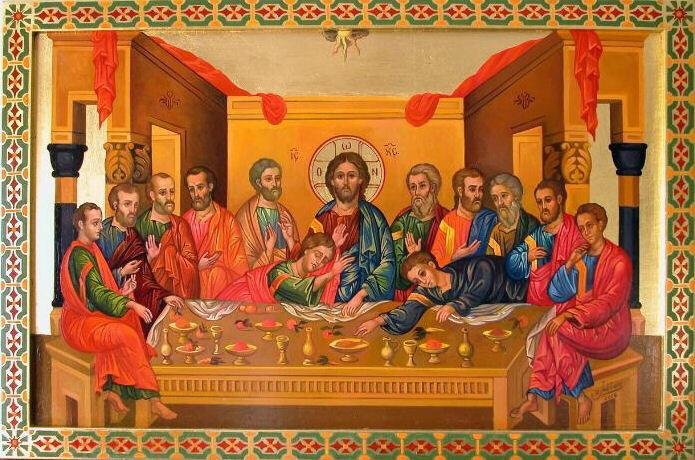
Mystical Supper

Mystical Supper

During the past few issues of this article I digressed from my thoughts about our Divine Liturgy to share some thoughts about the Creed that we use and the issues connected with the Creed over the course of our history.

For a period in the history of our Church, after our union with Rome, our Church used the changed Nicene Creed that the Western Catholic Church uses. In more recent years, we have returned to the Nicaeno-Constantinopolitan Creed that all Eastern Christian Churches use.

In the early Church, none but those initiated into the Church could pray the Creed. It is the ultimate symbol of our faith. Therefore it is contained within that portion of the Divine Liturgy which is called the Liturgy of the Faithful. It is only after we express our faith through the Creed that we presume to Remember (Anamnesis) what our Lord did, namely worship God by offering His very life to God, also giving Himself symbolically to all who follow Him.

The section of the Liturgy which truly remembers what Jesus did, is called the Anaphora. The word anaphora is a Greek word meaning a carrying back. It has been adapted to mean the prayer of oblation, which includes a repetition of the words of Jesus, carrying us back to the time of the first Eucharist. They truly unite us with the past in a real and true way.

As I am sure I have shared before, the first part of the Anaphora includes:
(1) our prayer to the Father,
(2) the recalling and articulation of the words of the Son, and
(3) the invocation of the Holy Spirit to transform the symbols of life (i.e., bread and wine) into the Body and Blood of Christ. The transformation of the gifts is done through the power of the Holy Trinity.

Once the gifts have been truly transformed through this action, we  remember what Jesus did. We offer the transformed Gifts to God – we offer our lives, together with Jesus, to the Father, the Creator, and the Spirit, the Giver of Life. At this point the priest intones this very beautiful prayer on behalf of all: We offer to You, Yours of Your own, in behalf of all and for all. The prayer is continued by all of us praying: We praise You, we bless You, we thank You, O Lord, and we pray to You, our God.

Truly our Liturgy presents, through its ritual, a powerful symbolism of what true worship of God is. To worship God we offer, together with Jesus, our very lives.
Think about this!

Understanding The Theology of Our Ukrainian Greek-Catholic Faith — 20150719

In 1596, in exchange for certain guarantees, a small group of Ukrainian Orthodox bishops agreed to recognize the authority of the Bishop of Rome. From the perspective of the Ukrainian bishops who signed the Union, its main import was to ensure retention, in toto, of the ritual, liturgical usage and discipline of its Church and that all of these matters be left in their own hands and jurisdiction. There were no doctrinal or dogmatic difficulties to be resolved. To them, Union with the Holy See consisted simply shifting ecclesiastical jurisdictional dependence from the Patriarch of Constantinople to the Patriarch of Rome.

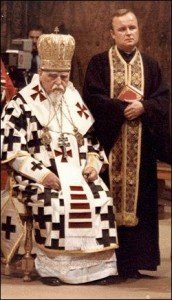
Patriarch Josyf SlipyjThe Holy See concurred completely on all counts and gladly guaranteed that all liturgical matters would be left to the Ukrainian prelates and their successors. To quote from the official Constitution of Pope Clement VIII of 23 December 1595 regarding the Union: we receive, unite, join, annex and incorporate our members in Christ, and to enhance more greatly the meaning of our love for all the sacred rites and ceremonies themselves, which the bishops and clergy use, as established by the holy Greek Fathers in the Divine Offices, in the Holy Sacrifice of the Mass and in the administration of the rest of the Sacraments and other sacred functions…with Apostolic graciousness we permit, concede and allow (them) to the same Ruthenian [Ukrainian] bishops and clergy….”

While the Union was intended to ensure the retention of the spiritual and liturgical practices of the Ukrainian   Greek Catholic Church, the reality is that it resulted in the separation of sacramental theology from moral and dogmatic theology that emerged in the Christian West through Thomism and Scholasticism after the Reformation. This was unknown in the Christian East. It is difficult to draw any precise line between these disciplines as far as Eastern Christianity is concerned. Indeed, it is questionable whether such a division can even be profitably attempted. Rather than segmenting various theological categories, the entire ecclesiological life of the Eastern Christian Churches is inextricably intertwined in the total Christian life of prayer and, in every case – liturgical, spiritual, or theological – its roots lie in the earliest tradition of the Church, namely, in the Patristic age.

So the approach to theology in our Ukrainian Greek Catholic Church is naturally different from that of the Western Catholic Church. During the coming weeks I shall try to explore these differences.

July 12, 2015

deisisBefore Jesus cured the two blind men, He is said to have asked them this: “Are you confident I can do this?” They, of course, answered: “Yes Lord.” Then, after He cursed them He said: “Because of your faith it shall be done to you.”

As I reflected upon this miracle story I realized that this is not the only story of Jesus curing blindness that we use in our weekly worship. The Church uses the cure of blindness just as she uses the cure of paralysis, namely to help us understand that with God’s help we can truly change our hearts and minds and become much more like Jesus.

I think people feel at times that they could never be like Jesus – they could never be a saint. And yet this is what we have been called to be: saints! Saints are people who have discovered the meaning and purpose of our earthly existence, namely to truly become spiritual beings.

Each of us, whether we are aware of it or not, have a Spiritual Self, that is a self that is made to live in accord with God’s Spirit within us. Because of God’s Gift of His Spirit, we can truly be spiritual beings, beings who know how to unconditionally love and forgive others. We have the power, because of God’s Spirit within us, to love our enemies and to live a life that is not self-centered but, rather, other-centered. We have the power to live like Jesus lived. It is all a matter of learning how to do this.

The problem is that we must be cured of our blindness and come to see that life here on earth is only one part of an eternal life of growing to be God’s children. We were created in the image and likeness of our Creator. This earthly existence is given to us to help us achieve this. It is truly all a matter of how we think about life.

In the portion of Paul’s Letter to the Romans that we use as our Epistle reading this weekend, Paul exhorts us, as he did the Romans, to become people who practice self-denial and patience. This is worthwhile advice for, when we practice self-denial, we learn how to be patient and, when we learn how to be patient, we begin to see life in a much different manner – we begin to see that who we are is much more important than what we have. We can be either people who make God’s Kingdom real right now for ourselves and others OR we can make life a hell for ourselves and others. We can be life-giving or death-giving by the way that we treat others. AND we must remember, that if we are death-giving we not only kill the spirit of others, we kill our own spirit!

Oh God, grant that we may truly see the real meaning and purpose of life and work to become Your children

The Divine Liturgy and Our Worship of God — 20150712

Mystical Supper

Mystical Supper

Although the Eastern Fathers were aware that in the West the procession of the Holy Spirit from the Father and the Son was taught, they did not usually regard it as heretical: “a whole series of Western writers, including popes who are venerated as saints by the Eastern church, confess the procession of the Holy Spirit also from the Son; and it is even more striking that there is virtually no disagreement with this theory.

The phrase Filioque first appears as an anti-Arian interpolation in the Creed at the Third Council of Toledo (589) at which time Spain renounced Arianism, accepting the true faith. The addition of this phrase was then confirmed by other local councils in Toledo and soon spread throughout the West, not only in Spain, but also in the kingdom of the Franks, who had adopted the Western Christian faith in 496, and in England, where the Council of Hatfield imposed it in 680 as a response to the heresy of Monothelitism. It should be noted, however, it was not adopted in Rome.

A number of Church Fathers of the 4th and 5th centuries explicitly speak of the Holy Spirit as proceeding “from the Father and the Son”. They include Ephrem the Syrian, Epiphanius of Salamis and Cyril of Alexandria. In the 7th century, Maximus the Confessor declared it wrong to make accusations against the Romans for saying that the Holy Spirit proceeds also from the Son, since the Romans were able to cite the unanimous support of the Latin Fathers and a statement by Saint Cyril of Alexandria.

The Eastern Church Fathers, as I have expressed in previous articles, use the phrase “from the Father through the Son”. The Roman Catholic Church accepts both phrases and considers that they do not affect the reality of the same faith and instead express the same truth in slightly different ways. The influence of Augustine made the phrase “proceeds from the Father through the Son” popular throughout the West but, while used also in the East, “through the Son” was later dropped or rejected by some as being nearly equivalent to “from the Son” or “and the Son”. Others argue that in the text of the Nicaeno-Constantinopolitan Creed, it says that the Holy Spirit proceeds “from the Father” but did “not state that the Spirit proceeds from the Father alone”. Religion can be a tricky business where words and phrases mean a lot.

Further Thoughts About the WAY of Jesus — 20150712

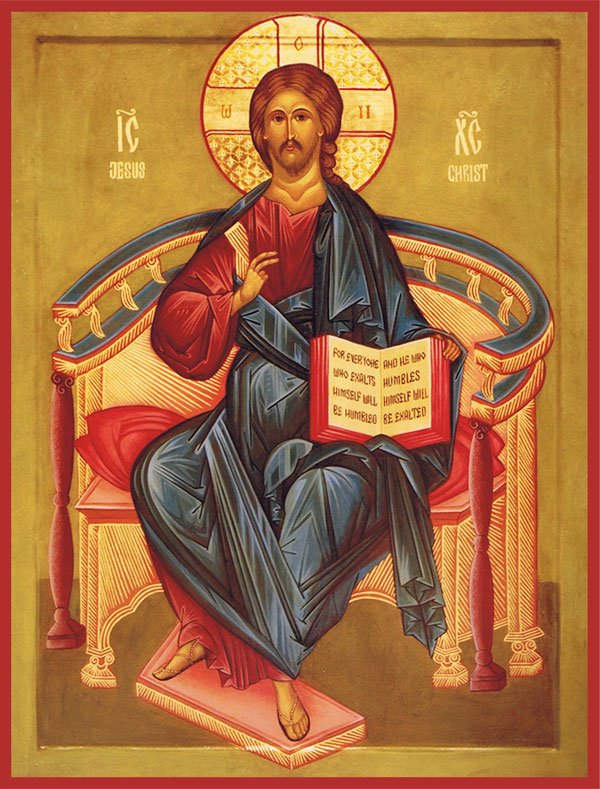
pantocratorAs I highlighted in last week’s sermon, when all is said and done, the primary message of the Good News (i.e., Gospel) is that the task of earthly life is metanoia. What exactly is metanoia? It is, in essence, the foundation of the WAY. Metanoia is the work of changing our hearts and minds – our thinking and our behavior – to be in   concert with that of Jesus. It is our belief that Jesus is the model of how humans should live. Our Heavenly Father, knowing that we would not be able to figure this out on our own, came Himself in the Person of Jesus and became a model for us on how we should live if we want to become all that we were created to be. Earthly life is given to us for a purpose! And what is that purpose? To become the spiritual beings He created in His image and   likeness. We are here to learn!

I can assure you that there is no one living that does not have to engage in metanoia if they want to be a follower of Jesus – if they want to be the human that God created them to be. If you think that you don’t need to change I would only ask you to assess your attitudes and determine whether they are in concert with those of Jesus.

God, in His infinite wisdom and loving goodness, decided, when He created humankind, that He would provide us with free will. His love for us is so great that He took the chance of allowing us to freely return His love. This is true unconditional love! He believed that love has the power to bring all things into unity and harmony and the earthly experience He created for us delivers multiple opportunities for us to learn how much we are loved. His only desire is our free love and our good.

I believe that it was never God’s intention to create a situation where He would punish us. He shares His very life with us! He would, in effect, be punishing Himself if He created a situation where He would have to punish us. This does not mean, however, that we cannot bring a great deal of misery to ourselves. Whenever we are self-centered and selfish, we open ourselves to pain and misery. Whenever we refuse to unconditionally love and forgive, we diminish ourselves and bring ourselves pain. We are the ones who punish ourselves when we don’t try to live with nobility and magnanimity.

It is my belief that the spirituality of the Eastern Church offers a different understanding of earthly life and calls us to embrace the belief that God really and truly unconditionally loves us and only calls us to return His love for our own good.

CALLED TO HOLINESS — 20150712

So the call to holiness is the call to find the Kingdom of God within us – to find His Spirit in the Temple of our own bodies. Throughout the centuries Christian authors have attempted to map the spiritual path to the inner vision of the Kingdom. The mapmakers necessarily had to base the maps they drew on their own experience. Since they generally did not realize that different human beings   begin the spiritual path at different levels of awareness, the mapmakers generally assumed that their experience could be   duplicated by others.

The most traditional of these Christian maps was drawn by Dionysios about 500 CE. Dionysios, following an even earlier   tradition mentioned by Clement of Alexandria in the second century, divides the path into three stages of inner growth: (1) purgative (purification from the grossest forms of egotism and selfishness); (2) illuminative (the breaking in upon the person of greater spiritual insights and understandings); and (3) unitive (union with God). Dionysios, however, proposed a second five-stage map based upon what he saw as the five levels of prayer: (1) vocal prayer, (2) mental prayer, (3) prayer of recollection, (4) prayer of quiet beyond thought, and (5) prayer of union with God. There have been many other attempts at mapping with any number of different stages.

There are two basic problems with these traditional maps to the Kingdom. First, all of them have been partial, mapping only portions of the spiritual path. For example, they have generally ignored the growth of consciousness in children, adolescents and sometimes in the ordinary Christian adult. With respect to adults, the mapmakers have assumed that all Christians begin the spiritual path at more or less the same level of consciousness as themselves and so can be expected to duplicate the mapmaker’s experience. This, of course, is not true. The path of each person is unique.

The Spirituality of the Christian East — 20150712

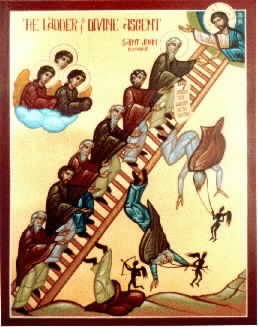
Ladder of Divine AccentFor those who have been following this article in the Bulletin, I have been sharing thoughts about the steps on St. John Climacus’ Ladder of Divine Ascent. Just to recap, the steps that I have covered so far are: (1) Renunciation; (2) Detachment; (3) Exile; (4) Obedience; and (5) Repentance. His sixth step is Remembrance of Death.

We live, I truly believe, in a real death-denying culture. While I have no opposition to cremation, too frequently it seems, that when it is done before a wake it is a means of escaping the reality of death. Most of us find it difficult to think about death and to deal with it. And yet it is something that we all must face. It seems that people do not want to talk about death or even think about it, as though pretending it will never happen can somehow stop its inevitability. While phrases such as “death comes to us all” and “death is a natural part of life’ have become clichés, deep down many behave as though death only happens to other people. When a loved one dies, even at a ripe old age, the faith of some Christians is shaken. This is because we are so busy driving the remembrance   of death from our minds that we actually forget it is an unavoidable and a most certain fact.

The remembrance of death is closely linked to repentance, which is why it is the step that follows it. All the Fathers of the Church have taught that repentance is the purpose of our life. Death brings repentance to an end. What follows death is the fulfillment and the very consummation of our relationship with God here and now.     So in Christian spirituality, the act of remembering death is important since it reminds us that our time here on earth is all about developing an ever more deep relationship with our Creator which can only be truly realized when we pass through death to eternity.