Understanding The Theology of Our Ukrainian Greek-Catholic Faith — 20150712

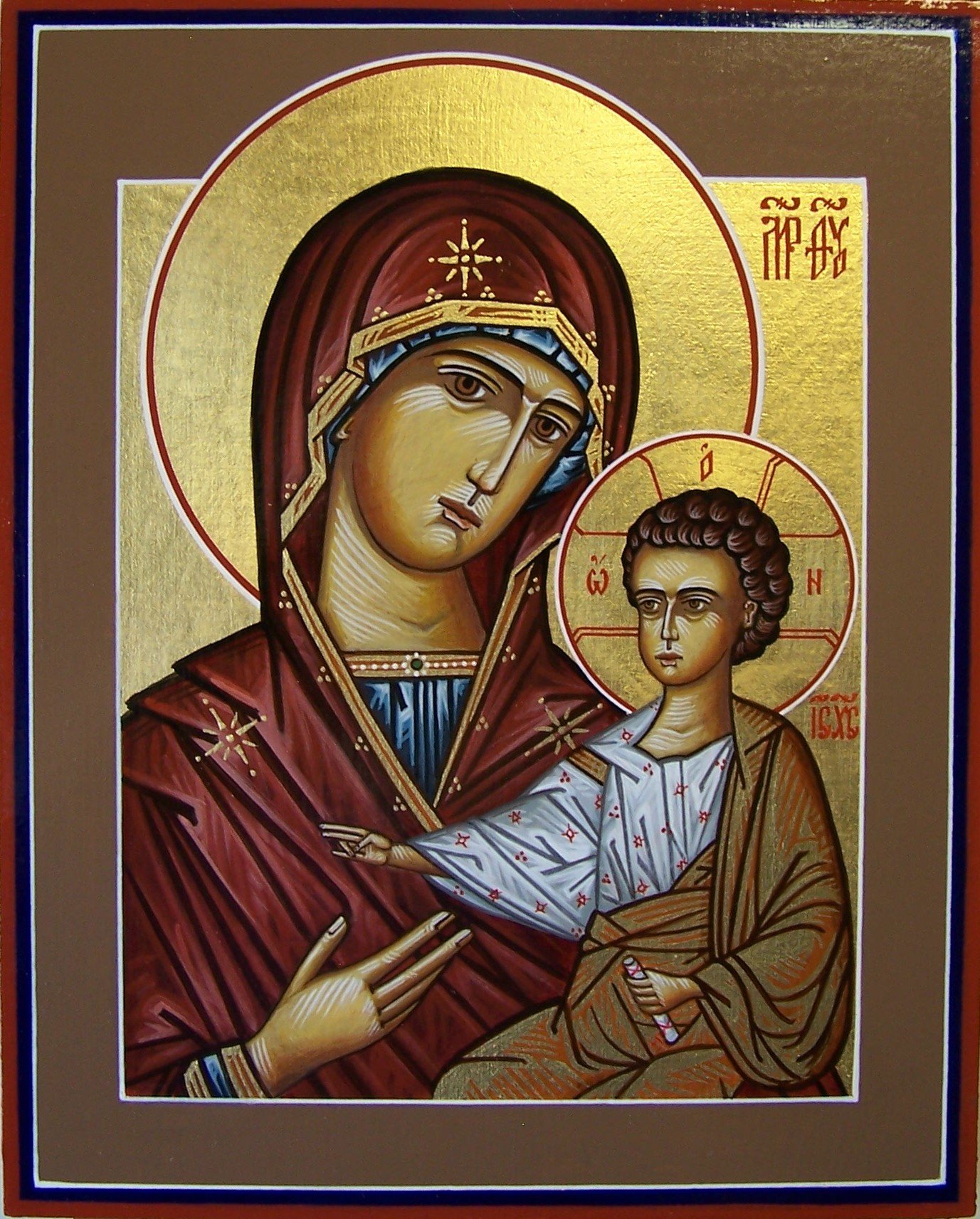
theotokosIn the last issue I shared one of the important aspects of our theology, namely the veneration of saints. Those not of the Catholic and Orthodox faith do not venerate saints through prayer, nor do they keep statues or icons of saints in their homes or churches. Many even actively condemn Catholic and Orthodox devotions to the saints because it seems very dangerously close to idolatry: worshipping a creature instead of the Creator. This is especially true of the practice of venerating Mary, the Mother of God,

Catholic and Orthodox Christians worship God alone. Mary and the Saints are only honored and venerated as humans specially blessed by God. The Catholic explanation is this: The worship of latria (latreia), or strict adoration, is given to God alone; the worship of dulia (douleia), or honor and humble reverence, is paid the saints; the worship of hyperdulia (hyperdouleia), a higher form of dulia, belongs, on account of her greater excellence, to the Blessed Virgin Mary.

Similarly, the Orthodox explain it in this manner: The worship (latreia) given to God is completely different from the honor (tim) of love (agape) and respect, or even veneration (proskynesis) “paid to all those endowed with some dignity” (Chrysostom).

The Bible encourages the veneration of angels, who are comparable to the saints in that they are creatures with a special relationship to God (References include Ex. 23:20; Jos. 5:13; Dan. 8:15 and 10:4; Matt. 18:10; Luke 2:9; Acts 12:7; and   Rev. 5:11 and 7:1).

The Council of Trent (1566) taught that idolatry is therefore committed “by worshipping images as God or believing that they possess any divinity or virtue entitling them to our worship, by praying to, or reposing confidence in them”. Catholic and Orthodox Christians do not commit idolatry when they venerate images since they see images as only reminders of the persons they respect. I think that it is important that we don’t say that we pray to icons. We only use icons to help us focus our attention on the persons that the icons represent. Catholics frequently explain the practice of using images to help prayer by comparing images of the saints to photographs of loved ones: both are reminders and memorials of the people they depict.

In our tradition we kiss and touch our heads to icons to help us remember the persons and events they represent.
Gaining a Deeper Understanding of the New Testament — 20150712

As I ended the last installment of this article, I was sharing thoughts, drawn from biblical scholars, about how we should, in our present day, interpret the book of Revelation. Should we think about it as revealing things to come or should we take seriously what John was saying to Christians in his time? Many prefer to take it as “things to come.”

Was John trying to say to the Christians of his time that: accommodation to imperial ways is wrong; the struggle between the lordship of Christ and the lordship of Caesar is the great conflict; it is important to persevere even when it looks like the beast is winning; the beast, appearances to the contrary, does not have the final word and is not the final Word? In its first-century context, Revelation is a pervasively anti-imperial document. What might this mean for Christians today, especially American Christians in the time of the American Empire? Was the problem with the Roman Empire that it was Roman? Or was the problem that it was an empire?

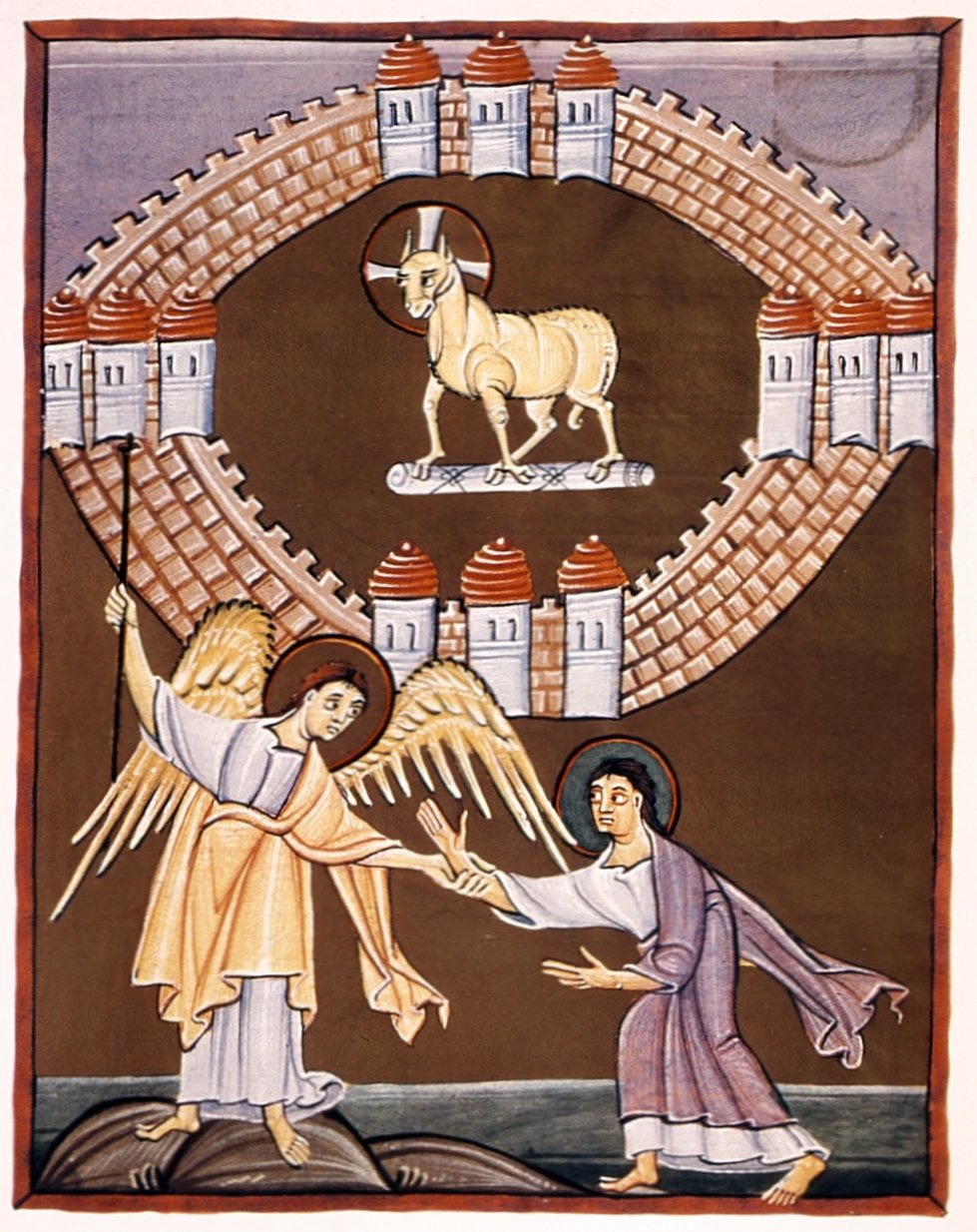
BambergApocalypseFolio

Note that a historical and contextual approach to Revelation does not restrict its meaning to the past. It begins with its past meaning, but is not confined to that. It asks: If this is what Revelation meant then, what might it mean now?

Revelation is full of contrasts. It uses the dualistic contrast between the forces of good and the forces of evil,     an ancient archetypal image that continues to have power in the present. Think of the Star Wars movies with their battles between the evil empire of Darth Vader and the forces of light symbolized by Luke Skywalker and his light saber. Revelation indeed particularizes the dualistic contrast into a conflict between the lordship of Christ and the lordship of Caesar.

It is full of contrasts in another sense as well. It is very violent, and much of the violence is done by God. God sends suffering, earthquakes, plagues and death upon the world as the seals are opened, the trumpets blown and the bowls of God’s wrath are poured out. God destroys Babylon the Great and the armies of the beast. The victory song in chapter 18 is filled with gloating over divine violence. At the same time, Revelation includes some of the most magnificent language in the Bible, much of which has found its way into Christian worship and hymns.

If you read Revelation and then worship the Divine Liturgy, you will see what the author means. The Divine   Liturgies we use incorporate some of the beautiful words of the Book of Revelation. Can you find them?

Learning Our Faith From the Greek Fathers of the Church — 20150712

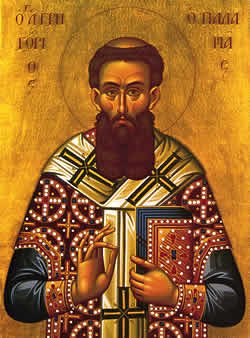
St Gregory Palamas

St Gregory Palamas

St. Gregory points out that Christ is not only the Sole Revealer of God, He is also the Sole Revealer of God’s purpose in His creation of man. In simple terms, what is true of Christ’s humanity can also be true for us – by grace. Christ is unique in that the union of human nature with His divine Person is hypostatic or personal. But the consequences of this hypostatic union, namely, the exchange of the natural properties of each of His two natures serves as a model for our own salvation and deification. What is true of Christ’s humanity can also be true for us – by grace, that is to say, as gift.

This is how the Eastern Church understands the mystery of salvation. It does not understand salvation in merely moral or ethical terms, but as the attainment of Christ like perfection. This is the purpose of our human existence – to become by divine grace (God’s help) what Christ is by nature.

This understanding is contrasted with the Western idea that to achieve salvation, one must refrain, by God’s help, from performing acts which can be called evil or sinful. Some may say that this is just a matter of semantics. Perhaps. There is a subtle difference and, I believe, this difference truly captures to a greater extent, the intent of God when He created humankind.

The Eastern approach highlights the fact that being called to be Godlike is a high calling and one which only God Himself can accomplish in us. But it is attainable and the Church sets before us the example of Gregory Palamas on the Second Sunday of the Great Fast precisely in order to emphasize the importance of personal experience in the life of the Church.

On the Second Sunday of the Great Fast, the Church has us remember Gregory as a prime example of what man can become, when he voluntarily unites his will and his life to God. It also is a clear statement that it is such persons as   Gregory, a true master of and certainly a trustworthy guide in the life in Christ, that shows us that it becoming more like Christ is truly achievable by us. In fact the history of the Church is replete with examples of such saints, both men and women, who stand as proof to us that this salvation – perfection in Christ – is possible. As Paul says: we have a cloud of witnesses who testify to this truth. It is within our power to truly become saints, if we so desire!

10 stupid and 10 smart ways to think about God — 20150712

It is my sincerest hope that my readers are enjoying these thoughts as much as I am.

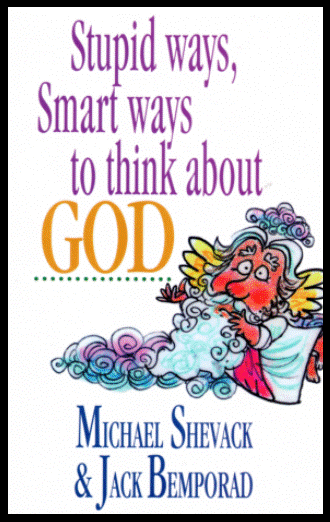
Picture1

The second stupid way the authors have identified that people think about God is:

GOD AS LITTLE

MARY SUNSHINE.

They begin their description with this mock prayer: O, Eternally-smiling One. Thou art more friendly than Mister Rogers. More sunny than Doris Day. Thou art the best little god anyone could ever have. Yes, put on your polarizers. It’s time to bask in the glorious light of Little Mary Sunshine. Everyone’s favorite kind of god. And why not?

He’s a hap-hap-happy deity. Hovering over you like an umbrella on a rainy day. You’ve got problems? Why worry? Why work at life? Little Mary Sunshine will take care of everything for you. Just     relax. Catch some rays. But be careful. Prolonged exposure can be harmful. For Little Mary Sunshine is a god of illusions. A god devoid of substance.

This view of God masquerades as a simple, almost enviable, childlike faith. It may even resemble, in its purity, a standard worth aspiring to. But its resemblance is truly superficial.

This god is all love. But not real love. He nourishes, but does not discipline. He coddles, but does not upbraid. God has been homogenized of all dimension, pasteurized of all impurities, until he is bland and suitable for middle-class palates. This “divine” love has been rendered so simplistic, so comfortable, it is not real. It bears no relation to any of the complications we experience in life. How could a God this good be responsible for a world filled with such suffering and cruelty? It’s so hard to believe, many Mary Sunshine devotees deny the existence of evil whatsoever when what they should deny is this concept of God.

Others explain evil by believing in demons, devils, Darth Vader, or some other character in a cosmic comic book of right vs. wrong. Suddenly, our all-powerful God has a competitor. Who’s the real god anyway? Yet this is just a Pandor’s box of theological Band-Aids. All to protect a god that is too good. A god that defies our God-given sense of reason, because he has created all light and no shadow. This concept of God is not just intellectually unsatisfying, it is also emotionally crippling. Because Little Mary Sunshine is a god of fragile people, desperate people who need to escape the imperfections of life and the darker sides of themselves. This god we have created for ourselves is also a fragile god. He is decimated by wars. Abandoned after the senseless death of a child. His benevolence all too often feels like a lie. Yes, this is a god we have cursed.

July 5, 2015

image379When I open my heart and mind to the message which is contained in today’s readings, I find that the Epistle, which is taken from Paul’s Letter to the Romans, clearly reflects the behavior of Jesus as it is described in the story of the cure of the paralytic man at Capernaum.

Here are the words of Paul:

Your love must be sincere…. Love one another with the affection of brothers. Anticipate each other in showing respect. Do not grow slack but be fervent in spirit…

The miracle story related in today’s Gospel says that when Jesus saw their faith (i.e., that of those who brought the paralytic man to him), He immediately responded to the situation with love and kindness. The story contrasts Jesus’ loving response with that of the Scribes. The Scribes were judgmental and reflected a true meanness of spirit since they showed no concern or regard for the paralyzed man. They judged the actions of Jesus instead of joining with Jesus in loving the man in need.

One of the things that this miracle story highlights is the real inclination that we humans have to judge others. Think about it and then take time to assess your own inclination to judge others. Do you remember when you last judged someone?

We humans find it so very easy to judge others who do not believe like we do, act like we do, or belong to the particular group that we do. It is critical, if we are to spiritually grow, that we find real ways to check this tendency.

Paul asserts that fraternal charity is absolutely necessary if we are to, become true followers of Jesus. In this same Epistle reading we hear these words:

Bless your persecutors; bless and do not curse them. Have the same attitude toward all…. Never repay injury with injury. See that your conduct is honorable in the eyes of all. If possible, live peaceably with everyone.

As I have shared with you before, our attitudes truly control our behaviors even though we may not always be aware of our attitudes. Most of them are formed during our childhood.

Underlying the tendency to judge others are the attitudes we have about others. Jesus simply responded to His detractors by ignoring their critical comments, turning His attention to the paralyzed man and curing him. Jesus demonstrated by His initial response to the man that concern for him was as important as curing him. Respect for all others is an important attitude.


Gaining a Deeper Understanding of the New Testament — 20150705

BambergApocalypseFolioA chronological approach to the book of Revelation sets its composition in the late first-century and asks what it meant (past tense) then. What did its language mean to its author and to the early Christian communities to which it was addressed? Within their shared field of meaning, what did the author communicate to them?

To illustrate this point, let us review a few illuminating and important examples:

The author expected the events he describes to happen in his near future. Seven times (note the number seven again), he writes, “The time is near, ““what must soon take place,” “I am coming soon.” “Soon” and “near” cannot plausibly be extended to two thousand years and counting. Like the authors of a number of New Testament documents, John of Patmos thought the second coming would happen soon.

The author identified the dragon, the ancient serpent, Babylon the Great, the great whore, the beast whose number is 666. It was Rome – not just the city, but the Roman Empire. The identification is unmistakable in a late first-century context. Because of the Roman destruction of Jerusalem in 70, Jews and Christians spoke of Rome as “Babylon,” because the Babylonian Empire was the previous destroyer of the holy city and its temple. The woman and the beast live in a city built on seven hills, a designation for Rome that goes back to antiquity. It is the city that rules the world; in a first-century context, that could only be Rome. The number 666 is a numerical code for Caesar Nero, the first Roman persecutor of Christians. The beast is the Roman Empire of the first century – not some future beast from our point in time.

The author chastised most of the communities to whom Revelation was addressed for their accommodation to the imperial way of life. They had abandoned their first love, forgotten what they received and heard, and become lukewarm.

The author’s message of the imminent destruction of Rome and the second coming of Jesus encouraged his followers to hold fast. The powers who ruled and oppressed that world and rejected the vision of a new world, the kingdom of God   proclaimed by Jesus and his followers, would soon be no more. “Be stead, take courage, do not be afraid,” they were told.

John expected the destruction of Rome and the second coming of Jesus to occur soon. Obviously, he was wrong. They didn’t happen.

This realization raises an interpretive question. What is truly a faithful interpretation of Revelation in our time? Is it one that affirms that what it says will still happen? That there will be a future beast who in a final battle at Armageddon will be vanquished by Jesus at the head of an army of heaven? That the plagues and wars and earthquakes and other signs of the end are still going to occur?

Many believe this is yet all to come!

CALLED TO HOLINESS — 20150705

Universal Call to Holiness

Universal Call to Holiness

Continuing thoughts from the last issue wherein I introduced the fancy and esoteric idea of nondual consciousness, I would add that Jesus’ nondual vision of the Kingdom of Heaven was not a paradox. It only seems like a paradox to our limited logical way of thinking. Jesus’ nondual vision was simply the seeing of what, in fact, is actually true. Jesus, however, found it impossible to describe his nondual vision in simple declarative sentences without sounding paradoxical. That is because the human mind, and the declarative, spacetime language that our human minds have created, is itself dualistic. Our minds, and therefore human language, are inherently structured on the basis of countless spacetime, logical polar opposites. In simple terms, because we think in terms of time and space, we cannot see a universe therein everything – past, present and future – are all one. There is NO TIME in God. We humans, however, find it almost impossible – or perhaps impossible – to think about things without reference to time and space.

Jesus did not say, “The Kingdom of Heaven is this” because this automatically excludes its opposite that. Nor did he say, “The Kingdom of Heaven is that” because that automatically excludes its opposite this. He did not say “The Kingdom is here” because here excludes its opposite there. Likewise, he did not say “The Kingdom is there because there excludes its logical opposite here. So Jesus ended up saying that the Kingdom was not here and not there. He did end up saying that the Kingdom is within.

Still another way Jesus got around the problem of declarative or logical language was to speak about his inner nondual vision of the Kingdom in parables, analogies, metaphors and stories. When we listen to His stories we find that He really hints that we will find the Kingdom within when we find God within.

Further Thoughts About the WAY of Jesus – 20150705

image332In the last issue I began to address the issue of our attitudes about religion. I have had people tell me that they don’t need to go to a church to encounter God and to praise and worship Him. They would prefer to go out into nature and find Him there.

I do believe that is important – to find God in our world. I do believe that we can also deceive ourselves into thinking we have had some kind of encounter with God in those settings.

The power of going to a church and worshipping God is multifold. First, there is something about the experience of joining with others in worshiping God which is rewarding and encouraging. It seems to add additional support to our personal belief in God. There are others who believe in God just as we do.

Second, I believe that despite the fact that some people disregard ritual, there is something in the human spirit that also embraces ritual. Most of our life is symbolic, if we only think about it. Our language is the ultimate use of symbols to communicate. Our worship combines all of our senses in thinking about, if   we allow ourselves to become truly engaged in the communal worship, this God Who seems to always be present in some way in our lives.

Human beings have been using rituals since the very beginning in order to deal with their fears and uncertainties. Our ritual is designed to address our fears and uncertainties about life. Think about it. We address the issue of death by   declaring there is life after death. We also address the issue of facing the uncertainties about life. Our ritual encourages us to trust and hope in a Creator Who deeply loves His creation – us.

Third, our ritual allows us to also envision in a symbolic way our thoughts about what it means to praise and worship God. I truly believe our Divine Liturgy is a magnificent creation. When I think about the men who created it I am in awe. It truly enhances our worship of God over the initial ritual from which it was taken.

Of course we have to have the attitude that, as human beings, we need to worship God. If we don’t think that we need to worship – and by this I mean that we don’t just go to the Liturgy to protect ourselves from punishment – then all the ritual in the world will not make church going important.

So our attitude about religion must be that it can help us to truly understand the meaning and purpose of life – it can help us deal with the vicissitudes of life and find inner peace.

Understanding The Theology of Our Ukrainian Greek-Catholic Faith — 20150705

One of the important aspects of our Theology is the veneration of saints. The Catholic and Orthodox Churches both recognize this veneration as an important part of our faith.

Saints have been honored since the early church. Special veneration was first given just to martyrs, but was extended in the fourth century to include confessors, those who suffered for their faith but not to the point of martyrdom. Bishops began to regulate the cults of various martyrs in their eparchies, although the veneration of various martyrs often extended beyond a single eparchy or country. Early church councils addressed the subject of the efficacy of the veneration of saints. An early source on the veneration of martyrs is the Martyrdom of Polycarp (c. 135 CE), which explains:

…it is neither possible for us ever to   forsake Christ … nor to worship any other. For we worship him indeed, as being the Son of God. However, as for the martyrs, as disciples and followers of the Lord, we worthily love them on account of their extraordinary affections towards their own King.

The Martyrdom of Polycarp also mentions that the relics of the martyrs were treated “as precious stones” and that the church celebrated the martyr’s day of death as their “birthday into heaven.” Similarly, around 250 CE St. Cyprian wrote:

Take note of their days on which they depart, so that we may celebrate their commemoration among the memorials of the martyrs… There are celebrated here by us oblations and sacrifices for their commemorations.

A writing called the Apostolic Constitutions (c. 390 CE) instructs: “Now, concerning the martyrs, we say to you that they are to be held in all honor with you.” The Seventh Ecumenical Council (787 CE) declared that “we adore and respect God our Lord; and those who have been genuine servants of our common Lord we honor and venerate because they have the power to make us friends with God the King of all.” The early Church seemed to know that the veneration of saints touches upon a number of beliefs, one being the immortality of the soul.

The veneration of the saints is rejected by most Protestant Christians, who regard the practice as idolatry. The Catholic and Orthodox Churches have a very succinct understanding, based on the early Church, of what is actually involved in the veneration of Saints.

(More to Follow)

10 stupid and 10 smart ways to think about God — 20150705

Picture1As I indicated when I started sharing the contents of this little book, the authors have identified Smart and Stupid ways to think about God. Last week I shared the first Stupid way. This week I would like to share the first Smart way.

A smart way to think about God begins with God Himself. Because God IS the beginning. The beginning of the beginning. The absolute beginning. It’s well worth repeating

A deceptively simple notion, it is a monumental concept. It means that before anything existed, there was still something. And that something is what we call God. Before the big bang, before the space-time continuum, before energy and matter, our universe, or any universe. God was there.

It means that this universe didn’t just happen out of nothing. Creation is no chance occurrence or coincidence. No celestial hiccup. It happened out of God.

God is the Origin of all existence. He pointed the universe in one direction. Shot what physicists call the arrow of time. Established a flow. From beginning to end.

Somehow, He is responsible for all that exists, has ever existed, will ever exist, or could ever exist. Somehow the universe – past, present and future – is inextricably joined to God’s Being.

God is a Being that is so basic, so fundamental, it cannot be split into simpler components. It cannot be placed in an accelerator or   reduced to one simple particle.

God is an indivisible Whole – a Whole that is beyond all the opposites of our reality. God is a Whole that is beyond protons and electrons – positives and negatives. And yet, somehow, all things are part of Him. Every force in the universe.

His is a Being of Infinite Potential. All possibilities are part of His Nature. Everything conceivable and also inconceivable. This is God!

He is a God that cannot be made out of stuff. His atoms were never part of galactic nebulae, or the dust of comets. He never simmered in the cosmic crockpot that gave birth to the universe. He was and is the cook of all things.

He is a God that cannot be shaped by the hands of time or the hands of man. He can never be fashioned in our image. He can hardly be imagined. He existed before imagination.

This is the only God that could ever be a real God. The only kind of God able to leap over all idols. This is the only kind of God that can never be proven false. This is the God made known by Judaism, popularized by Christianity and Islam. This is the only God conceptualized by those embracing monotheism. This is the God we believe in