Gaining a Deeper Understanding of the New Testament — 20150607

I have been sharing thoughts about the last book in the New Testament, namely Revelation or the Apocalypse. The author names his location as the island of Patmos and so he is often called John of Patmos. There is a tradition which says that John the Evangelist retired to or was exiled to Patmos.

From Revelation itself we learn a bit about him. Because it is addressed to Christian communities in seven cities of Asia Minor, most scholars surmise that he was known to them and was probably one of many itinerant teachers or prophets who went throughout the area. He was steeped in the Jewish Bible, the Old Testament. In fact two-thirds of his 404 verses allude to it. His Greek suggests that his native language was Aramaic, which has led to speculation that he grew up in the Jewish homeland as a Palestinian Jew and then traveled to Asia Minor as a Christian missionary, perhaps after the destruction of the temple and Jerusalem in the year 70.
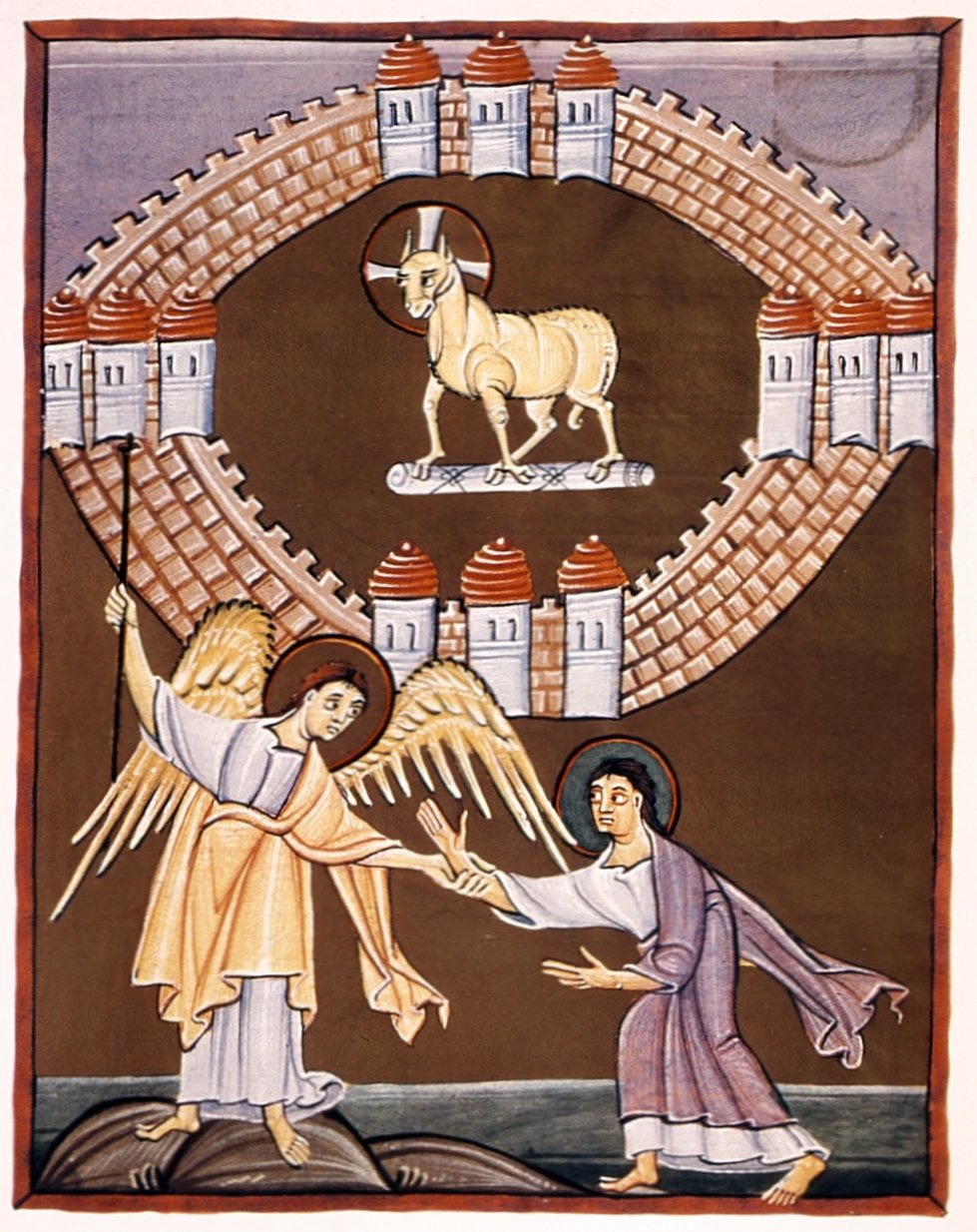
BambergApocalypseFolioFinally, he was a religious ecstatic. He had visions. In the first chapter he describes a vision in which one like the Son of Man – the risen Christ – calls and commissions him: Write what you have seen, what is, and what is to take place. Most of the rest of the document, chapters 4—22, is a series of visions he actually had, literary creations or a combination of the two is impossible to discern. What John wrote is an apocalypse. Indeed, the document is commonly known among Catholics as “The Apocalypse”. Originally a Greek word, it means an unveiling, disclosure, revelation. In Judaism Apocalypses were, in the centuries before and after Jesus, fairly common. They were sometimes revelations of the other world, the heavenly world, and sometimes both. This book combines both. Jewish apocalypses come out of a time of oppression and real suffering inflicted by the powers that rule this world and contrast the present evil age with a future blessed age that will come soon through a very dramatic intervention by God.

Like that of other apocalypses, the language of Revelation is highly symbolic. Some numbers are symbolic, especially seven. It appears sixty times and also structures major portions of the document which I will share with you in the next installment of this article. Pick up Revelation and begin reading it.
Understanding The Theology of Our Ukrainian Greek-Catholic Faith — 20150607

As everyone who worships with me knows, the theology of our Church stresses the fact that all major acts of God are Trinitarian acts and secondly that the particular role of the Spirit is to make the first contact, which is then followed – existentially, but definitely not chronologically – by a revelation of the Son and, through Him, of the Father. The personal being of the Spirit, however, remains mysteriously hidden, even if He is active at every great step of divine activity in time: creation, redemption, and ultimate fulfillment. His function is not to reveal Himself, but to reveal the Son through whom all things were made and who is also personally known in His humanity as Jesus Christ. As St. Basil wrote: It is impossible to give a precise definition of the hypostasis of the Holy Spirit and we must simply resist errors concerning Him which come from various sides. The personal existence of the Holy Spirit thus remains a mystery. It is an existence whose fulfillment consists in manifesting the kingship of the Word of God (i.e., the Logos or Christ) in creation and in salvation history.

For the Cappadocian Fathers (Basil, Gregory Nyssa and Gregory Nazianzus) the Trinitarian interpretation of all the acts of God implies the participation of the Spirit in the act of creation. When Genesis mentions the Spirit of God moving upon the face of the waters, patristic tradition interprets the passage in the sense of a primeval maintenance of all things by the Spirit, which made possible the subsequent appearance of a created logical order through the Word of God. No chronological sequence is implied here, of course; and the action of the Spirit is part of the continuous creative action of God in the world: The principle of all things is one writes Basil, which creates through the Son and perfects in the Spirit.

Basil identifies this function of perfecting creation as sanctification, and implies that not only man, but nature as a whole, is perfectly itself only when it is in true and real communion with God and when it is filled with the Spirit. This is particularly true of man, whose nature consists precisely in his being theocentric. He received this theocentricity, which the Greek Fathers always understood as a real participation in the life of God, when he was created and when God breathed into his nostrils the breath of life. This breath of God’s life, identified with the Holy Spirit on the basis of the Septuagint version, is what made man to be God’s image.

This Trinitarian focus truly distinguishes the Eastern Christian Church from that of the West!

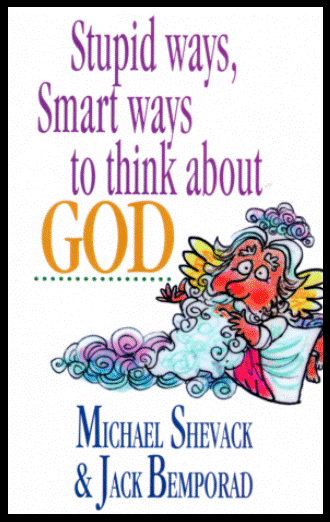
10 stupid and 10 smart ways to think about God. — 20150607

Picture1As many know, I have been in the process of weeding out my library. The books on the table in the vestibule are for those who might like to read. As I was   going through my books this week, I came across this   delightful little book that I forgot I had. I decided that I would begin sharing from this book, adding some of my own comments. I hope that you will enjoy it. The authors actually identify 10 stupid and 10 smart ways to think about God.

Somewhere in the heart of each of us sits an old man with snow-white hair and a long, flowing beard. He lives in a beautiful palace of light, way up in the sky. Clouds, like taxicabs, carry visitors to and fro. Winged angels flutter about, harp music playing in the background like celestial Muzak (i.e. elevator music).

This divinely enthroned man, looking suspiciously like a transfigured Charlton Heston, is God – God the first time most of us become acquainted with Him.

This is God the King. Benevolent Monarch of the World. He was kind and loving, like Mommy. Trustworthy, but firm, like Daddy. Wise and patient like Grandpa. He was the perfect picture of God for a child who was too innocent to envision anything else.

He was a good God. That is, until we grew up. Until we traded our childhood fantasies for real life. Until we needed to wrest control of our lives and didn’t want interference from our parents or an overly parental God.

As Anne-Marie Rizzotto wrote, “Each child brings his pet God to church under his arm. All people begin with childhood images of God which, of course, influence how they think about Him.”

He was a real God. That is, until mankind grew up, began to trade mythology for scientific theory, learned to prize logic over feeling and discovered so much about the world that this childhood image of God seemed stupid.

The old man in the sky became less than believable after mankind peered through a telescope. Also, the kingly god truly became undesirable after the revolutionary concept of democracy and the beard was hardly politically correct after women’s liberation. Of course beards, thankfully, have come back into vogue.

In many ways, we’ve grown smarter. But when it comes to God, many of us haven’t grown at all. We know what’s wrong with God, but not what’s right. We haven’t really thought through, openly and completely, this idea of one singular supreme Being. We have not come to terms with our view of God in light of everything we now know and feel about the world. We only know that we blame Him when we think life is unfair.

It seems, unfortunately, that religious education stops among many people after they are out of school and so their thoughts about God never change.

From the Desk of our Aspiring Deacon, Leonard — 20150607

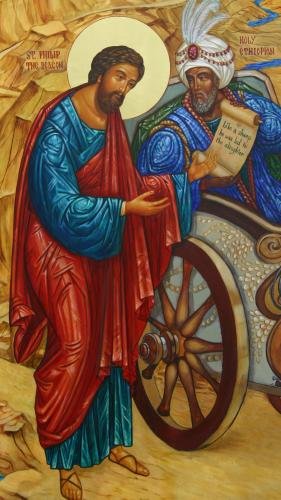
Deacon_Philip

Phillip the Deacon

The order of deacon can traces its roots, we know, back to the ancient church in Jerusalem. It was founded out of the necessity of performing the works of charity and the word in the early church. As the early church grew so did this holy order.

Around the year 200 CE a document was circulating called the Didache. This document was not scripture but was the first rule book for the day to day running of the ancient church. It gave instructions on many aspects of Christian life and the organization of the Christian community.

In section fifteen the early church set forth guidelines for appointing people to the office of deacon along with the office of bishop, similar to what was found in scripture. It says, appoint for yourselves, therefore, bishops and deacons worthy of the Lord, men who are meek and not lovers of money, and true and approved; for unto you they also perform the service of prophets and teachers. Therefore despise them not; for they are your honorable men along with the prophets and teachers

Many historians feel that the deaconate reached its golden age very early. Early in the third century, around the year 230, St Ignatius writes:

Everyone should hold the deacon in as great respect as Jesus Christ! For the deacons are   fellow ministers or co-ministers in liturgy, in the word, in charity, in administration, and in authority.

At this time period the role of the deacon in the liturgy was also becoming more defined, along with his assistance to the bishop in the running of church administration. He was the leader of the community prayer, but not the presider. The presider’s role was held by the Bishop or Presbyter, the priest, as we know today.

After the legitimization of the Church by the Emperor Constantine the deacon’s active role in distribution of the Eucharist was starting to cause conflict between the other ordained ministers so much so that it was one of the lesser topics taken up at the First Council of Nicaea. Canon eighteen defined more clearly the role deacons have in administering the Eucharist, within the liturgical assembly. The council stated that it was not the role of the deacon to give communion to the bishop or presbyter, but that he was to receive the Eucharist from the bishop, because he ranked below that of the bishop or presbyter. It was also stated that deacons are not to sit among the presbyters, but assuming amongst themselves in the assembly.

It is from this point the church started to define more clearly the different roles of her ordained ministers and the development of their functions within the Church community. At this point the function of the deacon began to change from its original role, as we shall see in future articles.

During this month, Leonard will be going to Pittsburgh for two weeks to begin his studies

Learning Our Faith From the Greek Fathers of the Church — 20150607

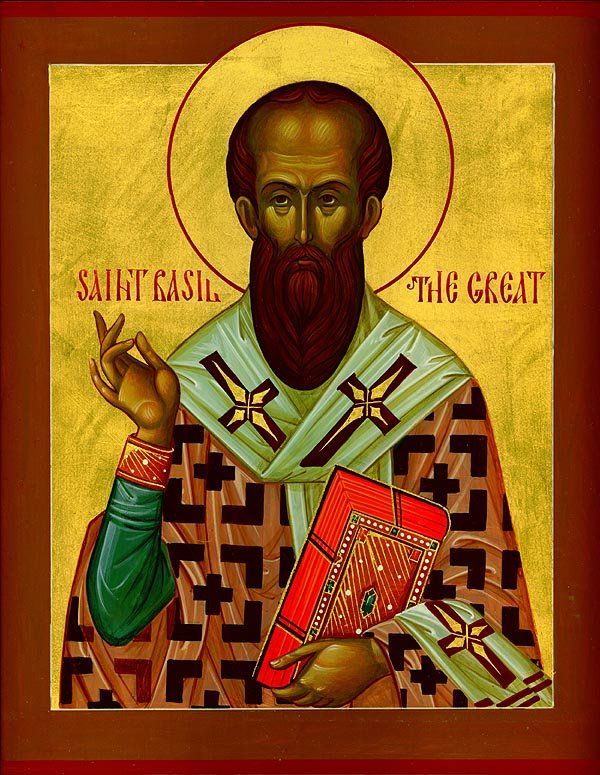
0101basilthegreat03In the last issue of this article, I introduced an idea, based on the Fathers, that there are two basic ways by which one may arrive at the realization that a fundamental change of life must take place – the way of light and the way of darkness.

Both of these ways are a gift from God and as such are the result of His saving uncreated grace (i.e., help) operating in our lives. The Fathers were speaking neither of an emotional nor a psychological state or condition. Repentance is not an emotion but rather an intelligent, thoughtful, voluntary process which a person engages in order to truly bring about the personal       transformation needed to become the adopted children of God. This requires a real union with Christ so that the Spirit within us can guide and support this   personal change.

Just as Christ became the New Adam in order to save the whole Adam, that is to say, to save all mankind, so too do we, by become Christlike – through the purification of the passions and the     cultivation of the virtues, by living according to the commandments of Christ – so too do we embrace, as does Christ, the whole Adam in our person.

This is what personal transformation is all about. By growing in virtue and eliminating vice in our lives, we are transformed into adopted children of God. This is Theosis and the goal of earthly life. We are here on earth and are confronted with a variety of life challenges in order to develop virtue and thus become a transformed human person capable of a true and deeper union with our Creator-God. We are here to learn how to be what we were created to be, namely children of God.

Once we begin to see and understand the true purpose of life, we begin to change and are every more capable of sustaining a real relationship with God. This is something that we have to learn and life gives us a multitude of chances and opportunities to learn how to have and maintain genuine relationships.

The teaching of the Fathers about Theosis is based on the understanding that man, the greatest of all God’s creatures, has been called to enter into direct and unmediated communion with God even during this present life. The chief manner by which this is achieved is through the grace of God, through sincere prayer that makes union with God real, and a voluntary effort to work for a deeper union with God. God’s Spirit will facilitate and guide this process when we voluntarily embrace it.

CALLED TO HOLINESS — 20150607

The mission of the Church is to evangelize. Contrary to manipulative strategies of proselytizers, those in true evangelizing ministry are simply inviting people to a relationship of love with God in the context of community. The call to evangelize is given to all those who have been initiated into the Church. We are all called to share the joy of knowing that we are loved by our Creator-God and that He is here with us, helping us to meet life’s challenges in a positive manner that leads to spiritual growth. In simple terms, we are called to be people with a positive attitude about life and determined to make every attempt to live like Jesus lived.

We do know that evangelization is no longer thought of as a means to convert people to our religion and way of worship. Rather, evangelization is bearing witness to the revelation God has made to mankind: the purpose of life is to begin the process of personal transformation so that we become ever-more like Jesus. Engaged in such activity bears witness to the realness of God’s Kingdom here-and-now.

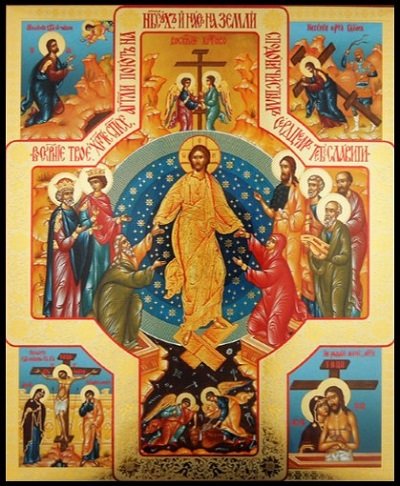
paschaLike the members of the early Church, we are called to bear witness to Jesus by the way that we choose to live. Like them, we are called to make the love of God real in a world that desperately needs God. Like them, we know that our salvation – knowing the true meaning and purpose of life – comes when we attempt to make God’s love for humans real in our world. Just as we come to love God by loving our fellowmen, so our fellowmen can come to love God by being loved by us.

Being a Christian means realizing that we are called to make every effort to transform our present world truly into God’s Kingdom. It doesn’t matter whether we can actually accomplish this task. It matters that we understand that this is our task and that we desire to make every effort to make His Kingdom a reality.

The Divine Liturgy and Our Worship of God — 20150607

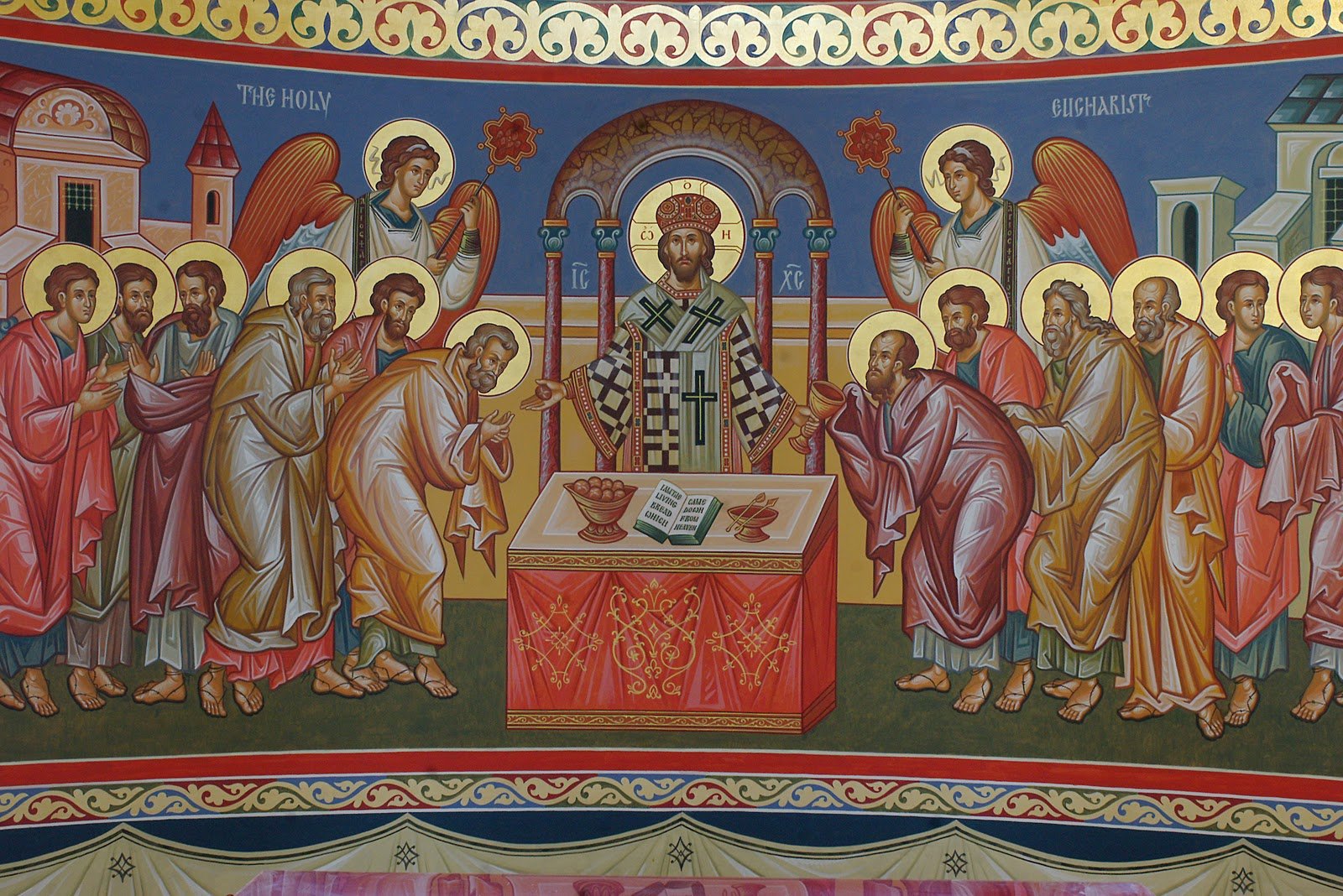
Holy Eucharist IconIn the last installment I began sharing thoughts about the word hesed which we have translated in our Divine Liturgy as mercy. I shared the fact that hesed is associated with ‘emet or faith. Hesed is also associated with mispat, judgment, which here signifies justice. The two virtues are a part of the conversion demanded by Yahweh and are two of the three demands in which Micah makes the will of Yahweh consist. They are with righteousness the attributes of Yahweh’s dealing with men. In this case hesed, when in association with righteousness, tells of Yahweh’s will to save.

Hesed as the will to save is more clearly perceived in its association with the Hebrew word for salvation and cognate words. The psalmist who trusts in the hesed of Yahweh rejoices in the deliverance of Yahweh and asks that Yahweh will show His hesed and grant His salvation. The same element appears in the association of hesed with salom (i.e., peace). Where Yahweh     withdraws His hesed, there is no longer any peace.

Other associations unite hesed with states of feeling. Hesed is not merely a quality or an attribute, but a sentiment.

Hesed sometimes indicates or implies Yahweh’s will to save. There are some passages in which hesed appears as the movement of the will of Yahweh which initiates and sustains His desire to save.

The New Testament use of eleos, which is likewise translated as mercy, is truly broader than the word mercy suggests. Jesus makes the eleos which one shows another the condition of the eleos which one may expect from God. The proof of the love of one’s neighbor is the demonstration of eleos which, in one of Jesus’ parables, means rendering assistance to one in need. In Matthew, eleos is also used to express a real readiness to truly forgive. Eleos is a component of the wisdom from above which shows itself in good deed in real contrast to worldly wisdom.

As we use it in the Liturgy, the eleos of God is saving will which is antecedent to any deed of man. It initiates and consummates the process of salvation in Christ. In men it comes very near agape (i.e., love). It is chiefly manifested in the readiness to do good and to forgive.

So as we say Lord have mercy, we ask Him to be ready to bestow on us His salvation, which is a truly experiential understanding of Who He Is.

The Spirituality of the Christian East — 20150607

The first fundamental virtue that St. John Climacus identifies, Obedience, is, as I shared in the last issue, first to God. Obedience, however, does not really stop there. In the broader sense of virtue, our obedience is to be extended to all people. It means more than taking orders. An obedient person truly considers nothing beneath him. Being the companion of humility, obedience can be seen as the imitation of Christ. To acquire obedience is to follow Christ and become the servant of all. If obedience is real and sincere, it bestows upon us the peace from above. If we practice it ungrudgingly (even if we do not like what we have been asked to do), we will find inner stillness and the peace of God, which surpasses all understanding, will be ours.

An obedient heart does not seek to please itself, nor does it yearn to get the upper hand. It is not concerned with winning arguments or coming out looking mightier, cleverer or in any way better than another.

St John exhorts us in this manner:

Your tongue longs to jump into argument, but restrain it. Hold back your mind, so busy with its own concerns, so ready to turn to the reckless criticism and condemnation of your brother.

Thus obedience is no passiveness, but humble action that emanates from a soul that is calm, peaceful silence and real inward stillness.

St. John recommends that those who are serious about spiritual growth find someone who they feel they can confide in and can help them focus their efforts. This is typically someone who believes that spiritual growth is truly   important, believes in a loving God and desires to support you in your growth. It should not be a person who thinks they have all of the answers. Remember that your spiritual growth is very personal and unique and must flow from you and not someone else.

May 31, 2015

Your Church throughout the world, O Lord, is clothed with the blood of Your Martyrs as with fine linens and purple robes; and so the Church cries out to You, O Christ our God: “Send down Your goodness upon Your people; grant peace to Your Church and great mercy to our souls.”

allsaints

On the first weekend after the feast of Pentecost, our Church celebrates and commemorates all the saints of the Church. It is the eighth weekend after Easter. We pay particular veneration to all those who are the fruit of the gifts of the Holy Spirit. Our Holy Fathers instituted this feast and directed it to be kept after the feast of the Descent of the Holy Spirit, as if to set before us an example of how the coming of the all-Holy Spirit enabled them to attain sanctity. He made holy and all wise those who were of the same nature as we so that we might realize that it is within our power to live like Jesus lived.

Because we all share in God’s life, which is present within us through the power of His Spirit, we all can become saints. It is a matter of becoming more fully aware of God’s Spirit within us. He is not absent from us! It is we who are not aware of His presence within us. A real part of life’s journey is coming to an awareness of God’s life and Spirit within us. The process of becoming more aware of the fact that the life-force within us is intimately connected to God’s own life-force, can lead us to a deeper awareness of God’s Spirit within us. The saints that we remember on this   feast are not saints because they somehow achieved perfection. They are saints because they became more deeply aware of God’s life and Spirit within them and drew upon His power to live like Jesus lived.

If you think about this you will immediately become aware of the fact that to achieve this goal of greater awareness, a person must (1) desire to became more aware of this fact; (2) believe that life is a sharing in God’s own life; and (3) engage in actions that can built this awareness. This, of course, means that a person becomes serious about their faith and decides that it is in their best interest to come to a deeper understanding of God’s life and Spirit within them.

One of the interesting things about life is that we all believe in certain things. The problem is, often they are the wrong things in which to believe.

Gaining a Deeper Understanding of the New Testament — 20150531

BambergApocalypseFolioIn this article I just began sharing thoughts about the last book of the New Testament, Revelation. It cannot be adequately comprehended except against the historical background which occasioned its writing. Like the Book of Daniel and other apocalypses, it was composed as resistance literature to meet a crisis. The book itself suggests that the crisis was ruthless persecution of the early church by the Roman authorities; the harlot Babylon symbolizes pagan Rome, the city on seven hills. The book is, then, an exhortation and admonition to the Christian to stand firm in the faith and to avoid compromise with paganism, despite the threat of adversity and martyrdom; he is to await patiently the fulfillment of God’s mighty promises. The triumph of God in the world of men remains a mystery, to be accepted in faith and longed for in hope. It is a triumph that unfolded in the history of Nazareth, and continues to unfold in the history of the individual Christian who follows the way of the cross, even, if necessary, to a martyr’s death.

Though the perspective of the work is eschatological – ultimate salvation and victory are said to take place at the end of the present age when Christ will come in glory at the Parousia – the book presents the decisive struggle of Christ and his followers against Satan and     his cohorts as already over. Christ’s overwhelming defeat of the kingdom of Satan has ushered in the everlasting reign of God. Even the forces of evil unwittingly carry out the divine plan, for God is the sovereign Lord of history.

The Book had its origin in a time of crisis, but it remains valid for Christians of all time. In the face of evils from within and without, the Christian can confidently trust in God’s promise to be with the church forever.

The author identifies himself as John. For much of Christian history, it was taken for granted that he was the same John who wrote the gospel and letters of John and who was one of the twelve disciples of Jesus. Modern scholarship does not think so. Indeed, the author does not claim to be one of the twelve apostles. In fact he refers to them as revered figures of the past. Moreover, John was a common Jewish name and there are several Johns in the New Testament.