The Divine Liturgy and Our Worship of God — 20150524

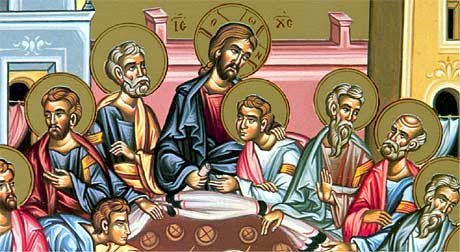
Mystical Supper

Mystical Supper

As I have indicated, the first part of the Divine Liturgy, from the very beginning to the Litany after the Gospel, which is known as the Petitions For the Day, is said to be the Liturgy of the Word. In the early Church once this portion of the   Liturgy was completed, the persons who were potential converts (i.e., catechumens) to the Church were dismissed, they were not permitted to attend the rest of the Divine Liturgy. This is one of the reasons why the weeks after Easter were still weeks of learning about the faith, since the newly initiated into the Church were then allowed to attend the entire Divine Liturgy and, of course, recite the CREED with all of the faithful. They still had more to learn about the beliefs of the Christian Church. That learning was centered around the Divine Liturgy and the other Services of the Church. As I shared in the last issue of this article, a special LITANY FOR THE CATECHUMENS was prayed immediately after the particular Petitions for the Day. This litany is no longer used but can be included if there are people studying to become a part of the Church.

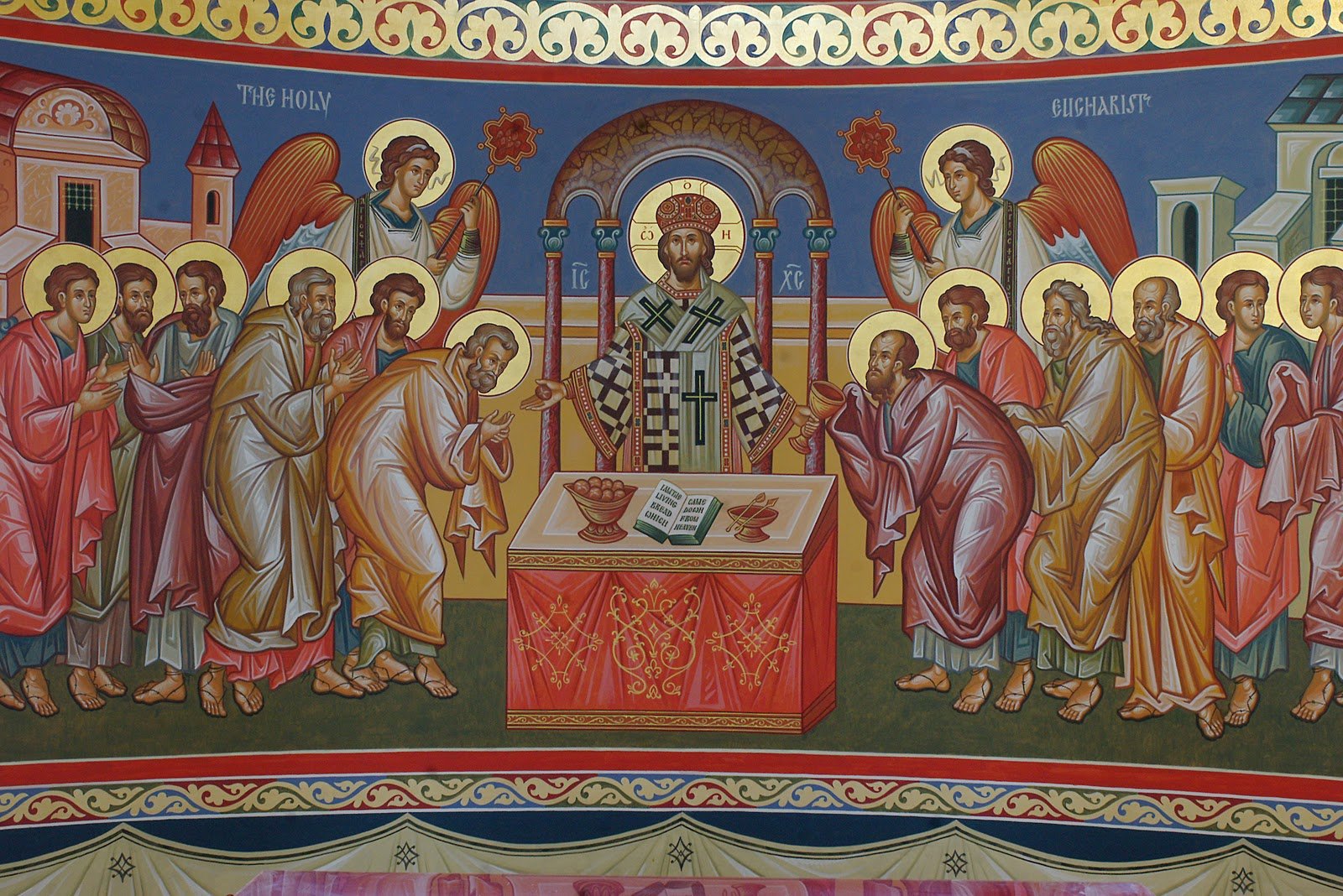
The second part of the Divine Liturgy is called the LITURGY OF THE FAITHFUL and actually begins with two prayers of the faithful. The first prayer begins with: We thank You, O Lord God of Powers, for having deemed us worthy to stand at this time before Your holy altar and to prostrate ourselves before Your mercy, for our sins and for our transgressions. It continues with asking God to accept our prayer.

The second prayer, like the first, states: Grant that we may stand before Your holy altar without blame and condemnation. It continues by asking God to help us grow in our faith, life and spiritual understanding and to partake of Your holy mysteries without blame and condemnation.

In the early Church this prayer was a spontaneous prayer that the presider or presbyter offered on behalf of those who gathered. A common practice in many parishes today is that the two prayers, which have become standardized, are said quietly by the priest. They are the PRAYERS OF THE FAITHFUL and were never originally said silently and only one prayer said aloud.

The Prayers of the Faithful are meant to help us focus on what we have come to do as we celebrate the Divine Liturgy. In both prayers we pray that what we do together and what we receive will be accepted by God without blame or condemnation. They are truly beautiful prayers.
Gaining a Deeper Understanding of the New Testament — 20150524

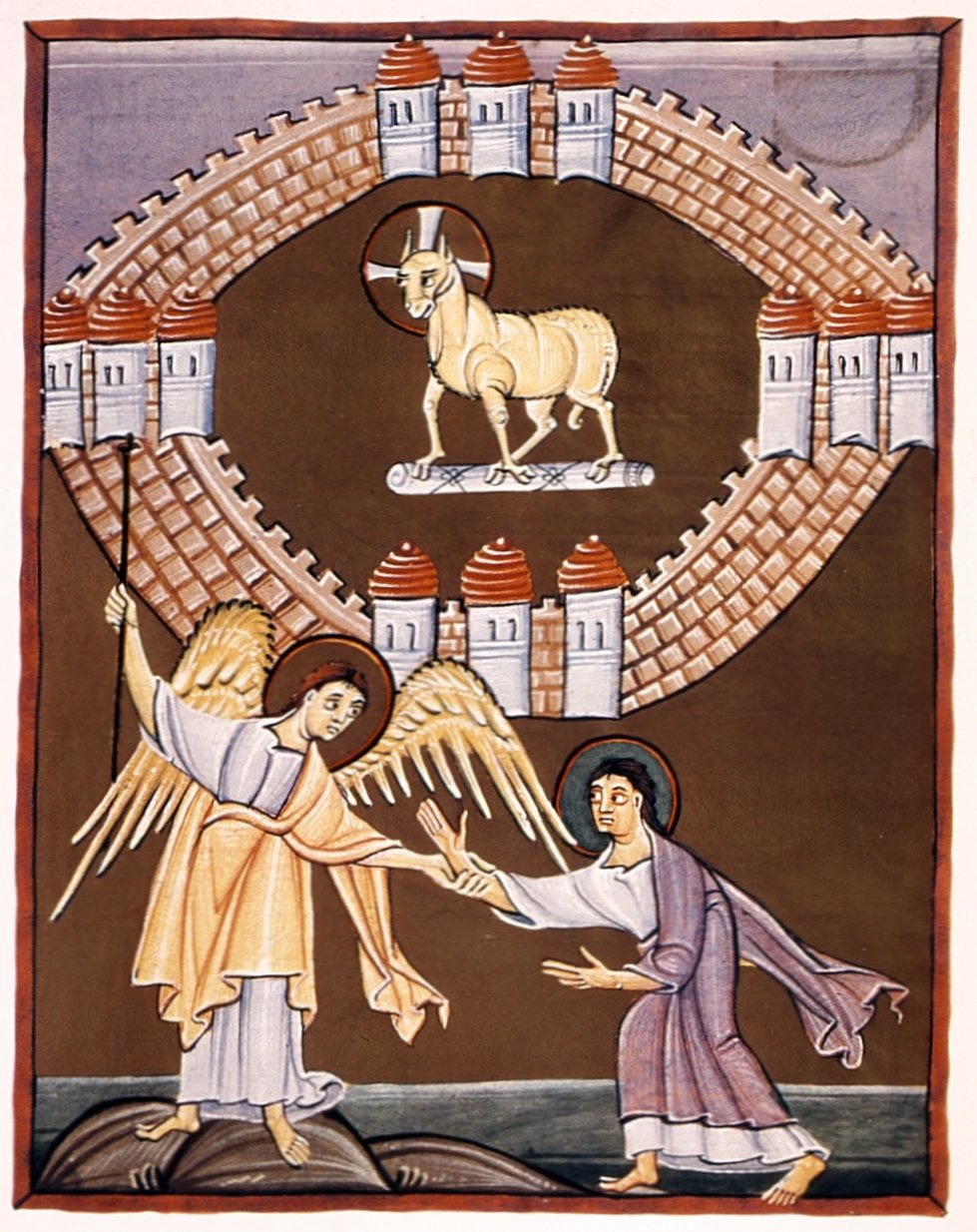
BambergApocalypseFolioThe last document in the canonical New Testament is Revelation or Apocalypse. It is named this because it speaks of the second coming of Jesus, the ending of this world, and its replacement by a new heaven and a new earth. It is probably the least read in our Church. It is also one of the most difficult to understand because it abounds in unfamiliar and extravagant symbolism, which at beast appears unusual to the modern reader. It has also become a mainstay for fundamentalist Christians and many of the evangelical Christians. Symbolic language, however, is one of the chief characteristics of apocalyptic literature, of which this book is an outstanding   example. Such literature enjoyed wide popularity in both Jewish and Christian circles from 200 BCE to 200 CE.

This book contains an account of visions in symbolic and allegorical language borrowed in part from the Old Testament, especially Ezekiel, Zachariah and the apocalyptic Book of Daniel. Whether these visions were real experiences of the author or simply literary conventions employed by him is an open question, the solution of which in no way adds to, or detracts from, the divine inspiration of the book.

The final two chapters describe the New Jerusalem descending to earth, a glorious city in which mourning, crying, pain and death are no more. In it is the throne of God and the Lamb. From it flows the river of life, on whose banks stands the tree of life, whose leaves are for the healing of the nations. It is a city of light. In the final verse of the vision: There will be no more night; they need no light of lamp or sun, for the Lord God will be their light (22:5). It is difficult to imagine a more powerful way to end the New Testament.

Because Revelation speaks about the second coming of Jesus and the events preceding it, it has, more often than not, been understood by some Christians to refer to events that are still in the future, and it could be soon.

This is the premise of Christian churches today that emphasize that the second coming may be near: what Revelation says will happen someday. It is also the premise of the recent series of Left Behind novels. All were bestsellers, totaling more than 70 million copies in the United States alone. They are about the final seven years of the world’s history, based on the Book of Revelation as interpreted by their authors.

Remember that St. Paul thought the second coming would be in his lifetime.

Learning Our Faith From the Greek Fathers of the Church — 20150524

Fathers of the first Six Ecumenical Councils

Fathers of the first Six Ecumenical Councils

In His Sermon on the Mount (Mat 5:1-7:29), Our Lord God and Savior Jesus Christ gives us a vivid description of the divine way of life, that is to say, He teaches us how to live as He does. This is especially evident when we bring to mind such verses as:

You have heard the commandment, ‘You shall love your countryman but hate your enemy.’ My command to you is: love your enemies, pray for your persecutors. This will prove that you are sons of your heavenly Father, for his sun rises on the bad and the good, he rains on the just and the unjust. If you love those who love you, what merit it there in that? Do not tax collectors do as much? And if you greet your brothers only, what is so praiseworthy about that? Do not pagans do as much? In a word, you must be made perfect as your heavenly Father is perfect. (Mat 5:43-48)

If we look closely at these and other such pronouncements, what we shall find is nothing less than Christ’s self-revelation. In other words, Christ is telling us how He lives, and how, therefore, we too should strive to live, if we would be perfect; if, that is, we would be as He is.

The beloved disciple John makes this clear when he says,

We know that, when he shall appear, we shall be like him; for we shall see him as he is. And every man that has this hope in him purifies himself, even as he is pure (1 Jn 3:2-3)

Thus, if we wish to be eternally with Christ, we must become like Him; and this process of becoming Christlike, this purification, invariably involves change, metanoiaa fundamental change in our whole way of life, in our mode of being.

What constitutes our mode of being? All of our attitudes of mind and behaviors. How we think about God, ourselves and others and the world constitutes our mode of being. People tend to act in accord with the way that they think. If we are bigoted and prejudiced, it comes out in our behavior.

Our reactions, then, in any and every situation and circumstance should be Christlike. Each time we find ourselves in difficult situations; each time that we are tempted to think or act according to the way of the world, and every time that we resist this impulse for the love of Christ, and ask for His help and mercy, we are indeed taking up our cross, we are indeed striving to change our way of life in accordance with Christ’s way of living, commandments and example, we are indeed beginning to repent. This is the process of Theosis. Personal spiritual growth and transformation is found in this process.

So salvation is much more than just believing. It also involves voluntary personal transformation.

May 17, 2015

Eternal life is this: to know you, the only true God,
and him whom you have sent, Jesus, the Christ

fathers1On the weekend between the feast of the Ascension of Our Lord and the feast of Pentecost our Church remembers the Fathers of the First Ecumenical Council, that of Nicaea. This is the foremost of the first seven Councils of the Church since it not only anathematized Arius but also undertook to find the appropriate words to describe exactly who we believe Jesus Christ is. He is equally and fully both God and Man. In addition to settling the issue of the nature of the Son of God and His relationship to God the Father, it set forth the first part of the Creed which expresses exactly what Christians believe, established a system for calculating the date of Easter and promulgated early canon law, the law of the Church.

Convened by Emperor Constantine the Great, it is historically significant as the first effort to attain consensus in the Church through an assembly of all the then known leaders of Christendom. It became the model which the Church used for almost a thousand years to settle debates about the faith.

When you reflect upon the action of this Council, you realize that it was the fulfillment of the Prayer of Christ for His Church since, as Jesus prayed, eternal life is to know the Father and to know Him, Jesus Christ. This Council began the Church’s reflection on Jesus as a Person. It clearly stated that He is equally both God and Man, making it possible for us to worship Him as God and also to imitate Him as a man.

The doctrine of the Holy Trinity is not merely an article of faith which Christians are called to believe. It is not simply a dogma which the Church requires its members to accept on faith. Neither is the doctrine of the Holy Trinity the invention of scholars and academicians, the result of intellectual speculation and philosophical thinking. The doctrine of the Holy Trinity arises from man’s deepest experiences with God. It comes from the genuine living knowledge of those who have come to know God in faith. It is the doctrine which allows us to believe that Jesus is both God and Man and that we are connected in a very intimate manner with God. God joined Himself to humankind and we share His life. As we pray the Creed today, let us express our belief in our Triune God.

Understanding Our Ukrainian Greek-Catholic Faith — 20150517

Although many may not have been aware of it, but during the period from Easter to Ascension the Shroud, which we removed from the Good Friday Grave on Eastern Sunday morning, traditionally remains on the Holy Table. The Divine Liturgy and services are celebrated on top of the Shroud. Then, on Ascension Thursday, it is taken from the Holy Table and stored away. In some churches it is actually hung in a frame on the wall of the holy of holies.

I relate this particular liturgical detail to illustrate one of the characteristics of our Church. It attempts in so very many different ways to make the experience of the life of Christ real to us and to help us understand that all of the events of His life are, in the eternal dimension, taking place right now. All of these ritualistic actions make our faith more concrete. Our Church wants these events to be more than just abstract memories or purely intellectual ideas. She hopes that in some way they are experiential and real to us.

Another way she also makes our faith more experiential is by asking us, in accord with Sacred Tradition, to STAND IN PRAYER during this time. Standing, while we pray, emphasizes that we are heirs to the Kingdom and, as heirs, we have been granted the privilege and the permission to stand in the presence of God, our Heavenly Father and King. The first time that we will kneel in prayer will be on the feast of Pentecost.

Again this simple liturgical directive is meant to help us experience in some real way that which we say we believe.  These are simple actions which are meant to make our religion much more concrete and real.

holywisdom

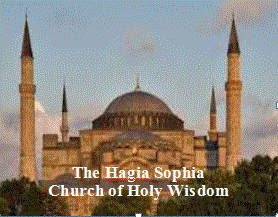
Now I will admit that not all of our churches include these traditional practices. I believe that is a great loss since I think that these practices really help us to experience our faith. They truly recognize the genius of the Byzantine Eastern Church. The Greek Fathers were truly masterful in finding ways to make the experience of our faith real. Think about it: the faith can be seen in the structure of the worship space, in the actions of the services, in the sights and sounds of the worship and even in the vestments of the clergy. One has to admit that it had to be under the inspiration of the Holy Spirit that the Greek Church created and fashioned our worship. This is one reason why the Slavs, when they went to Constantinople and experienced the worship of God in the Great Church, Hagia Sophia, came back to Rus and exclaimed: During prayer we did not know whether we were in heaven or on earth. Hopefully that is our experience!

The Spirituality of the Christian East — 20150517

Transfiguration

Transfiguration

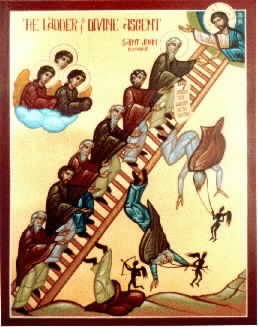
I have already shared with you the first three rungs of John’s Ladder. They are Renunciation, Detachment and Exile. The third rung, I believe, requires further explication.

Spiritual exile often means that we have very different, and even completely opposite values from the world in which we live. We live in an age where self-promotion, wealth, competition and fame are considered good. For some, these things constitute the very goal of life. To live as an exile, on the other hand, is to remain unheralded, unpublicized, masked, hidden, unseen; it is the striving to be humble, a wish for poverty and a real denial of vainglory. It is a realization that the goal of life is to become in the real sense of the words, God’s child. To strive for a likeness of God in our lives.

Christians are not often exempt from the desire for fame, self-promotion and worldly glory. A great temptation for us Christians is to use our faith as a pious excuse for satisfying these passions, all the while fooling ourselves into thinking that some higher purpose is what motivates us. So often we want everything we do for the Church, every good deed, every effort we make in Christ’s name, to be announced, praised and publicized. It is so easy to say to oneself, I am doing it for God. This is why St. John felt that detachment was the rung that precedes exile. For only when we have detached ourselves from the things of this world can we sincerely act in God’s name and not in our own, while using God or Church as a cloak to cover our otherwise naked vanity.

Exile requires discretion since not every kind of exile is good if taken to extremes. It is not pride to acknowledge your gifts and talents since they are gifts from God which are meant to be used for the sake of His Kingdom.

CALLED TO HOLINESS – 20150517

Being called to holiness means being called to more fully understand life and the purpose of life. St. Irenaeus in the 2nd century summarized the aim of God’s creation and the peak of its evolution when the Word became flesh: God became man that man might become God. The early Fathers of the Church, especially those who wrote in Greek and followed the Johannine and Pauline Greek texts, called the goal of the Incarnation Theosis or Divinization.

CaptureThe presence of God’s Word in Jesus Christ as the Light of the world does not coerce those who dwell in darkness to surrender to the Light and thus receive salvation. We find resistance in every atom of our being. Part of our unwillingness to let go and allow God to be sole Master within our lives comes from the state of disintegration in which we find ourselves. Of course this is a part of the genius of God in creating humankind with free will. Salvation comes when we fully    cooperate with God’s Spirit within us and make every attempt to imitate Jesus, the Christ. Salvation is a cooperative process. While God takes the initiative and calls us to salvation, He freely allows us to respond to His call. This, I believe, fully shows how deeply He respects us and loves us. True, unconditional love cannot be forced or demanded. It can only be offered, allowing the one loved to respond in kind.

The body, during this earthly existence, is now a burden, something that brings us fatigue, suffering and pain. It is all too often an instrument of evil desires. Endowed with freedom, we can readily choose evil, unmindful of our true nature to be loving children of God who loves us infinitely. It also provides us with unique opportunities to truly learn how to love, trust and hope in God. God knew exactly what He was doing when He created us as He did. Why do I say this? Because He Himself experienced human life in the Person of Jesus.

Gaining a Deeper Understanding of the New Testament — 20150517

indexI have been considering the Letter to the Ephesians. Despite the fact that Ephesians not only goes beyond and sometimes compromises what Paul wrote in his seven genuine letters, the letter also echoes some of what was central to Paul’s thought. For example Ephesians 2:6-10 concisely summarizes Paul’s affirmation of justification by grace through faith, found in Galatians and Romans. Those verses are:


Both with and in Christ Jesus he raised us up and gave us a place in the heavens, that in the ages to come he might display the great wealth of his favor, manifested by his kindness to us in Christ Jesus. I repeat, it is owing to his favor that salvation is yours through faith. This is not your own doing, it is God’s gift; neither is it a reward for      anything you have accomplished, so let no one pride himself on it. We are truly his handiwork, created in Christ Jesus to lead the life of good deeds which God prepared for us in advance.

The point is not that the author knew Paul’s letters to Rome and Galatia, but that he lived within a Pauline tradition and sought to be faithful to it. His vocation was to express what Paul meant to a later generation. He tried to preserve even as he also tried to accommodate.

If Ephesians is analyzed within the context of Pauline writings, the question of its relationship to the thought of Colossians and other letters of Paul may be fruitfully studied. This is why the letter is attributed to Paul.

The emphasis in Ephesians is principally on the Risen and Exalted Christ, with the significance of his death an underlying assumption. There is little reference to the Second Coming, so prominent in Paul’s other writings. Brief mention is made of the pledge of inheritance, day of redemption, wrath of God, and judgment. The picture given is more that of a Church growing and progressing in history rather than of one waiting for the imminent return of Christ.

The image of the Church in Ephesians is more universal and catholic than in any other Pauline writings. In Romans and 1 Corinthians the body of Christ    refers to the local church, but in Ephesians the body of Christ is the universal Church, of which Christ is the head and every Christian a member. Emphasis is placed on the possibility of joining Jews and Gentiles in one great people of God. The whole Church is the spouse of Christ. The earlier problems with Jewish persecution seem to have been settled.

Learning Our Faith From the Greek Fathers of the Church — 20150517

That we are all in need of repentance (Metanoia) is beyond dispute, as this is clearly indicated at the beginning of the Gospel in the very first words preached by both St. John the Baptizer and Jesus: Repent: for the Kingdom of heaven is at hand. At the end of the Gospel, where the Lord commissions His disciples we also hear: that repentance and remission of sins should be preached in his name among all nations, beginning at Jerusalem.

So the question that I believe is very important to answer is this: What is repentance and how does it bring about our personal renewal?

Repentance, says St. John Climacus, is the renewal of baptism. We know from Holy Scripture and our life in the Church that baptism means dying to the old man and being raised together with Christ in newness of life. This is more clearly seen in the traditional way of baptism, namely immersion. The person being baptized is plunged down into the water and then raised up again.  St. Paul says this in Romans (6: 3-7):

Ladder of Divine Accent

Are you not aware that we who were baptized into Christ Jesus were baptized into his death? Through baptism into his death we were buried with him, so that, just as Christ was raised from the dead by the glory of the Father, we too might live a new life. If we have been united with him through likeness to his death, so shall we be through a like resurrection. This we know: our old self was crucified with him so that he sinful body might be destroyed and we might be slaves to sin no longer.

So if, as John Climacus teaches us, repentance is the renewal of baptism, then it too must signify the renewal of the very same death and resurrection in Christ that we receive at baptism. But what exactly is this kind of death and what is this kind of resurrection? The short answer to this question, as the holy Apostle Paul goes on to say in Romans, must be that death which sets us free from sin.

So, in practical terms, how do we die to sin? Christ Himself tells us plainly that if any man will come after me, let him deny himself, and take up his cross daily, and follow me. But what do these words really mean? Is this just an exalted metaphor that is intended to encourage us to be good and honest citizens? Most certainly not. For if Jesus is truly the way, then surely, if we would be His disciples, we must also follow Him, follow His way.

I think that the way of Jesus should be evident to many since it is something that I have frequently referred to. I shall, repeat it again in the next issue

The Divine Liturgy and Our Worship of God — 20150517

In the last installment of this article, I had reached the point in the Liturgy where the Trisagion Hymn is sung. It was in 433 C.E., when Saint Proclus was Patriarch of Constantinople, that the city was evacuated due to a series of earthquakes. The citizens established campsites in the outskirts of town and were constantly praying for God to bring an end to this tribulation. As soon as the earth would start shaking they would pray with the words, Lord Have Mercy. During one prayer service, a boy from the crowd was snatched up into the air by an unseen force and carried up to such a height that he was no longer to be seen by human eyes. Then, whole and unharmed, the child was lowered to the ground and he reported that he heard and he saw the angels glorifying God singing: Holy God, Holy Mighty, Holy Immortal. All the people began to sing this Trisagion Prayer, adding to it the refrain, Have mercy on us! After this all of the earthquakes stopped. [The word Trisagion is from the neuter of Late Greek trisagios thrice holy – thrice (tris) + holy (hagios)].

Holy Eucharist Icon

What follows immediately after the Trisagion Hymn are the readings for the day. They are traditionally introduced by Psalm verses.

In the seventh century the Divine Liturgy had three readings: from the Old Testament, the New Testament and the Gospels. By the reign of the Patriarch Germanos of Constantinople (715-730 CE), the Old Testament reading disappeared and only two readings remained: the Epistle and the Gospel. For the longest time the Psalms that were read before the readings remained. These were finally shortened to only a few verses. The few verses before the Epistle are called the Prokeimenon, a Greek word meaning that which precedes. The Alleluia, with Psalm verses in-between, precede the Gospel.

The readings from the New Testament really constitute the focus of the first part of the Divine Liturgy. This section is called the Liturgy of the Word and is concluded with the sermon, reflections on the readings for the day, and then the petitions for the day (there was also a litany for the Catechumens). Originally those intending to convert to the faith were only able to attend this part of the Liturgy. They were not permitted to attend the Liturgy of the Faithful which characterizes the larger portion of the Liturgy after the Liturgy of the Word.