From the Desk of our Aspiring Deacon — 20150419

As many already know, Leonard Mier of our community has been accepted by our Bishop to the Formation Program for Deacons. As he and I talked about this, we decided that one of the things that would greatly enhance his preparation would be to be a regular contributor to my weekly Bulletin. This documents his spiritual journey and connects him to our parish in a unique and meaningful way. Here is the first installment.


Reflections on the Deaconate in Christ
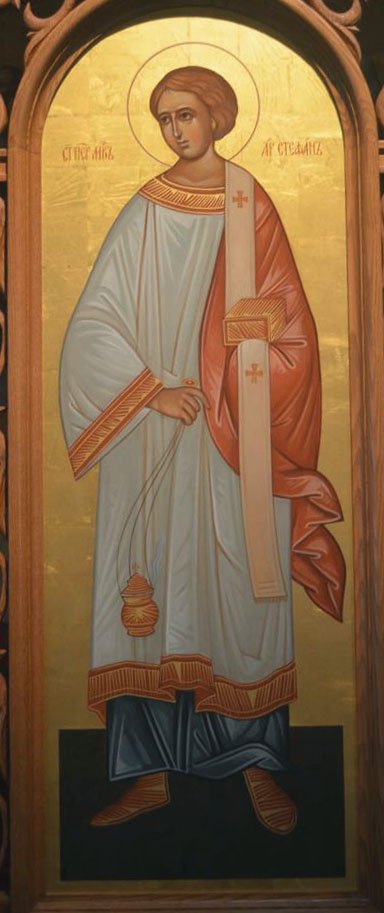
Deacon Stephen

Deacon Stephen


During the Divine Liturgy we, as a community, pray also for the diaconate in Christ. Do we, as a community, know what that is – what the diaconate is?

As part of my application for the diaconal program and also my spiritual formation, I have been asked by the Director of the Program to periodically send him my reflections on the role of a deacon in our Church. I would, therefore, as a part of St. Michael’s Parish Family, like to also share my reflections and thoughts with you.

On the Sunday of the Myrrh-Bearing Women, the church presents us with the narrative of the founding of the second, oldest, ordained ministry in the Church, that of the diaconate. Christ founded the first order, that of the bishop, when He commissioned the eleven apostles. We heard this in the Ukrainian Gospel which was proclaimed last Sunday.

Then Jesus approached and said to them, “All power in heaven and on earth has been given to me.  Go, therefore, and make disciples of all nations, baptizing them in the name of the Father, and of the Son, and of the Holy Spirit, teaching them to observe all that I have commanded you. And behold, I am with you always, until the end of the age.”

Because the community of the early Church was growing at a fast pace, the apostles needed help in the performing the works of charity which they believed Jesus taught was absolutely essential as children of God. What I see as unique about the call to the diaconate is that this call is not only a call from God but, as Acts shows, a call from the community.

Brothers, select from among you seven reputable men, filled with the Spirit and wisdom, whom we shall appoint to this task, whereas we shall devote ourselves to prayer and to the ministry of the word.” … They presented these men to the apostles who prayed and laid hands on them.

Unlike the order of the Bishop and the Priest, the deacon’s ministry is uniquely drawn from the community he lives in and called from to serve. His is a call primarily of service.

The origins of the English word deacon is Greek diákonos (διάκονος), a word that can be easily translated as: servant, waiting-man, minister or messenger. Some have speculated that its etymology is “through the dust” which is expressed in his liturgical vesture, I will reflect on this later. All these words, I believe, define the role that a deacon plays in a community.

It is my hope is to share more with you on the role of a deacon in a Christian Community and also some history of this office. This office has a specific role in the life and liturgical celebrations of the Church.

**********

During the coming weeks, Leonard and I hope to come up with a continuing program of Discussions on Our Faith which we hope to present at least once a month. The program will be designed to help stimulate thought about what we believe about God, Jesus, the Bible, the Church and our religion.

We would ask your help and assistance in putting together this program. Please simply answer the questionnaire in the next column. Please help us by responding to this questionnaire. It will help us build a program.
CALLED TO HOLINESS — 20150419

holy-cross-justice-icon-of-the-resurrectionIn this time after Easter our Gospel readings during the Divine Liturgy are taken, for the most past, from the Gospel of John. His Gospel views the beautiful diamond of God’s infinite being as a community of burning, loving life seeking to share itself with “other-then-God” beings, namely the created world. True love always seeks to extend itself to include others. If God is love by essence, then He is always seeking by His nature to share His being by communicating His presence. He is constantly calling us, who have been made   according to His image and likeness, to share in His very own nature. In Christianity God truly becomes a God-toward-others by the act of communicating Himself through His Word and His Spirit of Love. They is why we can say that He is IN ALL THINGS. Because of His love, He shares His life-energy with all created things. It is His Divine Energy that brings all things into existence and sustains all things in existence.

God created the whole world as good, as a sign of His burning desire to give Himself in faithful communication through His Word. The world at its interior is filled with the self-communicating Trinity. God is filling the universe with His loving, triune life. His uncreated energies swirl through and fill all creatures with His loving  creative presence. God delights to give Himself through His Word to His creatures. Everything flows out of God’s exuberant fullness of life and lives as a reality in His communicating Word. He speaks through His Word, and oceans and mountains, birds and beasts, flowers and all living things spring into being under His laughing, joyful gaze. Nothing that IS can escape. His loving, living touch, His active sharing as Giver of life. This God, as St. Paul preached to the Athenians, is not far from any of us, for in Him we live and move and have our being.

This is something that we must take time to think about. It changes our perception of ourselves and of all reality. The Creator, while He is part of all created things, is also bigger than – more than – all of the things that He has created and keeps in existence.
Think about this!

Learning Our Faith From the Greek Fathers of the Church — 20150419

holy fathers iconThe Fathers highlight another mystery concerning the Life of Christ on earth as a model and pattern for our own Life in Christ. This is revealed in the fact that even with the human nature of Christ we may observe a certain growth or dynamism, or, as Holy Scripture puts it, a certain increase: And Jesus increased in wisdom and stature, and in favor with God and man. The Fathers highlighted this aspect of Christ’s life in order to assert that Jesus was truly Man and truly God. Thus, before all things had been fulfilled, even after the hypostatic union of human nature to the divine Person of the Word – even Christ, in His human aspect, appears as increasing in perfection and knowledge. Hence, He also undergoes temptations; and He even reached point of agony. This, the Fathers tell us, is due principally to a certain division which may be observed in Christ before His glorious Ascension, owing to the asymmetry of His natures. Following His Ascension and the sitting of Christ the Son of Man on the right hand of God the Father, we have the new vision of the Christ-Man as equal to God, not of course according to His nature but according to His energy.

This is language which, I know, we may find difficult to understand. It is a concept of God that has not become very prevalent in our Western world. The Greek Fathers, in attempting to understand God, thought in terms of energy. When you think about it, Divine Life is an energy force and source. God’s energy brings all things into existence and sustains all things in existence.

So Christ shares the same energy with the Father and the Spirit. This does not, however, refer to Christ’s hypostatic aspect, for the pre-eternal and uncreated Word remained such even after His Incarnation. Nevertheless, in the human aspect of His union and existence, we find once again the model and pattern for our own Life in Christ, for, as the Fathers suggest: Christ is truly the unshakable foundation and the ultimate criterion for the anthropological teaching of the Church. Whatever we confess concerning the humanity of Christ is also an indication of the eternal divine plan for man in general. The fact that in the Christ-Man His hypostasis is God, in no way diminishes the possibility for us humans to follow His example, after which “in all things it behooved Him to be made like unto His brethren”.

The Fathers, as you can tell, went to great lengths to find a way to express the fact that Christ is truly and completely God-and-Man.

This mystery we believe!

Gaining a Deeper Understanding of the New Testament — 20150419

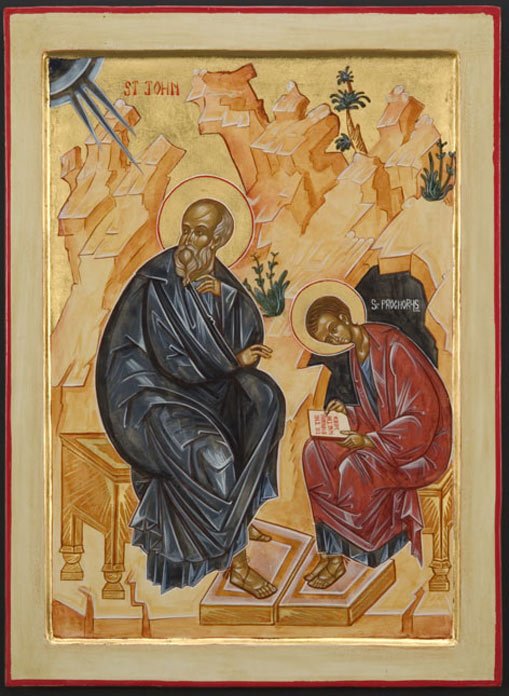
John’s language about “the Jews” is even more condemnatory that Matthew’s. Consistently, Jesus’ opponents are called “the Jews.” They are “from below,” from “this world”. They are children of the devil: You are from your father the devil, and you choose to do your father’s desires. He was a murdered from the beginning… a liar and the father of lies.”

Such language is dangerous, especially when separated from its first-century historical context. The author of John was Jewish, and most or perhaps all of the people for whom he wrote were originally Jewish. He knew that Jesus and his disciples were all Jewish. The reason for his harsh language was because his     community of Christian Jews, like Matthew’s, was experiencing rejection by non-Christian Jews. The rejection is reflected in the story of Jesus healing a bland man in John 9, especially verses 22:34-35.

Gospel of JohnScholars correctly point out that the term “the Jews” in John should be translated “the Jewish authorities” or simply “the authorities.” Despite his language, John is not indicting all Jews, but those responsible for Jesus’ rejection and for his own community’s rejection. To fail to clearly recognize the historical circumstances and the limited intention of these passages is to perpetuate the long history of Christian anti-Semitism. What do Christians, who take the Bible literally and absolutely, do with passages that say that Jews are children of the devil? But recognizing John’s late first-century historical context enables us to understand why he said what he said even as it delegitimates continuing to say what he said.

Thus John, like Matthew, comes from a time when conflict between non-Christian Jews and Christian Jews was intensifying. What historians often call the parting of the ways” between Judaism and what was becoming early Christianity was well under way.

John does not preserve as much of the memory of the pre-Easter Jesus as the synoptics do. But its use of archetypal imagery to testify to the significance of Jesus is magnificent and powerful. For millions of Christians ever since, Jesus has been “the Word” become flesh, the Light of the World, the Bread of Life, the Way, the Truth, and the Life. Much of John’s language speaks to the deepest of human yearnings. In the gospel’s final scene, the post-Easter Jesus speaks words that are also central to the synoptics: “FOLLOW ME”. Are you ready to follow Jesus?

The Spirituality of the Christian East — 20150419

St. John Climacus felt that the very first rung on the Ladder of Ascent is probably one of the more difficult rungs. John sees the first step as renunciation of this world and things of this world. He says that every Christian is called to a life of renunciation. He bases his thoughts on a passage in the Gospel of Luke which says: If anyone desires to come after Me, let him deny himself and take up his cross and follow me. This passage then also adds: For whoever desires to save his life will lose it, but whoever loses his life for My sake will save it (Luke 9:23-24).

Why is renunciation an important first step? Think about it. God’s kingdom is not of this world because it espouses all of the values that this world seems to reject. For example, our modern world prizes individualism and tells us that we have to look out for Number One. Our society also sees success as amassing great wealth and having things which, of course, we can’t take with us when we die. Our society fosters hatred for those perceived as our enemies and promotes the idea of doing unto others as they would do unto us, a true inversion of the Jesus teaching. In a very subtle way our society seduces us into thinking that this earthly life is really all that there is and that we must do everything in our power to hang onto it.

What is interesting to think about is that our American society was built on the Christian idea that we are one nation under God. In this day and age this is becoming harder and harder to believe.

When St. John points out that renunciation is the beginning point of our spiritual journey, it is very evident that he means that we must reject the things of this world that are, in any way, opposed to Christ and to our salvation. It means rejecting the pursuit of wealth, vanity, pride and inordinate   and inappropriate carnal pleasure.

I shall continue, in the next issue, more thoughts on renunciation.

HELP NEEDED

As you know, I try to honor all requests for Divine Liturgies for special intentions. I would greatly appreciate it if your requests could be submitted at least three weeks in advance so that I can put them in the Bulletin. Since we are posting the Bulletins to our website, I am making an effort to prepare them much more in advance than in the past. Therefore your requests need to be timely so that I can accomplish the task of getting the Bulletin done.
Thank You……Fr. Wayne

Understanding Our Ukrainian Greek-Catholic Faith — 20150412

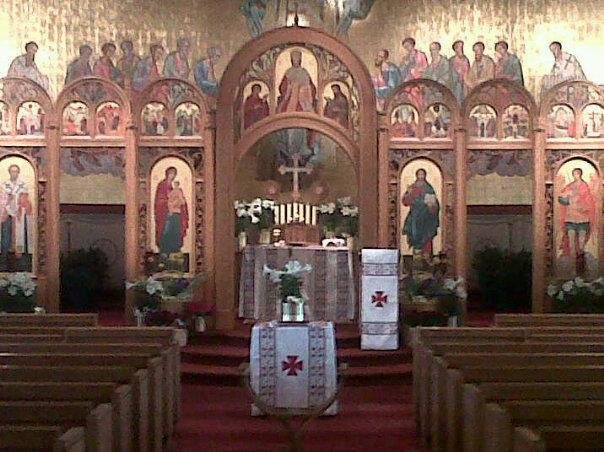
brightweekThe eight-day period from Easter to the Anti-Pascha (St. Thomas Day), as many may already know, is called Bright Week. This entire period is considered by our Church to be one continuous day. Each day a different Tone is used (the set of eight tones that we use every weekend of the year is called the Octoechos). During this period the iconostas, by tradition, remains open, the only time of the year that this occurs. The open doors remind us that Christ revealed, by His resurrection, that we have access to eternity.

With our celebration of the Anti-Pascha, Sundays become, for the next forty days, the first day of the week. After Pentecost Sundays are considered to be the last day of the week.

Since the Resurrection of the Lord is the greatest and most important and beyond all thought, it is rededicated not only once a year but also on every eighth day. The first rededication of the Resurrection is this weekend for it is truly both the eighth day and the first. It is the eighth day after Pascha and the first day, because it is the beginning of the other days. Again, it is called the eighth day because it prefigures the unending day of the future age to come, which will be truly the first day and a day that is not divided by a single night. This is why we call this eight day Anti-Pascha, which interpreted means in the place of Pascha. We should also know that due to the honor given Sunday by the Lord’s Resurrection, the early Church began the tradition of transferring the weekly day of rest, that is the Jewish Sabbath which is Saturday, to this most honored day. The Eastern Church still   liturgically observes Saturdays as special.

During this forty day period the Holy Shroud (Epitaphios in Greek and Plashchanitza in Old Slavonic) remains on the Holy Table and the Divine Liturgy is celebrated on top of it. It is then removed on Ascension Thursday to remind us of Christ’s ascension to the Father.

Normally, the entire Psalter is read during the course of a week and twice a week during the Great Fast. No psalms are read during the entire Bright Week and ordinary fasting is suspended.

Also during this forty-day period, the Easter Tropar is sung three times at the beginning and end of each service and also in place of other hymns. The great amount of repetition of this Tropar tells us that the resurrection of Christ is truly wonderful news to mankind and can never be declared often enough.

The Spirituality of the Christian East — 20150412

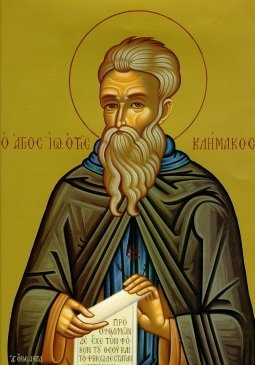
st_john_of_theladderDuring this time after Easter, I thought that I would share some ideas about Eastern spirituality that are derived from our Father among the Saints, St. John Climacus. While his Ladder of Divine Ascent was written for monks, I believe that there is much that people in all walks of life can glean from it.

The Ladder of Divine Ascent is undoubtedly one of the most influential Christian texts ever written and its spiritual insights truly speak to our Eastern spirituality.

One of the aspects of John’s Ladder that is worth considering is the very image of a ladder, of a climb and upward journey. There are thirty steps in John’s Ladder. John intended these to represent the thirty years of the Lord’s life that He spent in preparation for His public ministry.

Our spiritual journey truly requires patience and dogged persistence – taking one step at a time. No one can climb the entire ladder in a single stride. The individual steps of this spiritual ladder do not necessarily come in the same order for all people. Each person’s ladder, while it may contain the same number of steps, is totally unique.

St. John reminds us that we must not be impatient or hasty, for the climb is perilous. There is always a danger in seeking what is beyond our immediate reach. One should never attempt to compare his/her position on their spiritual ladder with that of others.

We do well to also remember that we are not seeking spiritual   perfection. It has not been attained by the saints and cannot be attained during this lifetime by us. The goal is to become engaged in the very process of spiritual growth. God has given all of us an eternal lifetime to climb this ladder. Being aware of the process and desiring to climb the ladder is what is most important. I call you to join me in this journey.

Learning Our Faith From the Greek Fathers of the Church — 20150412

It is important to remember that the Greek Fathers stressed that in Christ Jesus we find man’s rightful place, “on the right hand of the Father,” sharing in the divine Life; but, as with the two natures in Christ, man has been called to be united with God without mixture or confusion of any kind, that is to say, we never cease to be   His creatures, since He alone is Uncreated. This fundamental distinction is, truly of inestimable significance in Patristic theology.

holy fathers iconBecause of the union of our human nature to the Second Person of the Holy Trinity, human life takes on a whole new meaning. It literally reveals to us the connectedness between human life and God. The Greek Fathers explain how Jesus Christ is both God and man by talking about the interpenertration of the natural energy of each of the two natures in Christ in the other. While this, I am sure, seems very difficult to understand, the Fathers use a Gospel story as an illustration of this. The Gospel story is about the Lord’s Transfiguration on Tabor. In this story we first see Christ praying, performing, that is, an act which is proper to His human but not to His divine nature; while moments later, we find His humanity sharing in, indeed resplendent with, His divine glory, which is proper to the divine nature. St. Cyril of Alexandria describes the scene in this way: The blessed disciples slept for a short while, as Christ gave Himself to prayer. For He voluntarily fulfilled His human obligations. Later, on waking they became beholders of His most holy and wondrous change.

One spiritual writer points out that the union of the human nature in Christ is of course hypostatic, that is to say, that Christ is a divine Person, the Person of the Son and Word of God; but, it is equally important to note that the union of the two natures in Christ is also energetic. The significance of this energetic interpenetration of the divine and human natures in each other is of paramount importance for us human beings in that it forms the basis of our own union with God, which is also energetic and not essential or hypostatic. In other words, it proves to   us that the example of Christ is also realizable, also attainable, by us human persons, and that theosis to the point of divine perfection, far from being optional, is in fact and obligation. It is in this sense that the Fathers understand the exhortation: Be you therefore perfect, even as your Father which is in heaven is perfect.

I am sure that as I continue providing information, this will become clearer. I think the important thing to note is that God’s incarnation reveals the truth about our human nature.

The Divine Liturgy and Our Worship of God — 20150412

Mystical Supper

Mystical Supper

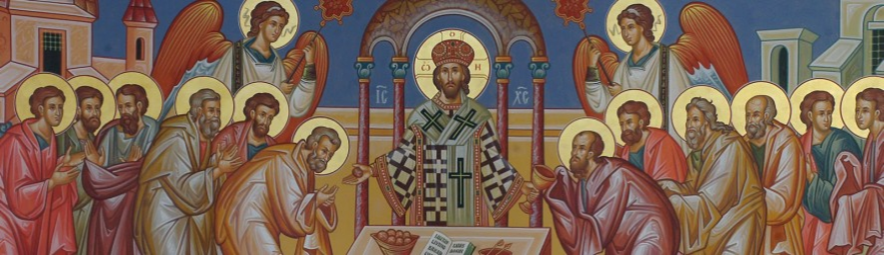
As I thought about the Easter mystery and our Divine Liturgy, it dawned on me that each Divine Liturgy is truly an experience of the Risen Christ since He literally comes into our presence in the mystery of the Eucharist – He is truly spiritually present in a very unique way. This is in fulfillment of His promise to us to be with us until the end of time.

This, of course, is one of the reasons why one the Church’s main teachings is the real presence of Christ, body and soul, in the Eucharist. It should be noted that many Christians find it impossible to believe that Christ is truly present in the Eucharist. The idea of the real presence of Christ is held as orthodox or true faith by both Catholic and Orthodox Christians.

The Church truly understands that the idea of the real presence is difficult to understand. This is probably why the Western Church has used philosophical terms to explain the real presence. The Eastern Church, of course, accepts the real presence as a profound mystery and only calls us to believe in it and forego any attempt to explain it.

In the Divine Liturgies that we use wherein bread and wine are changed into the Body and Blood of Christ (i.e., those of Basil the Great and John Chrysostom), our Church uses a very special sequence of prayers to indicate that it is through the power of the Holy Trinity that this miracle happens. The sequence is this: (1) offering the Father praise; (2) remembering the Son’s words; and (3) invoke invoking the Holy Spirit. We believe that sometime during this sequence of prayers God actually transforms the bread and wine into the Body and Blood of Christ. In the Eastern Church we don’t even dare to speculate when exactly this happens. We only   believe that it happens because God, in the Person of Jesus, promised that each time we do this in the name of the   Trinity, it happens – the Risen Christ IS with us in a real way. While our God is   always with us since we share in His divine life, He knows that we humans need concrete experiences of this presence. The Holy Eucharist IS this concrete experience of God’s presence.

I think that it become very obvious, when we think about this, why many people find it difficult to believe in the real presence. It is beyond our human understanding. All we can say is that we believe it is not beyond the power of our God. Just as we believe that God became a human, so we believe that He transforms bread and wine into Christ’s Body and Blood.