The Divine Liturgy and Our Worship of God — 20151011

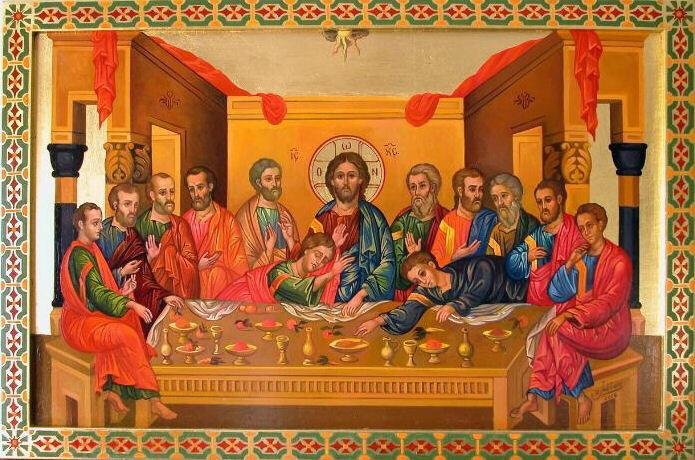
Mystical Supper

Mystical Supper

One of the key ideas in understanding the Divine Liturgy is, as I shared in the last several issues of this article, is the idea of Anamnesis – the ritual act of bringing a past action into the present. A clear example of Anamnesis in this Christian context, within possibly the earliest written references to the Last Supper and its implications for Christ’s disciples, is found in 1 Corinthians 11:24-25. In consecutive verses, the St. Paul uses different forms of the noun ἀνάμνησις, ἀνάμνησιν. Paul commands the Corinthians concerning the bread that has become Christ’s body, and then again concerning the cup of wine transformed into “the new covenant in [Christ’s] blood” (v 25).  Paul reinforces the twofold directive by placing it in the mouth of the Lord himself: “Do this in remembrance of me” (τουτο ποιειτε εἰς την ἐμην ἀνάμνησιν) (vv 24-25). Without using the term Anamnesis again, Paul further explains Christ’s command to commemorate the Last Supper through a communal meal that is at once an act of Anamnesis and of eschatological anticipation, that is an anticipation of the celebration of Christ’s presence in the age to come. Partakers in this meal are transformed by it as both Christ’s past gift of self and future second coming are brought into the present encounter with the Lord: “For whenever you eat this bread and drink this cup, you proclaim the Lord’s death until he comes” (v 26). In 1 Corinthians 11:24-26, Anamnesis is connected with covenant; the cup in particular is said to be “the new covenant in Christ’s blood.” This confluence of covenant and Anamnesis is not a Christian novelty. Indeed, a strong connection between Anamnesis and covenant exists in ancient Israelite tradition and is central to several Old Testament texts: Exodus 13:8 and Deuteronomy 6:28 ‒ wherein this covenant-anamnesis link is clear. In Exodus 13:8, the LORD instructs Moses: “On this day you shall explain to your son, this is because of what the LORD did for me when I came out of Egypt. This covenant, by which God granted Israel “the land of Canaan” (Exodus 6:4) is again remembered and applied to the relationship between God and Israel in the present tense in Deuteronomy 6:28: God brought us from there to lead us into the land promised on oath to our ancestors and to give it to us.

So we see the Jewish influence on the ritual we perform which we call the Eucharist – Our Thanksgiving to God.


Further Thoughts About the WAY of Jesus — 20151011

4Ev-MariaLaachI think that the reason why so many people are afraid to embrace the WAY of Jesus is that they feel Jesus’ passive way of meeting the hatred and the cruelty of others brought Him only pain and sorrow. No one wants to suffer! I also think that the reason why people don’t rush to embrace the Jesus WAY of living is that in our American society such an approach seems to definitely suggest personal weakness. We Americans cannot and do not want to think of ourselves as weak! Our sense of personal and   national independence or freedom fuels a sense of aggressive resistance to anything that does not also match our sense of justice. There seems to be a strong predisposition to meet violence with violence and hatred with hatred. It seems that we can only envision feeling secure if we are highly armed and willing to use force.

I realize that the enemies of our nation can be ruthless and cruel. If we become like them, however, we are no better than them. Our fear of “loosing” all the material things we have seems to provide energy to our aggressiveness.

What is interesting is that Jesus lived in a time that was very similar to ours. The Romans were cruel masters and sought to only subjugate others. They used cruelty and force to maintain what they saw as control. The interesting thing is, where are the Romans now! Cruelty only fuels hatred and, eventually, rebellion.

Jesus was born, raised and died in such a climate. Despite that, He taught that the only way to live was to love and forgive. Do we, when we fail to embrace His way of living, think that He was weak and unrealistic?

I believe that we are faced with the very same evil forces that Jesus faced. He refused to live in any way that betrayed His basic principles and beliefs. He did not let the cruelty and hatred of     others change Him and He did not espouse rebellion and hatred for those who oppressed Him and His people. He only encouraged others to live in accord with God’s Spirit and then allow life to take its course.

Yes, I know His WAY of living may be frightening and can provoke fear. I also know that the only way a person can embrace it is if he truly believes that Jesus IS the Son of God.

Think about it. If Jesus is truly God incarnate, would we not do all within our power to live as He calls us to live, regardless of the consequences? I think it makes more sense to be on the side of God than on the side of other humans who may not believe in Him!

Smart and Stupid Ways to Think About God — 20151011

Believe it or not, I have already presented 8 stupid ways and 7 smart ways to think about God. The 8th smart way to think about God is

GOD IS FULFILLMENT.

The authors that I am using for these ideas, start this eighth way of thinking about God by saying: It is always there, lurking in the shadows. It can slither up to us at any time, coiling itself around our hearts, paralyzing our mind. It begins to squeeze, ever so gently at first and then, tighter and tighter, until it suffocates our faith. It’s not a serpent. It is doubt!

It is easy to believe when we are not challenged by life. Sickness, failure and a host of other life-challenges, can truly challenge our beliefs. So often we hear: If our God is a loving God, why does He allow bad things to happen to good people? We hear this a lot when people encounter serious   illness in children.

The death of a child often provokes even good people asking: If God is so great, why can’t He change this?

People frequently doubt the true love and efficacy of God when things, perceived from a human perspective, seem to be unjust. Perceived injustices often result in doubts!

For our intellectual doubts, God can say little. We seem to think that God should act in a manner dictated by our sense of justice, that is if He is the God that we have made in our image and our likeness. God should, we humans often say, should act in a manner that is very consistent with our idea of justice. The problem is that He frequently doesn’t seem to act as we think He should. Even though we humans cannot see the “bigger picture” about life, we insist that we have the bigger picture and want to   insist that God acts in accord with our perception of what is just and good. As a result of God not acting in the manner we think He should, we begin to doubt that there is a God.

There are other kinds of doubts that arise as we experience life. One of the big doubts that seems to arise is: Does life have any meaning or purpose? Many people allow the challenges of life to allow them to question the meaning and purpose of life. Why? Because we humans don’t want to change and, when life doesn’t turn out the way that we think it should, we question what life is all about. We ask, why should we have to face challenges and struggles? Why is there illnesses, failures and difficulties? We fail to realize that without the various challenges that life presents we would never change or grow. Personal growth only comes when we are challenged to accept things that are not in conformity with what we think are just and appropriate. We begin to doubt that God really knows what is right for us!

CALLED TO HOLINESS — 20151011

vibrantparishAs I shared with you, Jesus wants us to know the truth about ourselves. He wants us to know our true selves. He is a lover of the truth.

Jesus points the way down the path of spiritual growth and self-discovery. He asks only that He can come along, for He knows that the way is dark and only He has enough Light to guide us unerringly on that road. This is one place where both Christianity and psychology meet and diverge. Just like     psychology, Jesus asks us to find our true selves. Unlike psychology, our true selves can only be found when we take Jesus into account. Jesus is God’s revelation about us and all humans. We are an unique union of both spiritual and physical, human and divine.

Self-discovery without Jesus’ guiding is introspection and it easily leads to self-centeredness, pride, confusion and error. Self-discovery with Jesus as guide is inner healing, and when we allow Him to guide every step, it leads to God-centeredness, hope, freedom and joy. This kind of spiritual growth is God’s will for us.

Jesus revealed that it spiritual growth requires that we die to ourselves. If we are to die to ourselves, it is our false selves to which we must die.

Our false selves are all those patterns of thinking, feeling and behaving that betray in us a false notion of who we are – selfishness, pride, lust, confusion and the like. Each of us is created by the hand of God as a person who can be actualized only by love in both affirmation and discipline. When we have not been able to find ourselves because we have not been loved, we are forced to identify ourselves with false notions of who we are. This identity process often   happens at an early age – before six – and this is the reason it is so important that little children are loved and told in word and action that they are lovable. We must share with children that they are made in the image and likeness of God, our Creator-Father. Also, when we grow into adulthood we must examine our identity and put aside any false ideas about ourselves.

Gaining a Deeper Understanding of the New Testament — 20151011

saintlukeLuke’s birth story of Jesus is an overture to his gospel, but it is very different from Matthew’s. There is no mention of Herod’s plot, no star of Bethlehem, no wise men, and no flight into Egypt. They almost seem like very different stories. In Luke, Mary is the main character not Joseph, as in Matthew. There are more significant differences. It is almost as if they are telling the story of the birth of two very   different people. One might ask how the stories could be so different.

In Matthew, the holy family lives in Bethlehem, and Jesus is born at home. In Luke, they live in Nazareth and Jesus is born in a stable in Bethlehem, because they had to travel there for a Roman census. Matthew’s story is dark and full of foreboding, dominated by Herod’s attempt to kill Jesus. Luke’s ios full of joy. Three “hymns,” known by Christians ever since as the Benedictus, or the Magnificat, and the Nunc Dimittis, herald the coming of Jesus. This is a hymn that captures Mary’s response to the revelation of the Angel Gabriel that she would birth a son, even though she did not know man. Angels sing in the night sky to shepherd, “Glory to God in the highest.”

The Church has, for centuries, presented an account of the birth of Jesus which combines the texts of both Matthew and Luke. As we know the story, it is not a story that has been presented as a result of combining the texts of both evangelists.

Like Luke-Acts as a whole, Luke’s first two chapters really emphasize the “Spirit.” They do so five times (1:15, 35,41, 67; 2:25-27). Luke also emphasizes marginalized people more than any other gospel. Jesus is born among them in a stable, and angels appear to shepherds, who were among the outcast. Women – Elizabeth and Mary and Anna – are prominent in his story of Jesus’ birth.

As Luke and Matthew present the story of Jesus’ birth, we see that they highlighted why He championed the cause of the poor. Just as Francis, the present Bishop of Rome, highlights God’s concern for the poor and the   marginalized, does Luke’s Gospel. When we think about Jesus and His       ministry, we know that He was truly concerned for the poor and marginalized! We treat God in the same manner as we do the least of our brothers and sisters.

Although it is often hard for us to hear these words, we must admit that God, through Jesus, has revealed to us that how we treat the poor is important.

Learning Our Faith From the Greek Fathers of the Church — 20151011

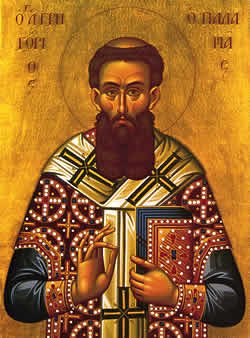
St Gregory Palamas

St Gregory Palamas

Another great Father of the Eastern Church is, of course, Gregory Palamas. Like Maximus the Confessor, the Transfiguration of Our Lord was at the very center of his theology. The vision of the Divine Light of Tabor stands at the epicenter of his theology, permeating and informing his every word. Many of the Fathers wrote about the meaning of the Lord’s Transfiguration before him and he regarded himself as but a faithful exponent and continuator of their spiritual theology. None, however, integrated the Taborian theophany into the very fabric of their theological vision in quite as comprehensive a way as he did. It is, indeed, this all-encompassing Taborian perspective which truly constitutes his greatest contribution to the subject and which justifies the   Eastern Church’s appellation of him as Theologian par excellence of the divine Light of Tabor.

Gregory’s fundamental concern, evident in all his works, is to affirm that even in this present life man is called to work for an unmediated communion with God Himself. Prayer is at one and the same time the chief means by which this communion is attained, and, in its truest form, the communion itself. Prayer as the true communion with God, prayer as true theology, is nothing less than the face to Face encounter with the theandric Christ, resplendent in His pre-eternal and divine glory as He was revealed to His three disciples on Mount Tabor.

For Gregory the divine Light of Tabor is unequivocally uncreated. It is a light, therefore, but a light that is radically unlike any created light known to man. Though perceptible to both the senses and the intellect, in the human experience of deification the Uncreated Light of Christ transcends every aspect of our createdness, including the human senses and the human intellect. Hence it is both suprasensible and supra-intellectual. Gregory accuses those who wage war against the Light, that is, those who consider the Light to be both sensible and created, base their understanding not on Scripture and   Sacred Tradition but on the rational word of the Greeks, on the wisdom, that is, of the world.

So what he is saying is that as we grow deeper in our relationship with God, the Light we experience is beyond human understanding. The saints have told us of their experience of God as an over-whelming feeling of being totally enveloped in a field of intense light. This same experience is reported by those with near-death experiences.

The Spirituality of the Christian East — 20151011

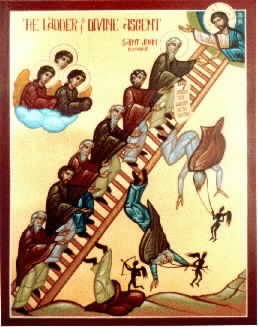
In this article on Eastern spirituality I have been sharing thoughts about the various steps on St. John Climacus’ Ladder of Divine Ascent. I have already completed eight of the steps. The ninth step on the Ladder is:

Ladder of Divine Accent

REMEMBRANCE OF WRONGS/MALICE.

St. John tells us that there is nothing more destructive to spiritual life than the remembrance of wrongs. It is, in fact, a complete contradiction to the imitation of God: “If you, Lord, kept a record of sins, who could stand?” (Psalm 129/130:3). It is the exact opposite of forgiveness. In the Lord’s Prayer we ask: “Forgive us our debts as we forgive our debtors”. When a debt is cleared, it is erased, as though it never existed. This is how God forgives us. He tore up the record of our sins on the Cross. They were drowned in the water of baptism, and they are washed away in the tears of repentance. If we refuse to forget wrongs, then we have not     forgiven as God forgives – we are still “keeping a record” of sins. We must ask ourselves this: Do I think that I am better or greater than God? Is the offense given to me greater than the offense I give to God when I commit hateful acts? It is clear, then, that if we go on marking iniquities, God will mark ours too.

The remembrance of wrongs is the fruit of unhealed anger. When we have mastered and purified our anger, wrongs will be forgotten.

Hopefully my readers can see, through this example, how the Ladder is meant to work. We must perfect each step before we can go onto the next step.

St. John tells us: Let your malice and your spite be turned against the devils. We are to redirect our anger against sin and evil, above all against our own sins and spiritual failings.

I shall share more information about this ninth step in the up-and-coming Bulletins.

Reflections on the Scriptural Readings for this Weekend — 20151004

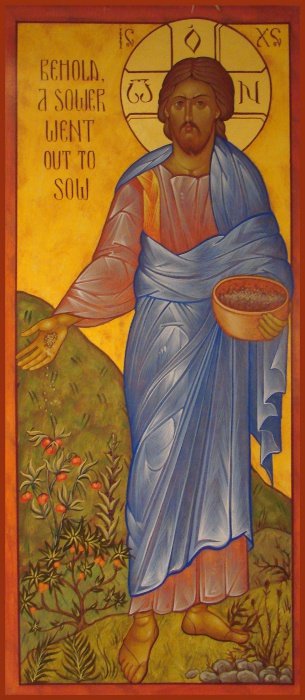
ChristSowerofSeedsAccording to Luke, the Apostles asked Jesus about the meaning of the Parable of the Sower. Jesus responded saying: The seed is the word of God. He then went on to say that the ground in the parable was a metaphor for the hearts, minds and souls of people who hear God’s word. Jesus then concludes His explanation by saying: The seed on good ground are those who hear the word in the spirit of openness, retain it, and bear fruit through perseverance.

Think about the Lord’s explanation. A person’s heart, mind and soul only become the good ground in which the Word of God can grow when there is one primary condition, a spirit of openness. One has to be open to the Word of God, believing that God’s Word brings truth about life and clearly reveals the way that life should be lived.

It must be admitted, all of us initially have, because of our life experiences, certain blocks to such openness of spirit. Most frequently these blocks are found in the attitudes we have about life and others. Frequently our attitudes are influenced by our society. It seems that our society promotes the stereotyping of others and freely makes judgments about what others believe and how they act. For example, currently our society, because of some of our experiences, promotes fear of others who are not like us. While this is natural, such attitudes block our openness of spirit, making it impossible for us to truly hear the word of God, retain it and, with perseverance, bear fruit because of it.

In order, therefore, to achieve this openness of spirit, we must identify the attitudes and thinking that blocks a real openness to God’s Word. While it may seem, to some a truly impossible task, we know from Paul’s words that God’s help is sufficient to achieve such openness. All that is initially needed is a true desire to embrace the WAY of Jesus – a true belief that the WAY of Jesus is the WAY to live.

So, perhaps a question is in order: Do I believe that Jesus is God’s revelation to me with regard to how I should live in order to have the fullness of life? If I don’t believe that Jesus is the WAY and the TRUTH about human life, then I will never hear His Word with an open spirit.

An openness of spirit is achieved only when there is a willingness to love others as ourselves; a desire to refrain from judging others; a real commitment to do unto others as we want them to do unto us; and a firm resolve to forgive others without placing any conditions on our forgiveness. May we truly have an openness to God’s Word.

CALLED TO HOLINESS — 20151004

I ended this article in the last Bulletin with the statement that it is my belief that the Call to Holiness is truly a call to find our true self. I shared that Christians have for ages misinterpreted the words of Jesus, thinking that He suggested that we must never express who we really are, our true selves.

How sad for us and for the world. It is sad for us because we never find out who we are and because we think Jesus asked us not to, and so we mistakenly think that by living this way we are the essence of Gospel-people. And it is sad for the world, because the world looks at us and says (in a certain sense, rightfully so), “If that is what it means to live as a Christian, I don’t want it”! For all they see are people who do not know who they are and therefore cannot be real people or make a significant contribution to life. They see people who look as if they were the living dead both emotionally and spiritually, and who are proclaiming that the Gospel has done this to them. Indeed God only wants us to find our true self, the self He chose to create.

Christians who live with the notion that God doesn’t want us to find our true selves, cannot have much energy for service or for spreading the Good News, because most of their energy is unavailable to them. For the essence of life itself, spiritual life, abides in our new selves, which God gives in Baptism. And so, if we are not in touch with our true selves. We are not in touch with the principle of life within us. Such Christians have only enough psychic and spiritual energy then to make their way through each day. They think that their energy is being sapped by the difficulty of living their faith, but the truth is that they have little energy because they are not living according to the totality of the faith that Jesus taught.

I think even good people, those who desire to have a relationship with God, can be zapped of their energy if they think that God expects them to adhere to a whole bunch of rules and is only waiting to catch them doing something wrong.                 What do you think?

Gaining a Deeper Understanding of the New Testament — 20151004

saintlukeScripture scholars maintain that Luke used Mark as a major source, as did Matthew, but in a different way. He included less of Mark – about 65 percent compared to Matthew’s 90   percent. And, rather than taking over large blocks of material from Mark and editing them only lightly, as Matthew most often did, Luke wove material from Mark together with his other sources. But his basic story line follows Mark’s threefold pattern of first Jesus’ activities in Galilee, second His journey to Jerusalem, and then, Jesus’ final days in the city of Jerusalem. Interestingly Luke expands the journey section from roughly three chapters in Mark and Matthew to nine chapters.

Like Matthew, Luke combined Mark with Q, editing and shaping both. In addition, again like Matthew, Luke has several hundred verses that are only in his gospel. Sometimes called special Luke, or simply “L”, this material includes stories of Jesus’ conception and birth and parables like the Good Samaritan, the Prodigal Son, the woman and the lost coin, the Pharisee and the Tax Collector, the Dishonest Steward and the widow and the unjust judge.

Luke shares the story of the empty tomb with Mark and Matthew. He also adds his own Easter stories, the most famous of which is Jesus appearing to two of his followers as an unrecognized stranger on the road to Emmaus. The gospel concludes with an ascension story, as does Matthew. But in Luke it happens just outside of Jerusalem, whereas in Matthew it occurs on a mountain in Galilee. Thus, even as Luke and Matthew both proclaim that Jesus is risen, they narrate this shared affirmation in different ways and place it in different locations.

Luke begins with two chapters about the birth of Jesus, as does Matthew. But they tell the stories in very different ways. Recall that Matthew’s is dominated by King Herod’s plot to kill Jesus. It echoes the story of Pharaoh’s attempt to kill Moses as an infant before the exodus from Egypt. It sets up Matthew’s theme of Jesus as the new Moses, the gospel as a new Pentateuch (the first five books of the Old Testament – the Torah) and what happened in Jesus as a new Exodus.

You will recall that our Easter Matins Service refers to Jesus as the new Moses and His resurrection as the new Exodus. Since the evangelists truly believed Jesus to be the awaited Messiah, He had to be the new Moses.