Gaining a Deeper Understanding of the New Testament — 20150823

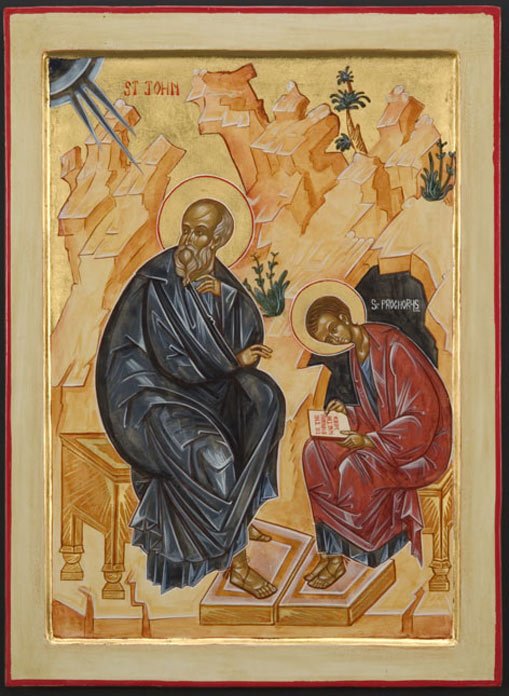
John the TheologianHopefully my thoughts on 1 John has encouraged my readers to pick up their bibles and read that short letter. You will not be disappointed.

Having concluded my comments on 1 John, I would share some thoughts on 2 John.

Unlike 1 John, 2 John has the characteristics of a typical New Testament letter. It begins by naming the sender, the elder, and recipient, the elect lady and her children. It continues with a greeting and a thanksgiving followed by a brief body and then a closing. It is very short, only thirteen verses. I would recommend my readers to read this.

The body has two themes, both sounded in 1 John as well. The author reminds the recipients not of “a new commandment,” but one they have known “from the beginning”: Let us love one another. Then the author refers to “deceivers” who “do not confess that Jesus Christ has come in the flesh” and then calls them “the antichrist.” These similarities to 1 John are the reason that many scholars think 2 John was written by the same person. There are others who discern subtle differences and conclude that it was written by someone else. In either case, it comes from about the same time period – around 100 CE or slightly later.

Especially interesting is the address in very 1: to the elect lady and her children. In verse 5, the author calls the recipient dear lady. At the end, the author sends greetings from the children of your elect sister. For centuries, it has been taken for granted that elect lady and elect sister refer to Christian communities, just as the church in the New Testament is occasionally referred to as the bride of Christ. This, of course, comes from the Old Testament which refers to Israel as the Bride of God.

The natural meaning of this language in 2 John is that the author is writing to a woman who is the leader of an early Christian community. The closing greeting from the children of your elect sister suggests another Christian community headed by a woman. Thus the letter may provide evidence for women in leadership roles in Johannine communities, consistent with what we see in the genuine letter of Paul.

This second letter, like the others, treats a specific problem. Missionaries who were determined to be heretical, were about to descend upon the community. They denied the reality of the incarnation of Jesus.
Smart and Stupid Ways to Think About God — 20150823

Picture1The fifth stupid way to think about God is GOD THE GENERAL. This way has God saying to all of us: Stand at attention. I am your God. I am Lord and Commander. I will not give one hoot for losers. You got that?

Greetings! You have been drafted into one of the stupidest ways of thinking about God. Say good-bye to the kids and kiss the little woman for the last time. It’s off to battle. He’s got might. He’s got right. He is General God!

He’s a nationalistic god, whose holy mission is to serve his country, protect its honor and defend its citizens. But don’t be swept away. This not merely a god of defense, though he is often justified that way. General God is a self-righteous and meddlesome god. He is not content with holding his position. He wants to advance, and advance, and roll into any nation, at any time. To shove his views down your throat. To purify the earth of all infidels.

This is General Madness, a territorial maniac. He is a mercenary who can be employed by any nation for any cause. He is the commander of crusades and the leader of jihads. He guides kamikaze pilots to their death. He makes the world safe for democracy.

But he does not interact in history to establish moral law. Instead, he infects history with violence.

Yes, General God becomes a symbol of unity for a few. He exalts some people and drive others apart. He is exploited by governments to mobilize consciousness en masse. He turns ideology into sacred theology.

This god grants us strength and exalts our ego. He causes us to treat our enemies as subhuman and teaches us to love our inhumanity.

This is hardly a god. This is a man-made expedient – an idolatrous creation whose job is simply to help us win, militaristically or economically. He is a warrior exhorting us to conquer for our country, in wars or in markets.

How wonderful it would be if we could indeed contain our moral dilemmas by force. How easy it would be to give up choice and just salute. How whole we all could feel if our divided loyalties could fuse into one truly, divinely inspired movement. People, nation, and god advancing together as one front, behind one flag – behind a swastika.

But in the end this god only leaves us dismayed by our destructiveness. Debased by our own primitive behavior. And all too often, we find ourselves godless.

General god is a god who hates to lose. A god who, upon defeat, hides in a bunker until national pride surges again.

Can we not dispose of this idea of God in the latrine once and for all? Can we not stop worshipping in the church of the Purple Heart? We will never find a different god unless we go AWOL from General God!

August 16, 2015

resurrection_iconOn this twelfth weekend after Pentecost, the combination of readings that are assigned present an interesting but also very poignant message. In the section from Paul’s 1st Letter to the Corinthians, he presents the idea of the importance of the Resurrection of Christ. In the portion from Matthew’s Gospel that is read, the real issue of the danger of worldly riches is addressed. What type of coherent message can we derive from these two readings?

Let me first address the Gospel message. The topic of the danger of worldly riches is presented in the following context. A rich young man asks Jesus what good he must do in order to possess everlasting life. Jesus first tells him that he must keep the basic commandments. The young man replies that he is already doing that and wants to know what he must do in addition to keeping the commandments. Jesus   simply tells him that if he wants to have the fullness of life he should sell your possessions, and give to the poor so that he might have his treasure in heaven.

The young man, because he is rich, goes away sad for his possessions were many. He was still too tied to the things of this world to be able to seriously deal with his spiritual life. In effect he was asking Jesus: How can I be holy without really changing my life. In effect he wanted his cake and eat it too.

To be holy requires real change! It requires that we give up in our hearts and minds the things of the world and concentrate our attention and efforts on storing up treasure in heaven.

This is difficult for most people to do. Like the young man, many would like to be holy without changing and without detaching themselves from the things of this world. A part of it, I think, is the fear of what will happen to us if we do direct all of our   attention to storing up our treasure in heaven. Will we have to give up all the things of this world?

The reason why Paul’s message is very valuable in this context is precisely this: the fact that Jesus rose from the dead is true proof that living like He lived is the way God intended humankind to live in order to have the fullness of life.

The biggest question that most people ask is this: Do I really have to give up all that I have and give to the poor in order to have fullness of life? The answer is that what we have to give up is our attachment to the things of this world. When we think more about the things that we have than about how we live, we cannot possibly experience the fullness of life.

It’s our choice!

Further Thoughts About the WAY of Jesus — 20150816

4Ev-MariaLaach

The more I think about it, the more I am convinced that the WAY of Jesus calls us to a life which truly spurns attachment to the things of this world. Why? Because when you think about it, the things of this world truly burden us and bog us down from truly storing up our treasure in heaven.

One of the things that I find very, very interesting is what so many older people do. They try to divest themselves of the things of this world. I also find myself trying to get rid of all the things that only clutter up my life. When I think about all the books that I have collected over the years I realize how very stupid I have been. I am now spending time to get rid of the books and it is a chore. I also think about our most recent rummage sale. We had books galore. We can’t even give them away. Nobody wants books any more. And, I will confess, they are a pain to move. I think about how many I have already moved and I wonder what I have been thinking. And they’re heavy to move.

So Jesus tried to teach us something that is really important. Don’t get so attached to the things of this world. You can’t take them with you when you die and they are very difficult to deal with when you get older. What sage advice!

Also think about this. When you have amassed a lot of stuff, you spend time thinking about how you can protect the stuff from being stole. The energy alone that we put into securing our stuff could better be directed to thinking about what we can do to build our relationship with God. That was really the point of today’s Gospel story, wasn’t it. Jesus was telling those who came to Him that the things of this world can keep us from dealing with what is important in life, our relationship with God. He was not saying that the things of this world are bad. He was telling us how we relate to the things of this world can detract us from giving ourselves to what is important in this life.

It is also important, I think, that we consider what St. Paul says to us in this weekend’s epistle. He clearly states that he is what he is by and through God’s favor. I wonder how many of us ever think about that. We are who we are because of God’s favor. God has given us so very much of Himself to us. So why do we cherish the things of this world? I think it is because, in some way, we want to hold onto this worldly life. Are we afraid of the future beyond death? St. Paul reminds us that there is life beyond the grave. Jesus revealed that to us!

Think about this!

Smart and Stupid Ways to Think About God — 20150816

Picture1The fourth smart way to think about God is God Is the Creator of Creators. So God, being creative as He is, kept His hands busy until one day, a trifling million years ago, a new species appeared. It didn’t look all too different. I was a little less hairy and seemed a little more   comfortable standing on its hind legs. But it still had a backbone, a protruding jaw, a bulging forehead and opposable thumbs. Like a chimpanzee or a gorilla. Yet this ape was different. Its brain was larger and its frontal lobes were more pronounced and, most importantly, it had a more advanced consciousness. It was not just conscious but also self-conscious – aware of itself. Indeed, this consciousness was so highly evolved it could be said to resemble God’s. To be created in His image.

Like God, man is intelligent. He can understand himself and the things around him. His intelligence allows him to extend dominion over the whole planet and even into the solar system. It allows him to influence life and even tinker with the genetic code.

Like God, man is also creative. He invents and builds. He makes objects in his own image. He, like God, is a creator. And, like the Creator Himself, man possesses a quality that is truly godlike. The true source of his dignity and his   suffering is his free will.

He is relatively free to make choices and he can determine what he wants to do, or not to do. He is not totally a slave to his animal instincts. He doesn’t live just for food or shelter and can strive for something far less concrete. He can, like God, even live for higher truths, nobler ideals and, even if they’re unattainable, he will work relentlessly toward them. He will strive to “reach that unreachable star”.

He is, however, also free to ignore lofty ideals. He can devote his life to fattening his wallet and truly create his own hell.

Yet all too often man feels the strain of this burden of free will. He can feel alienated from himself and others. He feels a separation between the ideals he can conceive and the reality he lives. In this distance from himself, man can feel even further separated from the ultimate ideal: the Goodness of God.

We all must admit to this inner sense or feeling of separation and alienation. There’s a gulf between our thoughts and our actions – between God and us.  And whatever you call it, it exists. Its real.

So it, too, must be part of creation. Does God have something in mind? Either He has, or He’s not only created a creator, but a lot of problems too. He’s actually created a creator who can freely come to know, love and serve Him and truly be His child.

The Spirituality of the Christian East — 20150816

The seventh step on John’s Ladder is MOURNING. Remembrance of Death, the sixth step, when truly understood and acquired, leads to mourning. It must be understood, however, that the mourning John talked about is not the kind to which we are accustomed – that is the sadness we humans seem to experience at the death of a loved one or a traumatic or difficult experience which brings   tears to our eyes.

The tears that John envisioned are those that are a gift from God when a person realizes how very much s/he is loved by our Creator-God and how unworthy s/he is of that love.

Tears are not always a sign of true recognition of this truth. Sometimes we cry not because we have realized this truth but because we feel sorry for ourselves. Sometimes we cry because we fear punishment or are ashamed and embarrassed.

Those who are truly humble and have come to a point in their lives when they truly understand what it means to be unconditionally loved despite their self-centeredness, are the ones who have been given the gift of mourning and tearfulness. These people are most frequently unaware that they have reached this step on the ladder. We must recall that it is for this reason that saints never believe they have attained sanctity. Humility is tricky! True humility makes it impossible to think that we are making any progress in humility. True humility understands that, although we do not deserve to be loved so very completely, we are loved in that fashion by our God. Recognizing that we are so loved can only bring tears to our eyes.

While it is true that few probably ever acquire the gift of tears, this is not to say that the tears we shed for our sins are worthless before God. These tears are the beginning of true humility and bring us closer to God.

The Divine Liturgy and Our Worship of God – 20150816

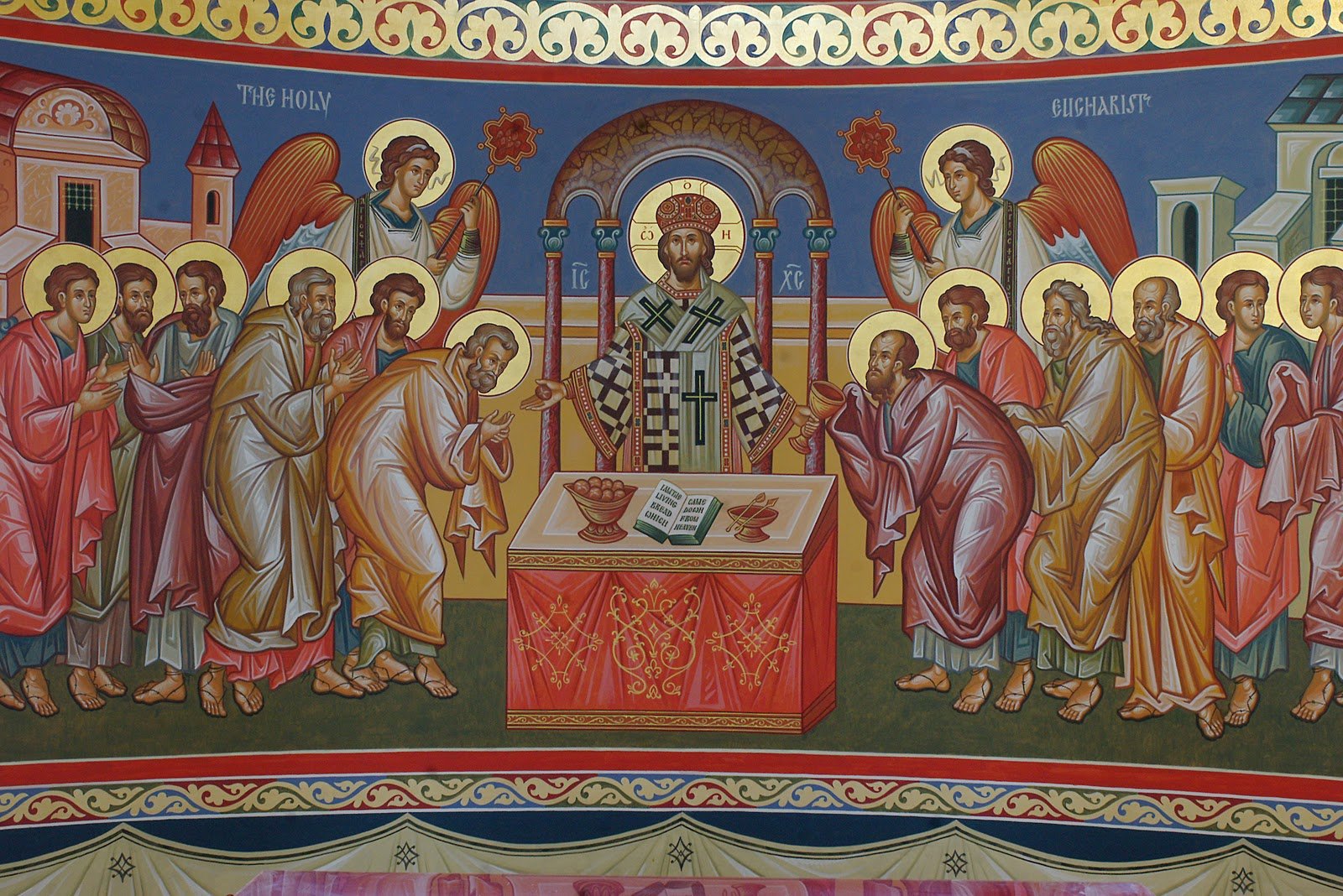
Holy Eucharist IconHaving just thought about the Hymn to the Mother of God which is included in the Anaphora of the Divine Liturgy that we use to worship God, we now turn to the commemorations of the deceased. I cannot exhort and encourage you enough to use the time at this point of the Liturgy to remember the deceased who are a part of your life. Even if the celebrant does not call the faithful to remember the deceased, I truly believe that it is important that each of us do so. We must remember that all those who have gone on before us are called to pray with us during the Liturgy. I would exhort all to remember the deceased by name. That makes them real and they become present to us in a real way.

The remembrance of the deceased is included in our Liturgy because, since there is no time in eternity, they are present with us worshipping Almighty God. Love demands that we remember those who have gone on before us. That connects us with them in a unique way and it makes us realize that they are truly alive in a different dimension.

Even if you attend a Liturgy where the priest does not remind you to remember the deceased, do so. Again this is a wonderful way to make our worship truly personal as well as communal. When it is personal, we are truly more engaged.

After we remember the deceased, we commemorate the Hierarchy of the Church. Why do we do this? If you will remember, we remember them in the very first Litany that we offer.

Again this action reminds us that the entire Church is involved in our worship. It is not just our community that worships God, but all Christians that are joined with us.

Following our remembrance of the Hierarchy of our Church, we also pause and remember the living that are special to us. Like our remembrance of the deceased, we pause are remember those who are currently a part of our lives. Not just our family but also our special friends. This is a beautiful act, in my estimation and I would truly encourage all to develop a list of people for whom you want to pray. Again this is a way to personalize our worship.

After that, the priest says a very wonderful prayer: And grant that we, with one voice and one heart, may glorify and praise Your most honored and sublime name, Father, Son and Holy Spirit, now and ever and forever.

Learning Our Faith From the Greek Fathers of the Church — 20150816

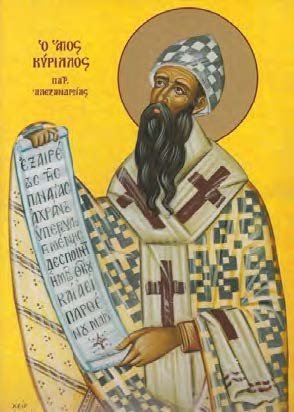
St. Cyril of Alexandria

St. Cyril of Alexandria

St. Cyril tells us that the only human person thus far to have achieved the blessed state of union with God is the Most Holy Mother of God and Ever-Virgin Mary, through whom the Son of and Word of God became flesh. St. Cyril was the first who defended the Holy Virgin as the Mother of God against the Nestorians – those who falsely taught that Christ was merely a man in whom the divine Logos dwelt. It is no coincidence, then, that references to the resurrection of the human body abound in his writings. The theme of the resurrection of the human flesh of Christ is inextricably intertwined with our appreciation of the Holy Virgin as Mother of God.

Interestingly, St. Cyril does not refer to the Resurrection but, rather, to the Transfiguration as the clearest recorded manifestation that we have of that reward, or glory, which the righteous – those who take up their Cross and follow Christ – will receive at the General Resurrection. Cyril describes this reward in terms of participation in eternal life and glory, and vision of glory. There are, in his estimation, interchangeable terms which describe the life of the Kingdom. For Cyril, the vision of Christ transfigured is perceived as a prefiguration of the participation of the saints in the glorious life of the Kingdom, which will be inaugurated at the Parousia.

What Cyril means by Kingdom is that vision of glory, in which Christ will appear at such time when He will shine upon those on earth. Cyril suggests that Peter’s words (Luke 9:33) might have been due to his mistaking the Transfiguration for the end of the world and time of the promised participation of the righteous in the Life of God. He goes on to explain that this could not have taken place at that particular time, since the redemptive work of Christ had not been completed. Man was, therefore, still subject to the power of death and corruption and consequently incapable of enduring the revelation of Christ’s divine glory.

This brings us, Cyril believes, directly to the significance of the resurrection of the body of Christ. In his commentary on the Gospel of John, he refers explicitly to the reason for Christ’s appearance to St. Thomas and to all the apostles in His resurrected human body. I will consider Cyril’s comments on John’s Gospel in the next issue

Understanding The Theology of Our Ukrainian Greek-Catholic Faith — 20150816

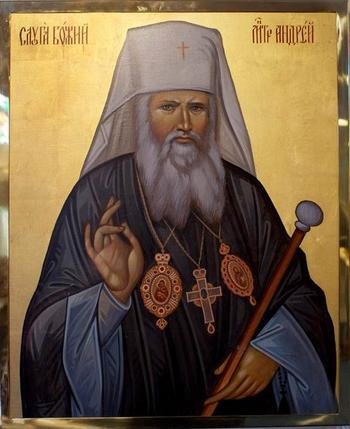
Venerable Andrey Sheptytsky

Venerable Andrey Sheptytsky

This information is taken from an article written by Dr Andrew Thomas Kania about Metropolitan Andrii Sheptyts’kyi, the head of the Ukrainian Greek-Catholic Church 1900-1944. Sheptyts’kyi’s story has been little known in the Western world until the last twenty years following the collapse of the Soviet Union. Dr Kania suggests he stands as a tall leader following the   dictates of conscience to be “his brothers’ keeper” in the protection of Jewish people from State persecution. Dr. Kania’s asked whether the model of spiritual leadership that Andrew presented is a model that has the power to attract people back to the Good News, given the particular challenges faced in the West as it might have had in the particular circumstances faced by the Ukrainian people in the 20th Century?

Recent years have seen an enormous degree of criticism leveled at the apparent apathy of the Catholic Church, and in particular Pope Pius XII, toward the Jewish communities of Europe who suffered enormous horrors in what historians call “The Holocaust”.

In numeric terms “The Holocaust” is only surpassed in the 20th century by Stalin’s plan of extermination for the Eastern Ukrainian people known as the “Terror Famine 1933”.

“The Holocaust” set the stage not only for tragedy and depravity, but also for great acts of heroism, such as was shown by Raoul Wallenberg, and Oskar Schindler. Until Ukraine won its independence at the beginning of the 1990’s, it was impossible to fully create a portrait of another individual of great courage who risked his own life, to not only counter the evil of fascism but also that of communism. This man was Metropolitan Andrii

Roman Aleksander Sheptyts’kyi was born on 29 July, 1865 of an aristocratic family in Prylbychi, Galicia (in present day Ukraine). Entering this world a number of months after the death of Abraham Lincoln, Sheptyts’kyi became Head of His Church at the turn of a new century, when the automobile was beginning its replacement of the horse and cart. He died with the sounds of German and Soviet tanks trampling his homeland, when the world would soon hear the thunder of the Atomic bomb.

Although baptized a Catholic of the Roman Rite on determination of his father Jan, Roman’s family could claim among their familial predecessors no less than two Eparchs and two Metropolitans.

During the coming weeks I shall share more about Metropolitan Andrii. He is a great figure in our church’s history.

CALLED TO HOLINESS — 20150816

Universal Call to Holiness

Universal Call to Holiness

In the third stage of spiritual development, a person starts to think about God more in terms of the proper rules and regulations that must be kept in order to have a good relationship with God. This, of course, parallels what a child goes through in life. The “good” child follows the rules of his/her parents and the “bad” child breaks them. So one’s relationship with God is centered around obeying His rules. He is the judge ready is think about the child as “good” or “bad”. Rules and commandments are taken with deadly seriousness. This is fine as far as a child is concerned, because a child seems them as the true and correct rules taught by parents, teachers and clergy who are smart. They also falsely learn that the one true way to please the one true Christian god is by keeping all the rules.

The problem is, however, that this way also doesn’t allow the development of a true relationship with God. When God does not send down an immediate punishment upon the child for not keeping the rules (much as parents do), then the rules begin to lose their power of control.

Think about it. When we were children we did things, even without the awareness of our parents, that were wrong and, according to this thinking, deserved punishment from God. When, however, punishment did not come, we began to question the rule that we broke and wondered whether what we had been taught was true.

The fact of the matter is that God does not spend time punishing us for the things that we do wrong. Of course some people believe when they get sick or fail at something that it is punishment from God for the things they did wrong. This, of course, is not true even though a person might feel that it is.

If this mystical level of consciousness sounds familiar, it should, because: (1) all of us went through this level during a period of childhood that we still remember and (2) parts of most Christian adults’   consciousness are usually still stuck at this level. True spiritual growth moves us beyond this level.