August 9, 2015

 My heavenly Father will treat you in exactly the same way that you treat your brother!
 Dormition of the Mother of GodThe poignant message we hear in the Christ parable shared in today’s Gospel is that God will treat us exactly in the same way that we treat our brothers and sisters. It is therefore our real behavior towards   others that determines our relationship with God.

This is one of the new aspects of Christianity. Jesus explicitly stated that our relationship with God is directly dependent on our relationship with other humans.

Prior to Jesus and even to this day, people have the false belief that they can have a relationship with God but hate their fellowmen. Jesus came to reveal to us that, because God is the life-force which animates all living things, how we treat other living things, especially our fellowmen and women makes all the difference. We cannot love God, says St. John, and hate our neighbors. This is truly the break-through made in human history and in human thought.

The problem truly is, however, that very few people truly believe this. There are more wars being fought in our world today because of religion. All of God’s attempts to change the hearts and minds of people to live like His children seem to have impacted very few.

We, of course, can be different. We can hear the message of Jesus and decide, despite what others in our society say, feel or do, that we will embrace the WAY of Jesus and not surrender to the mores of our society or its values.

Yes, this will make us marginal people! Yes, this will open us to ridicule by those who do not believe in God’s revelation through Jesus Christ. But, it will make us children of God.

Of course we have to believe in the truth of the revelation of God through Jesus. If we don’t truly   believe that God became incarnate in the Person of Jesus, then none of this means anything. We just embrace the values of our society and forget about the teachings of Jesus.

I, for one, would rather be in sync with Jesus, Who I believe is God incarnate, than all of the people in my society who may not have the foggiest idea about an after-life or the meaning and purpose of life. I find that many people only think about life as it is right now. They don’t think life is eternal and don’t think that we have been put on earth to learn how to be children of our God-Creator.

I won’t take that chance!

Understanding The Theology of Our Ukrainian Greek-Catholic Faith — 20150809

Understanding The Theology of Our Ukrainian Greek-Catholic Faith — 20150809

August in our Church is, probably one of the liturgically more intense months of the year in terms of the individual feasts that we celebrate. There are three major feasts during this month:

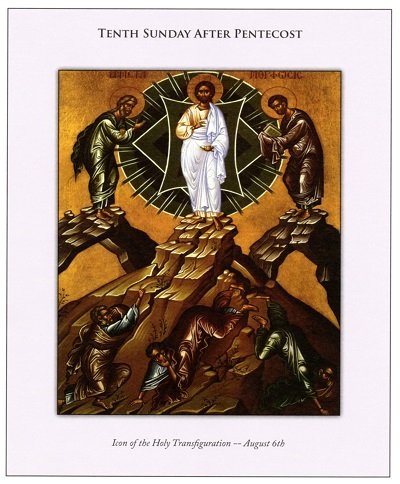
The Transfiguration of our Lord, August 6th

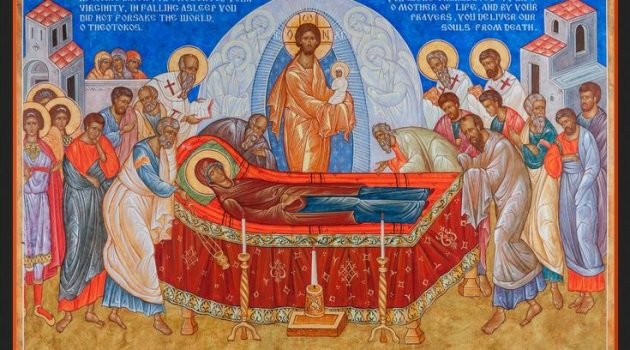
The Dormition of the Mother of God, August 15th

The Beheading of John, the Baptizer & Prophet, August 29th

These three feasts honor the major persons in our Christian history.

Last week we celebrated the feast of the Transfiguration of our Lord. Next weekend we celebrate the Falling Asleep or Dormition of the Mother of God. Then at the very end of the month we remember the Beheading of John, the Baptizer.

Of these three feasts, one, that is the Dormition of the Mother of God, has a fast connected with it (August 8th-14th). Each of these feasts explicitly reveal to us something about our faith.

The Transfiguration reveals to us that God is the life-force within us. The Dormition reveals to us that human life is eternal. The Beheading of John reveals to us the importance of living in accord with what we say we believe. All three serve as an encouragement to us as we attempt to discover the meaning and purpose of life here on earth.

This highlights the fact that our Church not only remembers a saint almost every day of the year, but also a number of major feasts that can help us understand our religion and the   revelation of God.

It is important to understand, if we belong to a particular religion and Church, that religion is all about helping people discover the meaning and purpose of human life. We are not just the result of an accidental happening in the universe and exist without any real meaning or purpose! We are not alive for just a limited number of years and then fall into complete non-existence. Rather there is a reason why we are here and why earthly life is like it is.

The various Feasts and Saints of our Church share with us this belief. We see in the feasts the things that happened to people who helped formulate our religion. We see in the remembrance of the various saints how other humans have responded to the challenges of life, and hopefully, gain courage to meet the challenges of our lives.

All things in our Church, our calendar, our services, our dogmas and our doctrines are all meant to help us find the meaning and purpose of life. As I have shared before, people find it more important to find meaning in life than happiness. True happiness comes with finding meaning and purpose.

Further Thoughts About the WAY of Jesus — 20150809

4Ev-MariaLaachAs I again prepared another sermon, I thought to myself: What a loving God we say we believe in. He loves us so very much that He went to great lengths to show us how to live so that we can gain the greatest benefit out of this earthly life. I say this because I am thinking about the WAY He showed us how to live. He actually came Himself in the Person of Jesus and went through the struggles of life and showed us how to handle them. He didn’t complain how His life turned out and didn’t insist that life be exactly the way that He wanted it to be.

Now I know that many will immediately say: Yes, but He was also God and so He could live the way that He lived. This is always the typical response of people who don’t want to change and feel that the challenges they have to face in life are unfair. They stress Jesus’ divinity so that they don’t have to be challenged to live like He lived.

Our Church clearly tells us that Jesus was truly and fully man as well as being truly and fully God and that His divinity did not dictate how He lived His life. If it did, then He could not be a model for us.

Jesus lived His earthly life as a man in order to show us how to live. He found the strength to confront the challenges that life presented by faith, prayer and fasting. His divinity did not lessen the pain He felt from being: abandoned by His friends; frequently misunderstood; unjustly accused; cruelly tortured; and painfully killed! His belief in a loving God, plus the way He lived His life allowed Him to courageously face these challenges with nobility and grace. He showed us how to accomplish this in our own lives.

One of the things that He taught us was that our attitudes about God, life and others makes a difference. When our attitudes are like His, then we have the power to face the challenges of life with nobility and not spend all of our time   trying to escape them.

One of the attitudes that He had was that life provides us with what we need in order to grow in our likeness of God. He also thought us, which was made very explicit by St. Paul, that we are the temples of God’s own Spirit, and thus have the power within us to live like Jesus lived. It truly depends on how we think about life.

When we begin to see that this earthly life is give to us in order for us to learn how to be children of our God-Creator, then things change. Ask yourself: What do I see as the meaning and purpose of life?

CALLED TO HOLINESS — 20150809

In this article I have begun to share with my readers some thoughts about the stages of spiritual development. Being called to holiness, I believe that it is important to know the stages that we must go through in order to achieve the personal holiness which life is meant to help us develop. I am suggesting that the stages of spiritual development are akin to the stages of consciousness development.

The first stage of spiritual development requires that we move away from being self-centered to becoming other-centered. To have any sort of relationship, whether with God or another person, we have to be other-centered. Self-centeredness gets in the way of any true relationship.

We know that about the age of two, another spiritual passage beings in earnest. The infant’s mind begins to emerge as something separate from its physical/emotional being. The use of symbols begins about the age two. At this time the child develops a magical consciousness. The magical thinking typical of this level includes the polytheistic world of gods, demons, fairies, and other creatures that inhabit the young child’s inner world.

In terms of spiritual development, in this second stage the tendency is to see and think about God as someone who can rescue us from the challenges of life. It is hard for a person, in this stage, to separate their idea of God as being the one who makes all things in life happen and the one who can change all things in life. At this stage, people tend to ask God to rescue them from the more serious challenges of life instead of asking God to help them live-through and nobly deal with the challenges. Since God is seen as all powerful, He should be able to rescue us from the difficulties and struggles of life. Unfortunately great disappointment can result when a person discovers that God is not a life-saver or rescuer.

Learning Our Faith From the Greek Fathers of the Church — 20150809

There is another outstanding Greek Father of the Church whose writings we should all be aware of, that is St. Cyril, the Patriarch of Alexandria. He wrote much on the resurrection of the human body.

It has been said that unless Christ was raised from the dead, unless the tomb of the Lord was found empty, the Christian message would indeed be useless. St. Paul actually wrote this: If Christ be not raised, your faith is vain.

But why do the saints and the Fathers speak about the Resurrection in such uncompromising terms? Quite simply, because if the Lord’s Resurrection is merely a beautiful metaphor, then they also which are fallen asleep in Christ are perished, and we are of all men most miserable, for nothing but death and corruption – nothing but non-being – would await us.

Christians know that Christ is risen; and they know that His Resurrection signifies our resurrection and so         together with St. Paul they affirm that now is Christ risen from the dead, and become the first-fruits of them that slept. For as in Adam all die, even so in Christ shall all be made alive. The Resurrection of Christ the New Adam, then, is a foreshowing of our own resurrection, of our intended place in the Kingdom of Heaven.

However, within the mystery of Christ’s glorious Resurrection is also contained the mystery of the way in which we have been called to share in the very Life of God the Holy Trinity; and it is here that we arrive at the fundamental doctrine of the Church concerning the resurrection of the body.

Put simply, the whole of our humanity – body as well as soul – has been called to live eternally with God. This is the significance of the salvific work of Christ: that by His Incarnation, Crucifixion, Resurrection and Ascension, Christ has raised human nature to the right hand of God the Father, to the level of Divine Being.

Fundamental to Eastern theology, God came in the Person of Jesus in order to reveal to us how we might cooperate with His grace (help) in order to become more unto His likeness, having been made in His image. As I have shared with you, the Eastern Church teaches us that God, having given us free will, has, through life, also given us opportunities to grow in His likeness – to live like Jesus!

The Spirituality of the Christian East — 20150809

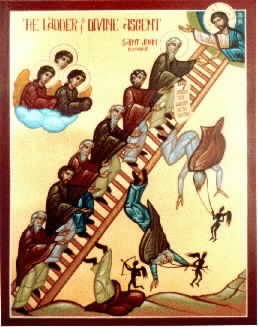
Ladder of Divine AccentI would finish these thoughts on the sixth step of the Ladder, Remembrance of Death, with these few additional comments.

When we remember death, life is put into perspective. We will not waste our time on things that are not good and profitable for our souls. We won’t sweat the small stuff, to use a modern idiom. This is why St. John wrote, No one who has acquired the remembrance of death will ever be able to sin. Our worldly desires are mortified when we remember that death is at the door. At the same time we seek all the more urgently to do good. When people know they have only so long to live, they begin to get their affairs in order: they prepare a will to dispose of their things and seek to be reconciled with those they have fallen out with.

The saints lived each day as though it were their last, and so they always sought forgiveness and reconciliation, they gave away their possessions to the poor, and they spurned the pleasures of life.

Thus the remembrance of death does not mean giving up on life, but living life the way we ought to. It pushes us to do good, and it keeps us detached from the things of this world. Thus it liberates us from the shackles of earthly cares.

It has been said that the person who has died to all things remembers death, but whoever holds some ties with the world will not cease plotting against himself.

None of us knows the time of our death, yet we must always be ready for it. If we live as though we are going to die tomorrow, we will be ready. We will carry out God’s teachings every day and will always be prepared for our departure from this world. We can hope that, like the Righteous Symeon, we shall meet our death with hope and joy: Lord, now You may dismiss Your servant in peace.

The Divine Liturgy and Our Worship of God — 20150809

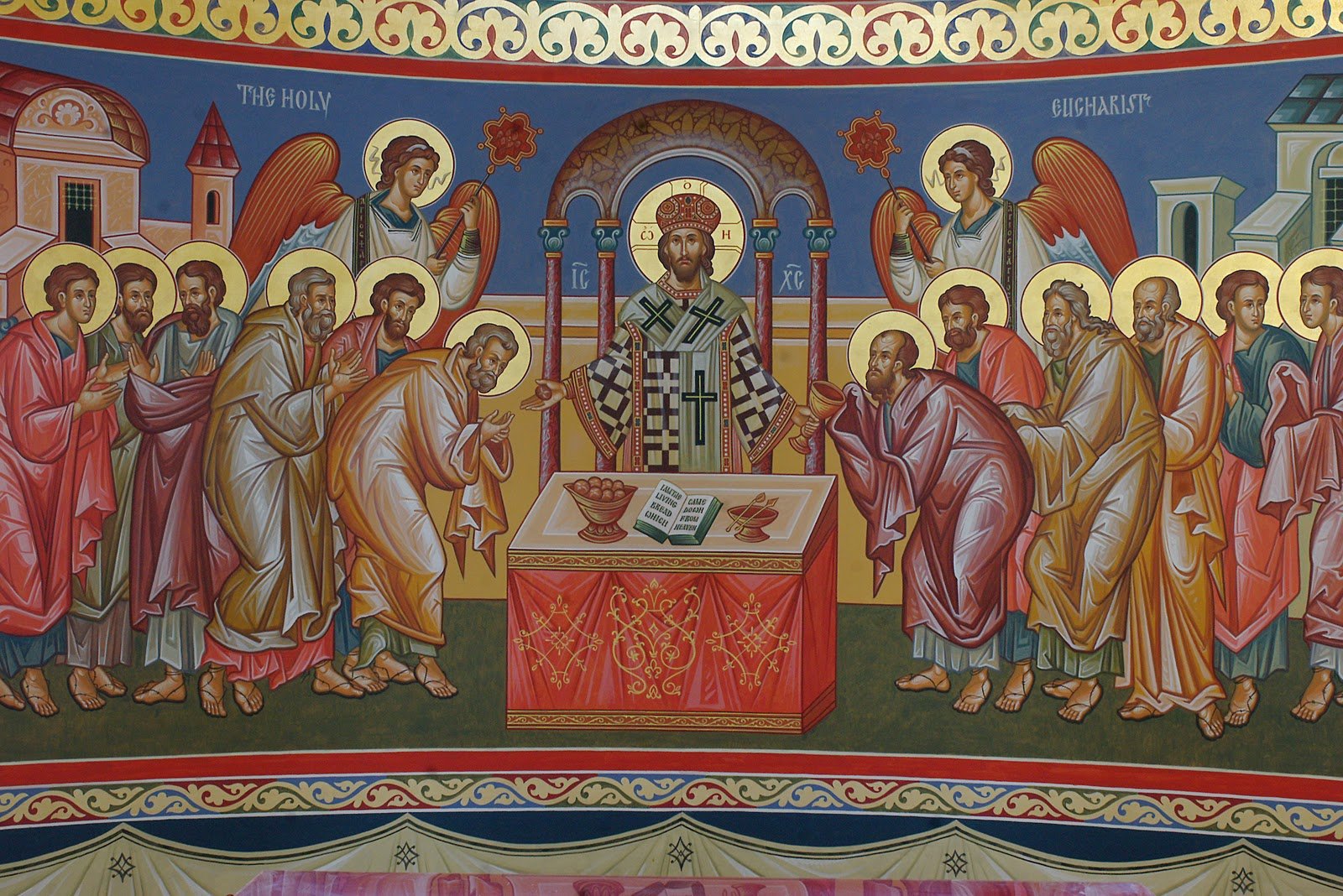
After we have prayed during the Anaphora that the Holy Trinity change the bread and wine into the True Body and Blood of Christ, we commemorate all those who have gone before us into the spiritual dimension, especially the Mother of God.

The Axion Estin, the Greek name for the Hymn to the Mother of God, is the great hymn of praise to the glorious Theotokos, found in nearly every major service of the Byzantine rites. It is believed that it was composed in the eighth century by St. Cosmas the Hymnographer. It was well over one hundred years later that this hymn was added to the Divine Liturgy, but with an added beginning as the result of the following miraculous event.

On June 11, 980 CE, as a group of monks were conducting an all-night vigil before the icon of the Blessed     Virgin Mary. They suddenly noticed a monk standing on the right of the icon whom they did not recognize at all. He was unknown to the monks and no one could explain his abrupt presence. This unidentified monk began to chant the beautiful hymn written by St. Cosmas, but rather began with the words: It is truly proper to glorify You, Theotokos, the ever blessed and most pure Virgin and Mother of God.

The monk then explained to the others that he was the Archangel Gabriel and that these words should be added to the hymn. The Archangel then vanished from their sight, leaving the monks amazed at the power of God. Since that day on June 11, 980 CE, the additional words to the hymn of St. Cosmas have been sung by all Eastern Christians around the world. The icon of the Blessed Mother Axion Esti is still venerated today in the Cathedral of Mt. Athos.

We do well to listen closely to the words that our Church places in our mouths in praise of the Mother of God. It states that we believe that she is more honorable than the Cherubim and beyond compare more glorious than the Seraphim. These words recognize that she, the Mother of God, is the greatest of all created beings. She is considered to be the greatest because she voluntarily participated with God in making His incarnation in the Person of Jesus a reality. The integration of this hymn in our Liturgy states how very   important Mary is in the history of salvation and what a profound model she is for all to imitate.Holy Eucharist Icon

Smart and Stupid Ways to Think About God – 20150809

Picture1The fourth stupid way to think about God is GOD AS THE GODFATHER. This way of thinking would have God respond to you, when you ask Him for a favor, in this fashion: So you want a favor. You say God, give me justice. Avenge my honor. But this I cannot do. I’ve known you for many years. But when was the last time you paid me a visit? You do not treat me with respect.

Slump your shoulders, bow your head, and walk humbly before your Godfather, Il Capo della Famiglia, the Cosmic Consiglieri, Don Godleone.

He’ll bless you on your wedding day. Fulfill all your worldly desires, and even maybe knock off your enemies, provided, of course, you’re willing to pay the price.

But if you’re not willing, no matter. Don Godleone is prepared to make you an   offer you can’t refuse. He   carries you, and all his godchildren, in his vest pocket. Like so many nickels and dimes.

He doles out favors with one hand and carries a submachine gun in the other. To that extent, he is more balanced than other gods you may be familiar with. He has a light side and a dark side.

But Don Godleone is hardly a good model for the Universal God. He is interested only in his Family – not the family of mankind. When you think about many religious people, despite what religion they belong to, who only think that God rewards the people of their particular religion, you are dealing with the idea of God as Don Godleone. For this god is a primitive tribal god who is jealous, xenophobic and obsessed with his own domain and who is willing to rub out anyone who dishonors him.

Such a god is worse than immoral. He is amoral and can be appeased only by fanatical displays of ritual loyalty. You must kiss his hand. You must kneel. You must huddle in the light of a full moon and make burnt offerings at his altar. You must even be prepared to sacrifice your first-born.

This is not a faith. It is extortion. A holy protection racket that mankind buys into.

Is there no god whose contract on our lives is a true covenant, worthy of respect? A god whose sense of give-and-take is bound by moral ethic? A god that does not need to be continually placated? A god with whom we can have a real, long-lasting relationship?

For although Don Godleone represents a certain advance in thought – an agreement between God and man – it is nevertheless a stupid way of thinking because it is morally meaningless.

It is time we left the Family of the Don and found a better way to think about God and His requirements. One that isn’t a cement straitjacket, a one-way ticket to the bottom of the river.

Gaining a Deeper Understanding of the New Testament — 20150809

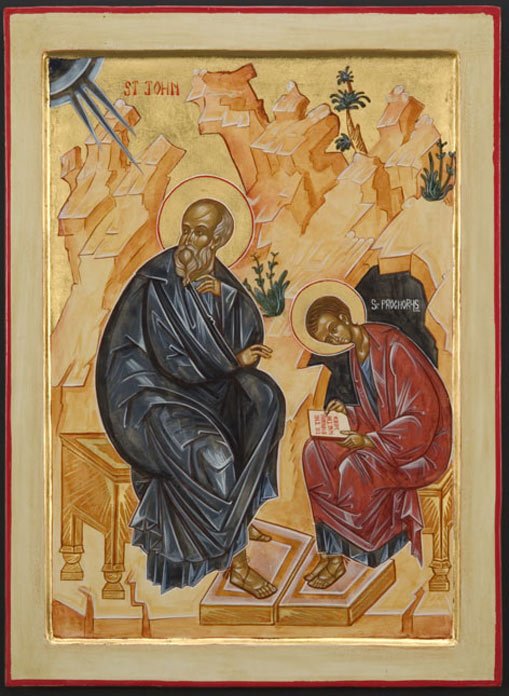
John the TheologianI have begun sharing thoughts about the first, second and third Letters that are attributed to John. Dating these   letters is truly difficult. There is a consensus that they are later than the gospel of John, most likely written around the year 100 CE. But there is no way of knowing whether all were written at about the same time or whether they might be separated by a decade or more.

Though called a letter, 1 John does not have the typical characteristics of a letter. Its introduction does not refer to the sender or the community to which it was written, and it does not end as a New Testament (NT)   letter most often does. In contrast, 2 and 3 John clearly are letters to particular individuals and their communities.

I am sure that if you read these letters, especially 1 John, you will love them as much as I do. They are truly inspirational.

The epistle is of particular value for its declaration of the humanity and divinity of Christ as apostolic teaching and for its development of the intrinsic connection between Christian moral conduct and Christian doctrine. Although the author recognizes that Christian doctrine presents intangible mysteries of faith about Christ, he insists that the concrete Christian life brings to light the deeper realities of the gospel.

With good reason, 1 John has been associated with the gospel of John from the 2nd century on. The two documents have common themes. Those themes are:

Light and darkness
*****
Word and incarnation
*****
Abiding in Jesus, God, the Spirit

*****
Eternal life

*****
Those who are born of Jesus, God, the Spirit as children of God

*****
“The world” as that which stands in opposition to God as   known in Jesus

*****
And finally: “Love one another” and “God is love,” as other dominant themes of the letter.

Probably the best known quote from 1 John is the following:

If anyone says, “My love is fixed on God,” yet hates his brother, he is a liar. One who has no love for the brother he has seen cannot love the God he has not seen. The commandment we have from him is this: whoever loves God must also love his brother.


Do take time to pick up the Bible and read 1 John!

August 2, 2015

I assure you, if you had faith the size of a mustard seed,
you would be able to say to this mountain,

‘Move from here to there,’ and it would move.
Nothing would be impossible for you.

transfigureThis weekend our Gospel reading is taken again from Matthew’s Gospel and presents the story of the curing of the possessed boy. It would seem that the cure of the boy is not the most important part of the   story. The interaction of Jesus with His disciples seems to be more important.

Think about the interaction. First, we hear that the man had taken his son to the disciples to be cured. Apparently the disciples were performing a variety of miracles. Jesus doesn’t criticize them for attempting to perform miracles. It was apparent that He thought that they would be doing such things.

Second, he kindly chastises them for their lack of faith. It seems, at least from the reported story, that Jesus expected that they would have understood how to accomplish such a miracle.

Finally, Jesus shares with his disciples what is needed to perform miracles. He assures them that they will be able to do all sorts of things if only they have a little bit of faith. The amount of faith only has to be as small as a mustard seed, which is the smallest of all seeds.

So what does this story tell us? It tells us that we will be able to overcome all the challenges that life presents to us if only we have a little bit of faith. Faith makes all the difference in the world.

This is interesting in light of modern psychological research. Research has shown that belief in one’s ability to accomplish something makes all the difference in outcomes. Professional athletes that are coached to believe that they can accomplish victory over their competitors, always do much better and tend to accomplish victory. Believing in oneself and one’s ability is the key to real success.

So, if we believe that we can truly become more like Jesus, we will. Of course we must desire to be like Jesus and realize that accomplishing that task is the true meaning and purpose of life.

We are called to holiness. Believing that we can accomplish this is truly very important.

Paul indicates that, as a disciple, he was able to endure many things because of his faith and belief in Jesus Christ. We can too. It requires, however, belief to make it possible. Remember the words of Jesus: Nothing is impossible if we have faith, even faith as small as a mustard seed.