The Spirituality of the Christian East — 20150705

I would continue sharing thoughts of St. John Climacus’ fifth step on his Ladder of Divine Ascent: Repentance. He describes repentance as a critical awareness and a sure watch over oneself. He writes: We ought to be on our guard, in case our conscience has stopped troubling us, not so much because of it being clear but because of its being immersed in sin. It is   important to examine ourselves. Lack of guilt could be the result of adjusting to sin and passively accepting our condition. Time for quiet reflection before prayer can help us to recognize where we are going wrong – not only in what we have done, but in what we have failed to do.
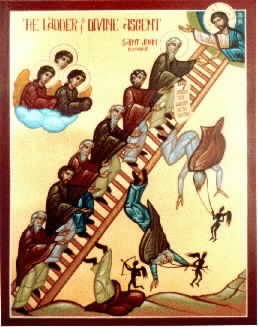
Ladder of Divine AccentThere is another positive aspect of repentance, which is this: repentance does not mean giving up our passions, but mastering them. The passions are absolutely essential to spiritual life. Without passion, we simply do nothing. Sloth, or despondency, is perhaps the only passion that cannot be turned to good, being not so much a passion as the absence of passion. But generally speaking, the passions, if properly directed, can make us saints. It is very important to remember that the saints did not give up anger, but directed it toward sin rather than their fellow man. Their hatred was turned on their own transgressions. Their envy was transformed into a burning desire to imitate the saints.

Repentance is not only penitence and contrition, but movement toward goodness, wholeness,   forgiveness and joy. It is not negative, but positive. It looks not down into hell, but up into heaven. Its fruits are hope, diligence, peace, joy and self-control. It is a renewal of our baptism, a baptism of tears that washes away our sins and purifies the soul, giving us a clean slate and a fresh start.
Learning Our Faith From the Greek Fathers of the Church — 20150705

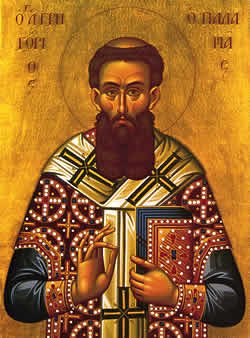
St Gregory Palamas

St Gregory Palamas

St Gregory Palamas, one of the truly outstanding Greek Fathers, teaches us that it was none other than Christ Himself that was revealed first and foremost in history precisely because it was He, and not the Father or the Holy Spirit, Who was to become flesh. In other words, because it was the will of God the Holy Trinity to save us by coming as the Messiah, by being Incarnated in the Person of Jesus, Who is also the Son of God.

But if it is indeed true that “Whoever has seen me has seen the Father”, and that “no man can say that Jesus is the Lord but by the Holy Spirit, then the revelation of Christ must at the same time be a revelation of the Holy Trinity. Gregory teaches us that the Christocentric character of God’s dispensation towards man should not blind us to the great mystery of the unity and common action of the Holy Trinity. Ultimately, in other words, Christology and Trinitarian theology are one and the same doctrine. What the three persons do, they do together, in unison.

Another Gregory, Gregory of Nyssa, teaches this:

We do not learn that the Father does something on his own, in which the Son does not co-operate. Or again, that the Son acts on his own without the Spirit. Rather does every energy which extends from God to creation… have its origin from the Father, proceed through the Son, and reach its completion in the Holy Spirit?

Here we have the classic schema of the divine economy: from the Father, through the Son, in the Holy Spirit – the divine operation of the Most Holy Trinity is always from the Father, through the Son, in the Holy Spirit.

But the fact remains that the distinction of persons, the diversity in God the Holy Trinity, is also necessary to maintain since only one of the Three Divine Persons became man; only one of the Holy Trinity was born and crucified, though this is accomplished with the consent of the Father and the Holy Spirit. It is true, of course, that the Father gives His only-begotten Son and the Holy Spirit testifies of Him as Lord and God. But the distinction of persons remains. We see this most concretely in the mystery of the Divine Eucharist, where the Spirit is present in Holy     Communion as well as the Son, but it is a different kind of presence: the Spirit did not become human.       (More to come)

The Divine Liturgy and Our Worship of God — 20150705

Mystical Supper

Mystical Supper

The next second in the Creed is devoted to the Holy Spirit. Again, the Nicene Creed of 325 was added to. The Creed of Nicea simply stated: And in the Holy Spirit. The Constantinopolitan Creed of 381 added the words in Italics: And in the Holy Spirit, the Lord and Giver of life, who proceeds from the Father, Who with the Father and the Son together is worshipped and glorified, who spoke by the prophets. In one holy, catholic and apostolic Church; we acknowledge one baptism for the remission of sins; we look for the resurrection of the dead and the life of the world to come. Amen.

There are two separate issues in the Filioque controversy. First, the orthodoxy of the doctrine itself and the action of interpolating the phrase into the Creed. Although the debate over the orthodoxy of the doctrine preceded the question of the admissibility of the phrase as   inserted into the Creed, the two issues became linked when the insertion received the approval of the Pope in the eleventh century.

Already in the fourth century the distinction was made, in connection with the Trinity, between the two Greek verbs ἐκπορεύεσθαι (the verb used in the original Greek text of the 381       Nicene Creed) and προϊέναι. In his Oration on the Holy Lights, St. Gregory of Nazianzus wrote: “The Holy Spirit is truly Spirit, coming forth (προϊέναι) from the Father indeed, but not after the manner of the Son, for it is not by Generation but by Procession (ἐκπορεύεσθαι)”.

The Fathers were very careful to use words which had significant meaning to express their belief about the Trinity. We who use English, I think, are not always as careful. The Greek is very nuanced. That the Holy Spirit proceeds from the Father and the Son in the sense of the Latin word procedere and the Greek προϊέναι (as opposed to the other Greek word ἐκπορεύεσθαι) was taught in the early fifth century by St Cyril of Alexandria in the East. The Athanasian Creed (probably of the middle fifth century) and a dogmatic epistle of Pope Leo I, (446 CE) declared that the Holy Spirit proceeds from both Father and Son.

The Eastern Fathers did not believe this to be just a matter of semantics. To them the words chosen to express our concept of God was very important and not a trivial and insignificant matter. The Filioque controversy was part of why the Great Schism.

COMPASSION: THE WAY OF JESUS — 20150628

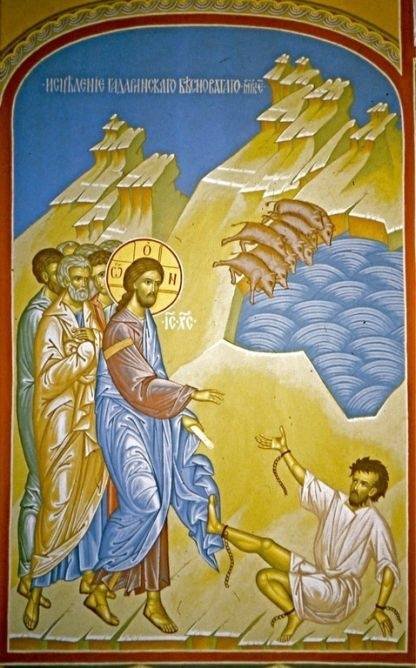
11692739_1050900824922315_8652066096103867131_nIn today’s Gospel reading we hear the story about Christ’s expulsion of savage demons from two men. After some reflection, I believe this story highlights the compassion and confidence of Christ. He did not fear the savage demons even though most people, according to the story, were afraid to travel down the road where they were. He only thought about the two men who were being ravaged by the demons.

According to the story He also showed an abundance of understanding when the swineherds asked Him to leave their territory because His good act ruined their business. He accepted their actions without question. I would have thought that the villagers would have been thankful. Jesus cured men from their village and removed a threat to their safety. Jesus, however, didn’t berate them or judge them. He knew in His own heart that He had done something kind and that His intentions were good. That was the only thing that mattered.

This story helps us understand the WAY of Jesus and His attitudes towards others. He was always accepting and thoughtful of others while, at the same time, truthful. His actions were always dictated by the attitudes that He had about others. When we have genuine attitudes about the goodness of other people, we can always respond in a loving way, regardless of how others treat us.

Also consider the fact that, according to the story, Jesus even positively responded to the requests of the savage demons. They asked to go into the swine. He granted their request. He did not, by the way, cause them to rush down the bluff into the sea and drown. That was just    something the demons brought on themselves.

I realize that some may question Jesus’ actions   towards the demons and even think that He, after He cast them out, caused them to drown. The story doesn’t say that at all.  Jesus didn’t punish the    demons for just being themselves. His main focus was to extend compassion to the two men who were possessed.

As I look around our world today I find that compassion is sorely missing in our society. This, I believe, comes from the self-centeredness that seems to be prevalent in the world. As followers of Jesus Christ we have to honestly assess our attitudes about others and judge whether these attitudes are in concert with those of Jesus.

While self-assessment is not an easy task, it is, I believe, an important one. If we are to grow spiritually, we have to look closely at our attitudes and then work to bring them into unity with Jesus, the Christ.

Understanding The Theology of Our Ukrainian Greek-Catholic Faith — 20150628

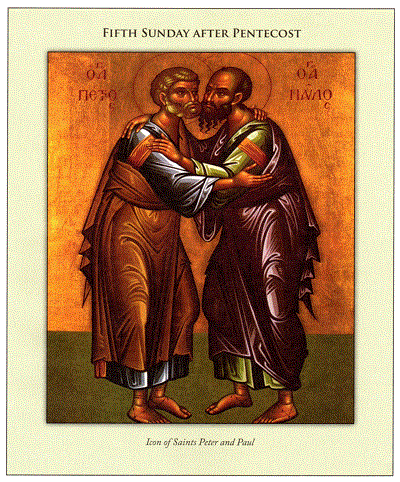
sspeterenpaulWe truly owe to the Holy Apostles Peter and Paul the priceless treasure of the Christian faith. They passed on Christ’s teachings. They laid a firm foundation for the Church of Christ. Both Apostles are distinguished for their character, their zealous apostolic labors and their great cult in the Church. Both men were, to use a colloquial phrase, bigger than life! Our Church celebrates their feast on June 29th.

Peter and Paul were   martyred in Rome under Emperor Nero in the year 87. Peter was crucified, head down at his own request [so that he would not die in the same way as Christ], and Paul, because he was a Roman Citizen, was beheaded. The Church unites them in a common celebration and gives them identical honor.

Peter, a brother of Andrew the First-Called, was from Bethsaida. They were the sons of Jonas, of the tribe of Simeon. They lived by the work of their hands. At the time when John the Baptist was in prison, Jesus came to the Lake of Genesarett, and finding Peter and Andrew mending their nets, He called them and they followed Him without hesitation. Peter preached the Gospel in Judea, founded the Church of    Antioch where followers were first called Christians, and finally went to Rome.

Paul was a Pharisee and belonged to the tribe of Benjamin. He was born in Tarsus of Asia Minor. At first, he persecuted the Church with great zeal and violence, imprisoning and killing Christians. Then, according to tradition, Christ appeared to him on the way to Damascus and changed his heart. He was baptized in Damascus by Ananias. He became one of the greatest exponents of Christ’s teachings, which he explained in letters or epistles.

Two letters in the New Testament are attributed to Peter and 14 to Paul, although a number of those attributed to Paul are thought to have been composed by his followers.

They are called by our Church: Prime Apostles.

The Divine Liturgy and Our Worship of God — 20150628

Mystical Supper

Mystical Supper

The CREED that we pray each and every Divine Liturgy is really the Niceno-Constantinopolitan Creed which is really a modified version of the Nicene Creed of 325. The Council of Constantinople made a few additions to more clearly express our faith. The Creed clearly professes our belief in God as Trinity.

There are four sections to our Creed and each of the first three sections express our particular beliefs about God as: Father, Son and Holy Spirit. For example, the first version said of the Father that He is the Maker of things both visible and invisible. In 381 these words were added to state that He is the Maker of (added: heaven and earth and of all) things visible and invisible.

The second section is devoted to our belief in Jesus Christ. Of the Three Persons, the section devoted to Christ is the longest and had the most additions because of the various heresies about Christ.

Some examples are represented by the words in italics: only-begotten of the Father, before all ages;  He came down from heaven; was incarnate by the Holy Spirit of the Virgin Mary; He was crucified for us under Pontius Pilate  and suffered, and was buried, and on the third day he rose again, according to the Scriptures; and ascended into heaven, and sits on the right hand of the Father; and He will come again with glory, to judge the living and the dead; whose kingdom shall have no end. The Fathers believed it was important to add these words so that our beliefs about Jesus are very nuanced.

Another difference between the Creed we use and that of the Western Church, which has added a few words, is that we say Jesus suffered and was buried and do not add the word died. The two original Creeds did not use the word died in reference to Christ.

While I believe that all additions to the Creed have been done in order to express greater clarity, the Western Church has made some changes outside the Ecumenical Councils accepted by the early Church. This makes it neither right or wrong but has been one of the sources of disagreement between Catholic and   Orthodox  Churches.

It has been the stance of our Church that using the original version of the Creed that was finally accepted when all Christendom was in union is the better policy. In the next issue I will address the biggest controversy about the Creed.

Further Thoughts About the WAY of Jesus — 20150628

What are your attitudes about religion? Is religion just a set of magical rituals that, if you keep repeating them without failure, will secure a place for you in heaven? Is religion just a set of dogmas and doctrines which God has dictated through the Church and which you have to believe in for God to love you? Are religious beliefs just like an assortment of food in a cafeteria and you only have to pick and choose what you want? Is your religion the only true religion and all others wrong? Is your religion just a series of commandments and laws which, if you break them, can result in God punishing you?

It is imperative, I believe, that we find answers to these questions. I also believe it is important that we also ask ourselves these questions: Do I only belong to my religion because it is the way I was raised? Do I only belong to my religion because I am afraid of going to Hell?

As Eastern Catholics I think that we have one additional question to answer: Am I an Eastern Catholic because I was baptized as an Eastern Catholic?

By the way, in raising these questions it is not my intention to suggest that religion is superfluous or to question the efficacy of belonging to an Eastern Catholic Church. On the contrary, I have personally chosen to be an Eastern Catholic because of the spirituality that I find it representing.

I truly believe that religion has a very important role in life. I believe, however, that at some point in life a person has to make an intelligent, personal choice to be a part of a religion and to faithfully and sincerely embrace that religion. When a person does that, the benefit of religion become more obvious and real.

In order to intelligently and voluntarily embrace a religion, however, I think a person must recognize and understand their attitudes about their religion. Belonging to a religion doesn’t guarantee anything! It truly doesn’t guarantee heaven.

Some may immediately ask, then why should I belong to a religion? If you ask yourself that question then you know that your attitude about religion may not be correct. Jesus came to tell us that the way we live, which is taught by our religion, is important for us.

If we intelligently embrace religion, life takes on, I believe, a new meaning and purpose. If we embrace our religion without thought of loosing heaven and gaining hell, life takes on a whole new meaning and purpose.

I truly believe that our religion can provide us with the help need to discover the meaning and purpose of life and   become all we were created to be.

God the Cosmic Bellhop — 20150628

The first Stupid Way to think about God, according to these authors, is to think of Him as Cosmic Bellhop. The authors begin with this prayer: God, I’m checking in. Though just for a short stay. But while I’m here, please see to it I have a wide-screen color TV, a new red Porsche and a large Dr. Pepper, heavy on the ice. Amen.

The belief that God is the ever-gracious Host Who is supposed to respond to our every demand and need is a stupid way of thinking about Him. He is not our own personal puppy Who is eager to gratify our every desire and indulge our every whim. He is not the One we only pray to when we’re in trouble or praise when we win the lottery. He is not the one we should expect to respond to all of our various petitions as automatically as a 24-hour cash machine.

Could anything be more stupid? Yet how often, in our attempt to cope with life, we take the noble notion of God, who is supposed to be served by us and turn Him into a manservant.

Despite our lip service, despite our respectable intonations and self-effacement, we cannot disguise the truth: We believe we can simply order God what to do. It is a stupid idea to think that God’s sole purpose is to underwrite our ego, our selfishness. When we think of God in this manner it is only for our own ignoble gratification and our own petty desires.

When we think of God as a Cosmic Bellhop, we show how strongly we cling to our infantile desires to control and manipulate those around us. We also show a lack of faith in our ability to provide for ourselves.

Although we stiff Him on tips we wonder why He doesn’t place the entire universe at our feet. Then when this happens, we double-lock the door of our hearts. Hang up a Do Not Disturb Sign, act like angry        children, and continue our self-indulgence by ceasing to believe in Him.

Here is the challenge: Do you recognize that the concept of God you have been using and created is inadequate? Do you understand that you have set up unrealistic expectations for God and doomed your faith from the start? Is God someone who, because you have been good, is supposed to rescue you from the challenges of life?

While it is not unreasonable to expect a god to be responsive to our needs, it is unreasonable to expect God to grant all of our wishes at the sound of a bell or a rattled-off prayer. The question is: Are you willing to explore other approaches that can make God more accessible?


Remember, when you make God your Cosmic Bellhop, it’s you who ends up carrying the baggage!

CALLED TO HOLINESS — 20150628

As I shared with my readers,

The call to holiness is a call to make God’s Kingdom real right now. It means giving meaning to the words of John the Baptizer and Jesus when they said: Repent, for the Kingdom of God is at hand.

As one author, Ken Wilber, put it: The Kingdom of God is nondual consciousness, the highest level of human consciousness. There are many different levels of human consciousness. Swiss developmental psychologist Jean Piaget, who was a professor of child psychology at the University of Geneva, was a pioneer in the study of the developing consciousness of children.

The nondual consciousness that is the vision of the Kingdom of God is the highest stage in the growth of human consciousness from infancy to full spiritual maturity. By the process of inner growth in spiritual awareness, a pat of constant inner realization, we gradually come to see our own union with God in Christ so that, at the final stage of nondual awareness, God alone and His Kingdom remain. We see, when we realize the vision of the Kingdom of God, that we, like Jesus, are not mere human beings after all, but are now, and have always been, nothing less than immortal, unlimited, divine Spirit.

In His ministry, Jesus wanted more than anything else to tell us about the nondual vision of the Kingdom He saw. He saw a Kingdom right here on Earth in which everyone was truly and substantially one with God and one with each other. At the same time, however, He saw that this nondual oneness didn’t take away from God’s transcendence or from our own humanness or individuality.

To our human minds this sounds like a paradox: how can we and God be one (divine) and yet God remain transcendent and we remain human and individual? So the call to holiness is a call to come to an awareness of this reality and an understanding of its implications for how we think and live.

Gaining a Deeper Understanding of the New Testament — 20150628

In the last issue of this article I began giving a brief synopsis of the visions that are contained in Revelation. I presented the first two visions and would continue with the third.

  • Seven angels blowing seven trumpets. A third of the earth burns up, a third of sea creatures and ships are destroyed, a third of earth’s rivers become poisonous, a third of the sun, moon, and stars are darkened. Giant locusts ascend from the smoke-filled “bottomless pit,” a great army of two hundred million cavalry invades, and a third of humankind is killed. (You can see that numerology plays a great role in these visions).
  • The cosmic woman and the dragon. As a woman clothed with the sun, with the moon under her feet, and wearing a crown with twelve stars gives birth to a male child who will rule the world, a dragon waits to devour him. She and the child are rescued. War breaks out in heaven between Michael and the dragon, the “ancient serpent,” who is thrown down to earth where he makes war on the woman’s children.
  • The final plagues and the seven bowls of God’s wrath.
  • The destruction and fall of “Babylon the Great”.
  • The defeat of the beast and his armies.
  • The thousand years.
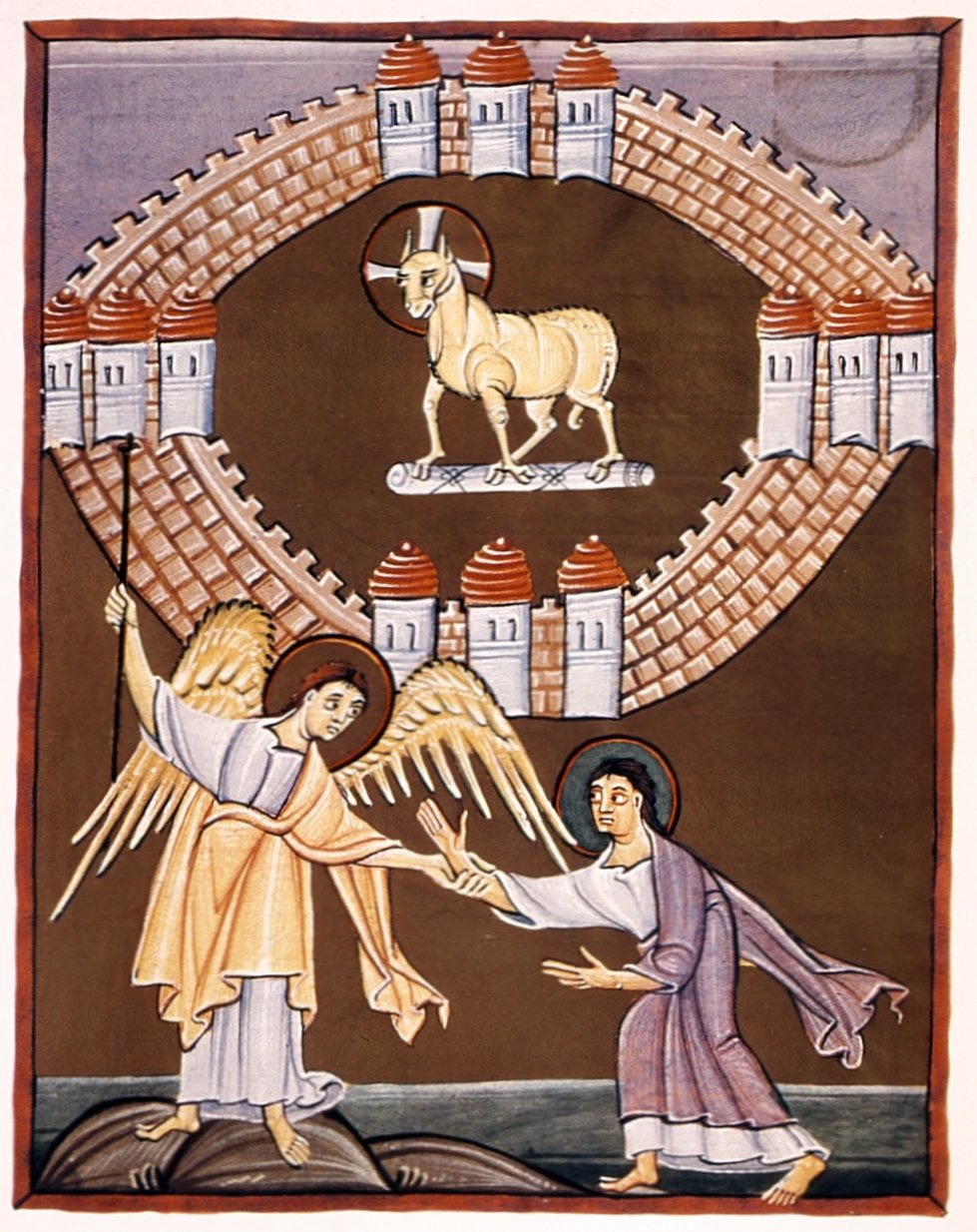
  • The New Jerusalem.

BambergApocalypseFolio

There the visions end. The rest of   chapter 22 contains concluding affirmations, warnings and promises. It ends: “The one who testifies to these things says, ’Surely I am coming soon.’ Amen. Come, Lord Jesus! The grace of the Lord Jesus be with all the saints. Amen.”

Recall that I shared with you that some Christians believe that the image-filled visions are to be interpreted as referring to events that are still in the future – that it speaks in veiled but decipherable language about the signs of the end and the second coming of Jesus. Christians throughout the centuries have often interpreted it this way. There was a flurry of end-of-the-world expectation around the year 1,000 as the first millennium ended. In the Reformation in the sixteenth century, Luther and others identified the great whore, Babylon the Great, the beast as Rome and the pope. He also thought the second coming was near.

Some Protestants from the nineteenth century on have proclaimed that the second coming is at hand. The expectation continues. One poll suggests that as many as 40 percent of American Protestants think it certainly or probably will happen in the next fifty years, a conviction based on the futurist interpretation of Revelation. Recall that Paul thought the Second Coming would happen in his time.