The Divine Liturgy and Our Worship of God — 20151129

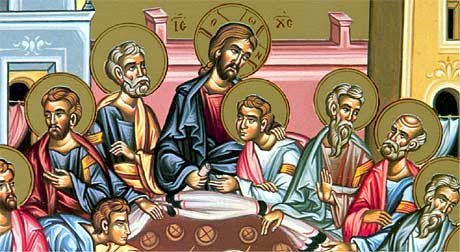
Mystical Supper

Mystical Supper

In the two Byzantine anaphora texts the object of remembrance becomes: the passion, cross, burial, resurrection after three days, ascent into heaven, sitting at the right hand of the Father, and the second coming in glory.

Even more enlightening than the lengthened list of saving acts in the   anamnesis proper is the repercussion of the anamnesis on the form of the command to “do in memory” and of the account of institution. In the liturgy of Basil the anamnesis command is so formulated that not only Paul’s words: “For as often as you eat this bread and drink this cup, you proclaim the Lord’s death until He comes,”(1 Cor 11:26) but also its liturgical expansion: “and confess my resurrection,” are put into the mouth of the Lord himself as a continuation of his own words: “Do this in remembrance of me.”

At this period (4th Century) the idea of the eucharistic celebration as a re-presentation and even an identical image of the Last Supper was interpreted in such concrete terms that the biblical account of institution underwent a further assimilation to current liturgical practice. In Basil’s anaphora the words over the bread were: “He gave thanks and blessed it, sanctified it, broke it and gave it to his holy disciples.” The words over the chalice were: “He mixed the wine and water, gave thanks and blessed it,     sanctified it, and gave it to his holy disciples.

Also indicative of the greater emphasis on the anamenetic character of the eucharist is another alteration in the Basilian redaction (i.e., Basil the Great) of the anaphora. The older expression: “He left us this great mystery of his love,” which occurred in the transition to the account of institution, is now made more concrete, in keeping with the liturgical anamnesis: “He left us as a memorial of his saving passion that which we have offered in accordance with his commission.”

The Basilian redaction of the anaphora already offered an example of how, in the age of the Second Ecumenical Council, the passages of the anaphora that dealt with the Holy Spirit called for greater emphasis and expansion. This was true in particular of the epiclesis.

Hopefully all of my readers are quite aware of what the anaphora and the epiclesis are.
Seek and you will find!
Gaining a Deeper Understanding of the New Testament — 20151129

The first letter of Peter is distinctive for a number of reasons. It is one of only two documents in the New Testament (NT) that uses the word “Christian”. It is the only document in addition to John that uses “born again”. This does not reduce the power or significance of the phrase. What is means is widespread in Christianity very early in history. It has the same meaning as Paul’s “dying and rising” with Christ, that is dying to an old way of life and being raised into a new way of life. But the specific phrase is found only in this letter and in John.

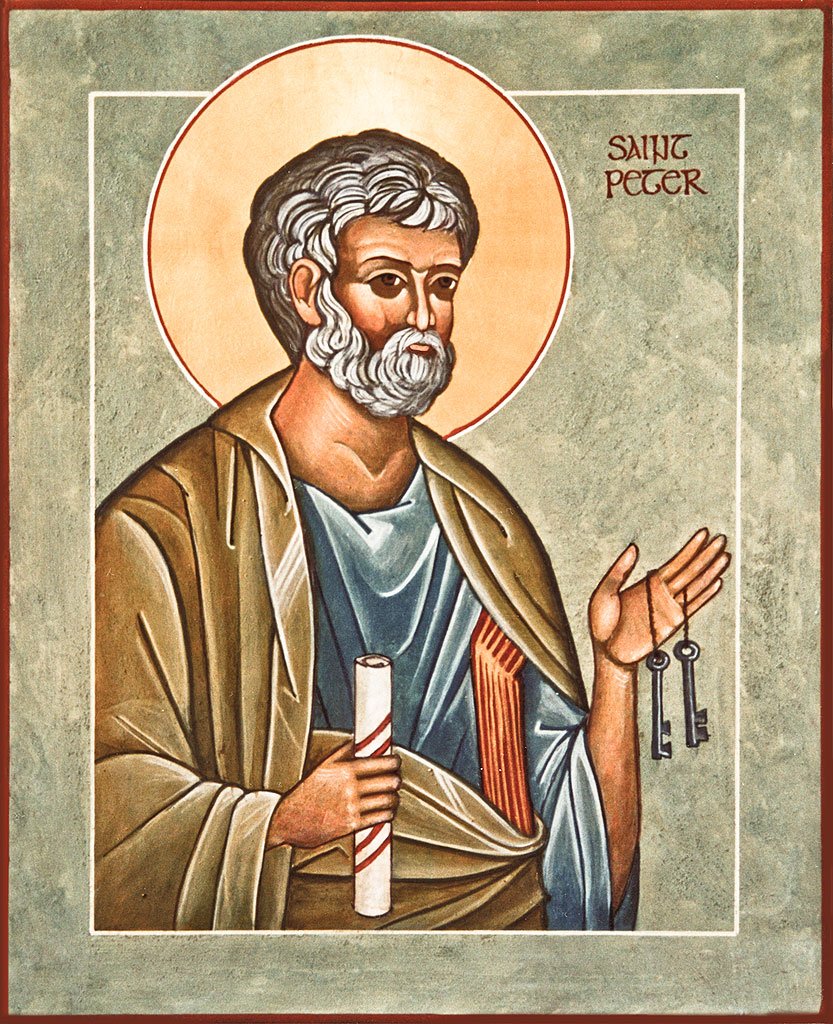
Saint Peter

Saint Peter

This letter also uses a   distinctive metaphor for Jesus. He is “a living stone”. In John, Jesus is the “light of the world,” the “bread of life,” the “gate for the sheep,” the “true vine,” and so forth. In Hebrews, Christ is the “great high priest” and “sacrifice.” Here He is a “living stone,” indeed the “cornerstone” of “a spiritual house.” The author then calls the recipients to be “living stones” in “a spiritual house” and to be “a holy priesthood” offering “spiritual sacrifices”. The important image of the community as priests leads to one of the best-known passes in this letter: But you are a chosen race, a royal priesthood, a holy nation, God’s own people, in order that you may proclaim the mighty acts of Him who called you out of darkness into His marvelous light.

The letter’s advice in a time of persecution is striking. The author instructs his readers how to respond to those who were persecuting them: “Do not fear what they fear, and do not be intimidated”. The letter suggests that their persecutors operated out of fear; they were not to be intimidated by them.     Instead, they were to “cast all their anxiety” on God. “Fear not – do not be afraid” is the constant counsel of the Bible, Old and New alike. Thus, though this letter is from the early second century, it preserves much that is authentically Jewish and Christian.

Unlike the Epistle of James, First Peter presents the moral exhortation which is its dominant feature in close relationship to Christian doctrine: the Trinity of persons in God; the redemptive value of Jesus’ death and resurrection; the sinfulness of man, whom God destined to be holy. Some scholars are of the opinion that 1 Peter is taken substantially from an early Christian baptismal liturgy. Whether this view is correct or not, the passages in question are among the clearest expositions on the meaning of Christian baptism to be found in the NT.

It is well worth your time and effort to read this five chapter letter. You won’t regret it.

The Spirituality of the Christian East — 20151129

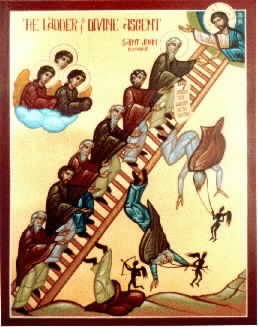
Ladder of Divine AccentI would continue some remarks on the 10th Step on John’s Ladder, SLANDER. History tells us that one monk, the Elder Aimilianos, always walked away when someone began speaking about someone behind his back. St. John, however, suggests a much more confrontational response. He writes:   Do not allow human respect to get in your way when you hear someone slandering his neighbor. Instead, say this to him: “Brother, stop it! I do worse things every day, so how can I criticize him?” You accomplish two things when you say this. You heal yourself and you heal your neighbor with one bandage.

By gently pointing out the sin of slander, we not only spare ourselves from engaging in this sin, but we may also succeed in making the slanderer realize his error and bring the whole unpleasant conversation to an abrupt end.

Slander is a sure sign that we are not truly repentant. “If we are on the watch to see our own faults, we shall not see those of our neighbor.”

It is pride that blinds the truth. This is never more obvious than in the sin of gossip and slander. For often we consider the minor failings of our neighbor more worthy of anger and derision than our most grievous iniquities. It is not uncommon for someone who has committed sins of hatred, envy, violence, theft or sexual perversion to condemn another for simply being annoying, for boasting, smoking or swearing. If we were as outraged by our own sins as we are by the foibles of others, we would all be saved. We condemn minor faults in   others while we overlook our own grievous sins, not out of ignorance, but because we forget God; we think if we conceal our sins from one another, the sin is of no consequence.

This is great food for thought!

Reflections on the Scriptural Readings for this Weekend — 20151122

pantocratorThe two readings this weekend deliver a knock-out message. The Epistle, which is taken from Paul’s letter to the Ephesians, clearly tells us to Live in the Light. The Gospel of Luke tells us: Trust in God and not in possessions. If a    person truly lives in the Light, s/he only trusts in God and does not put trust in the things of this world, especially since rust and moths can easily destroy anything we have. Luke tells us to grow rich in the sight of God. Paul tells us a number of important things:

  • Be correct in your judgment of what pleases the Lord;
  • Take no part in vain deeds done in darkness;
  • Keep careful watch over your conduct – do not act like fools, but like thoughtful men;
  • Do not continue in ignorance, but try to discern the will of the Lord;
  • Avoid getting drunk on wine; and
  • Sing praise to the Lord with all your hearts.

What absolutely sage advice! Truly this advice is critical in today’s world and especially as our society prepares for Christmas, a feast originally meant to make real God’s manifestation of Himself to humankind. It has now been turned into a money-making, secular, thoughtless event which truly takes God out of Christmas for all but the firmest of heart.

The commercialization of Christmas has been developing over the years. It is now fully blown, mesmerizing people into thinking that things, especially really expensive and popular things, can express love in some strange way. Things can never express a person’s love for another and the people who believe they can, truly act, as Paul suggests, like fools.

The business men of our society try to convince us that the things of this world show love. They do this only because they want to make a profit. One only wonders how many of the people who are trying to convince us to give expensive things to others at Christmas believe that God came Himself into our world in the Person of Jesus.

One of the things that I believe God is attempting to do through the Church is to call us to PUT JESUS BACK INTO CHRISTMAS. We have the power to do this if we don’t buy into the marketing ploys of companies. We are called to make this Christmas, a holy time – a time when we remember what God has done for us. How will you celebrate Christmas 2015? Will you make it holy by the way you celebrate it?

Why not celebrate Christmas like a true Christian?

Gaining a Deeper Understanding of the New Testament — 20151122

I have been sharing thoughts about the first letter of Peter. It was probably a “circular” letter, carried and read to a number of communities in different locations. The recipients had been experiencing suffering because they were followers of Jesus. It would seem that the persecution was not necessarily lethal; no deaths are mentioned. It probably consisted of social ostracism which could have been severe because it meant the severing of friendships, family relationships, even financial relationships and even perhaps occasional acts of violence, even though they were not institutionally sponsored.

These communities were mostly made up of Gentile “God-lovers.” That they were Christian Gentiles is indicated in the letter. “You have already spent enough time in doing what the Gentiles like to do” (4:3) is an unlikely sentence if the letter was addressed primarily to Jewish Christ-communities. Then the author lists a series of typically Gentile vices as seen from a Jewish point of view. The real recipients were not Jews who had become Christian, but Gentile “God-lovers” who had become Christian.

Unlike many letters in the New Testament (NT), this one does refer to conflict within the Christ-communities. The conflict is with outsiders. There are no chastisements, though there are warnings and cautions about the situation of suffering being faced.

The letter combines affirmations about Jesus, God, and the new life with exhortations, moral teaching and also encouragement. The rhythm is repeated again and again:

Saint Peter

Saint Peter

Affirmation in 1:3-12,
Exhortation in 1: 13-17
Affirmation in 1:18-25
Exhortation in 2:1-3
Affirmation in 2:4-10
Exhortation in 2:11-4:11

Some of the exhortation is quite general:

Prepare your minds for action; discipline yourselves; set all your hope on the grace that Jesus Christ will bring you when he is revealed. Like obedient children, do not be conformed to the desires that you formerly had in ignorance.Some exhortation is very specific. The recipients are to “accept the authority of every human institution,” including the emperor and governors. Slaves are to accept the authority of their masters, and wives the authority of their husbands. These exhortations reflect the growing accommodation of early Christianity to conventional cultural values, a movement away from the radicalism of Jesus and Paul.

You are encouraged to pick up your New Testament and read 1 Peter.

FROM THE PASTOR’S DESK

On Thursday of this week we celebrate, as a nation, THANKSGIVING DAY. The event commonly called the First Thanksgiving was celebrated by the Pilgrims in 1621 after their first harvest in the New World. In 1789 George Washington named Thursday, November 26th a day of Public Thanks, the first time it was celebrated under our American Constitution. In 1863 Abraham Lincoln proclaimed that a day of Thanks should be celebrated on the fourth Thursday of every November. Finally, in 1941 Theodore Roosevelt and the Congress proclaimed that Thanksgiving Day would be on the fourth Thursday in November. It was originally a religious day when people gathered to give thanks to God for things received. It seems to be only a secular day now, when the focus is on eating and watching football. Put God also back into Thanksgiving! Thank Him for all that you have received during the past year. Say a prayer!

MAKING THE WINTER FAST REAL

Spiritual growth requires that we not only pray and fast but begin to make our faith real by integrating real, Christ-like behaviors into our lives. This week’s suggestion is:

CALL OR VISIT SOMEONE WHO IS ALONE AND, PERHAPS IN NEED OF SUPPORT AND KINDNESS

This is meant to be a random act of kindness – something you don’t have to do but which you freely do in order to develop in your life the attitudes and behaviors of Jesus. You will also be surprised at how much you benefit.

The Divine Liturgy and Our Worship of God — 20151122

Mystical Supper

Mystical Supper

I have been attempting in this article to convey the Eastern Liturgical idea of the Divine Liturgy being anamnetic in character, that is experiencing the past as truly present – an occasion wherein participants can experience the real presence of God. It seems that in the 4th century, when Arianism was being fought by right-believing Christians, St Basil the Great began using a doxology to protest the Arian interpretation of the one commonly in use. The one that Arians misinterpreted was: “to God and Father with the Son together with the Holy Spirit. St Basil, instead, introduced this doxology: to God and Father, through the Son in the Holy Spirit.

The Eastern theologians, St. Basil included, energetically defended the divinity of Christ, in the sense of a     consubstantiality with the Father, against the Arians. Remember that the Arians didn’t believe that Christ was equal and of the same substance as the Father. At the same time, when the discussion turned to the mediatorship of Christ, they focused their attention on the historical work of redemption. Statements of scripture and tradition about a subordination of the Son to the Father could thus be understood in terms of the Lord’s earthly life and related solely to his humanity.

After Basil’s reform of the doxology, the priestly action of Jesus as the here and now active mediator of our prayers and sacrifices – an action that had formerly been the object of keen Christian awareness – was increasingly obscured; the priestly activity of Jesus was increasingly located in his past work of redemption. In consequence, there was also an increasing emphasis on the Liturgy as a re-presentation, or making present, of the past saving act of Jesus.

“The anamenetic character of the Lord’s Supper was seen as the means of making the past saving act present to us and giving all subsequent followers of Jesus – the Church – a share in redemption.

The greater stress on the general anamnetic character of the eucharistic celebration led inevitably to a richer   development of the anamnesis as a particular prayer. This development cannot be missed in the liturgies of the fourth century. The anaphora of His had said simply: “Mindful of his death and resurrection we offer you the bread and cup”. I will continue to explore more about anamnesis

CALLED TO HOLINESS– 20151122

CaptureIt is interesting how this weekly article has changed over the months. It began with my attempting to share the vision of our Patriarchal Synod for all parishes – that is revitalize and reenergize Ukrainian Greek Catholic parishes. The Synod has asked each Eparchy and parish to look at what it means to be vibrant and relevant in our modern world. It seems that this is the task of all Catholic Churches. In the West there is the great effort of Evangelization – that is the Church being a vibrant force in the world for good by sharing the Good News.

It is my contention that before we can spread the Good News of Christ, we have to be engaged in becoming holy. Of course I think this, unfortunately, frightens most people since they don’t believe they have it within them to become saints. And yet if we are baptized into Christ, if we say we are Christians, we have been called to be saints.

The first big question is: What does it mean to be a saint? To be a saint can’t mean being perfect since there is only one Who is perfect, God! It can’t mean being without sin since there is only One Who is without sin, God!

The second big question is: What is holiness?

One interesting definition for holiness is the state of being whole, that is really understanding who you truly are in God’s creation. As a human being, therefore, it means being aware that a part of you is spiritual and a part of you is material! It means that you must support the development of both dimensions of your life. Being called to holiness means being called to develop the spiritual dimensions of your life.

All religions claim that it is their purpose to help people focus on the development of their spiritual nature. Christianity offers us a model for our spiritual development, namely Jesus Christ Who we believe is none-other-than God incarnate.