The Spirituality of the Christian East — 20151122

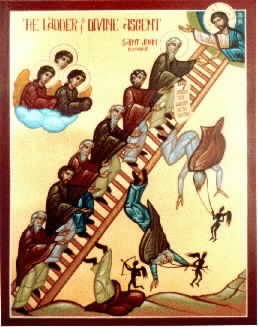
Ladder of Divine AccentThe tenth step on St. John’s Ladder is, as I shared in the last Bulletin, a sin called SLANDER. For what reason do we consider spiritual sins such as pride, hypocrisy, hatred and slander less grievous than “’physical” sins? A chaste virgin can be more defined in God’s eyes than an adulteress or a prostitute.

There is another reason that to pass judgment is to usurp shamelessly a prerogative of God: God alone knows the secrets of the heart. Often we see someone sinning and think we have seen the whole person, when in fact we have only caught a glimpse of him at his worst or at his weakest. We do not know whether that person has then shed tears in prayer and begged God for forgiveness. Unfortunately, we are keen to note people’s visible iniquities, but we are not so quick to consider their unseen repentance.

St. John tells us: Do not condemn. Not even if your very eyes are seeing something, for they may be deceived.

Let us note that stern warning: whatever sin of body or spirit that we ascribe to our neighbor we will surely fall into ourselves. Again, this reminds us of St. Paul’s words: In whatever you judge another you condemn yourself; for you who judge practice the same things! And, of course, if we have not yet committed the same sins (or, at least we think we haven’t), it is possible we will do so in the future.

Slander is a sin that Christians always try to justify. We say, I am not judging him, I’m just concerned for him. St. John calls this false love.

Slander is also a very infectious sin. Many of us find ourselves getting caught up in animated conversations about others, and not wishing to cause offense, we go along with it. We start contributing our own judgmental comments. Many Christians are not sure what to do when they find themselves in this situation. The advice, keep your big mouth shut!
Understanding Our Ukrainian Greek-Catholic Church — 20151122

image379During the past two week I have shared the first two of six real characteristics of our Eastern Christianity, namely that it is communal and intuitive. The third characteristic is that it is holistic. Everything stands in relationship to the other. It refuses to separate Truths into categories and then study them as self-contained units. The Christian of the New Testament culture saw the world as a whole, one in which God’s presence is revealed everywhere. He saw body, soul and spirit as distinct, yet inseparable; the nature of faith, love and service belonging together.

Christ came to redeem the whole person: body, soul and spirit, and it is this whole person who will one day be seated with Christ in heaven for all eternity. This is the image that Paul gives us in 1 Corinthians 15; Romans 8:11-30. Of course we know this to be an anthropomorphism – using images that we humans understand. The fact of the matter is that, as you probably already know, or should know, heaven is not a place where we will all be sitting around singing hymns and sipping mint juleps. (I suspect that some really do believe Paul’s vivid description of heaven). Christ likewise will redeem all of creation as well, in the Last Day summing up all things in Himself (Ephesians 1:9, 10). It is for this reason that the Eastern Christian does not erect an impenetrable wall between what is sacred (spirit) and what is profane (matter). God has created both, sustains both, and one day will restore both.

As you will recall from another article in the Bulletin, the Fathers had much to say about the resurrection of humans from the dead. Like Jesus’ resurrection, the whole person, we believe, will be raised from the dead.

There are many other ways in which we can say that Eastern Christianity is truly holistic. Consider the mysteries or sacraments that we celebrate. They deal with the mysteries of life and, albeit, not always evident, they all have the same, basic ritual format.

For example, the way that the mystery of marriage (human love) is celebrated is based on the Initiation Ritual (i.e., Baptism, Chrismation and Holy Eucharist). Parents who raise their children in our Eastern Church, see, when they celebrate their child’s marriage in the Eastern Church, a real repetition of the child’s initiation into the Church.

This represents a holistic approach to life. When we experience a human mystery and want to understand it, we ask the Church to celebrate it with us. She always does it the same way.

Learning Our Faith From the Greek Fathers of the Church — 20151122

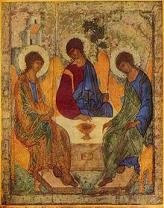
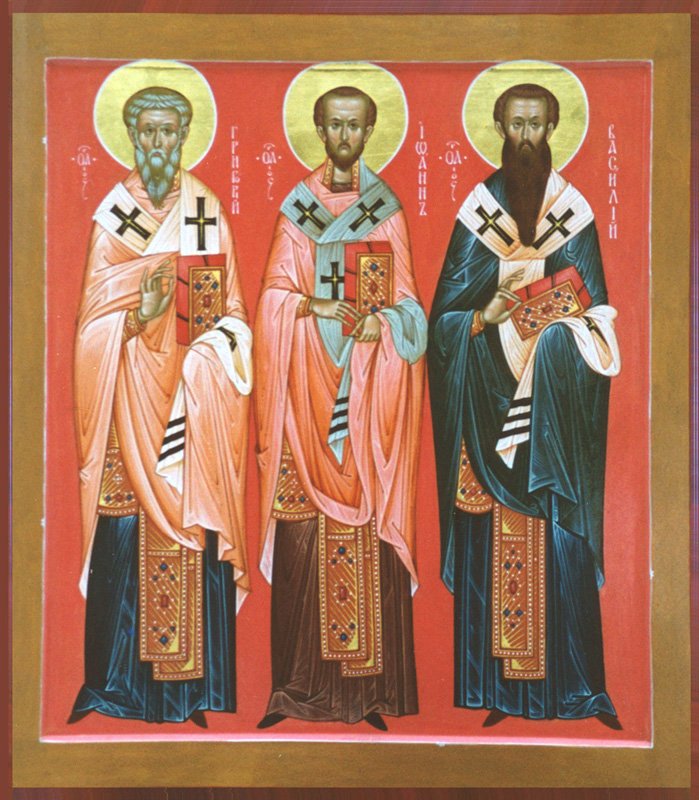
capadociosPerhaps three of the most influential Eastern Fathers of the Church were the Cappadocian Fathers: Basil the Great, Gregory of Nyssa (Basil’s brother) and Gregory Nazianzus. They advanced the development of Christian Trinitarian theology, especially our understanding of the Holy Spirit. Hopefully their names come as no surprise to persons who have been reading my Bulletins on a regular basis.

The early Christian understanding of creation and of man’s ultimate destiny is inseparable from pneumatology (study of spiritual beings, especially in Christianity the study of the Holy Spirit); but the doctrine of the Holy Spirit in the New Testament and in the early Fathers cannot easily be reduced to a system of concepts. The fourth-century Christian discussions on the divinity of the Spirit remained in a soteriological (salvation), existential context. Since the action of the Spirit gives life in Christ, He cannot be a creature but is consubstantial with the Father and the Son – He is of the same substance as the Father and the Son.

You will recall the when attempting to identify Jesus, the Fathers likewise asserted that He, Jesus, is also of the same substance (consubstantial) with the Father. This argument was used both by Athanasius and by Basil. The writings of these two Fathers remained, throughout the Byzantine period, the standard authorities on the Holy Spirit. Except in the controversy around the Filioque – a debate about the nature of God rather than about the Spirit specifically – there was little development in the conceptual understanding of the Holy Spirit – in the Byzantine Middle Ages. This does not mean that the experience of the Spirit was not emphasized with greater strength than in the West, especially in hymnology, in sacramental theology and in spiritual literature.

Basil writes, “As he who grasps one end of a chain pulls along with it the other end to himself, so he who draws the Spirit draws both the Son and the Father along with It.” This passage, quite representative of Cappadocian thought, implies first that all major acts of God are Trinitarian acts, and secondly that the particular role of the Spirit is to make the first contact, which is then followed – existentially, but not chronologically – be a revelation of the Son and, through Him, of the Father. The personal being of the Spirit remains mysteriously hidden, even if He is active at every step of divine       activity.
More to follow about the Spirit

Reflections on the Scriptural Readings for this Weekend — 20151115

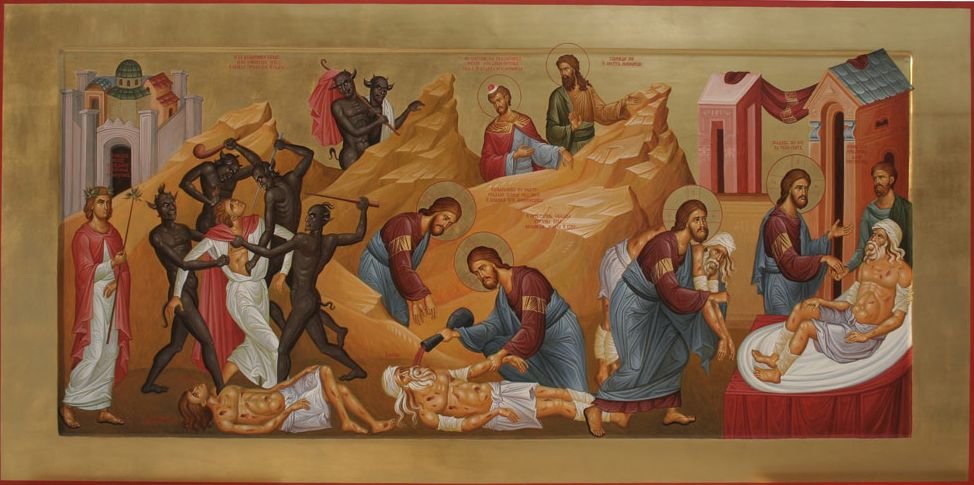
samaritanThe Jesus parable we hear this weekend as our Gospel is, probably, one of the most famous of all the Lord’s parables. Luke presents the Good Samaritan parable as a way of presenting ideas about discipleship. He has a lawyer ask Jesus how salvation is to be achieved. Jesus’ answer indicates what should be the conduct of the real disciple. It is the conduct of the wise, the prudent and the little ones, not just of those learned in the Law.

Luke sets the stage for the parable by having a lawyer put this question to Jesus: Teacher, what must I do to inherit everlasting life? In response to this question Jesus asks the lawyer: What is written in the law? The lawyer responds with this: You shall love the Lord your God with all your heart, with all your soul, with all your strength, and with all your mind; and your neighbor as yourself. When Jesus acknowledges that the lawyer has responded correctly, the lawyer quickly adds the all-important question: Who is my neighbor? Jesus answers his question with a parable that involves an extreme example.

In the parable Jesus compares the failure of two religious leaders, a priest and a Levite, with the unselfishness of a Samaritan. Samaritans were hated by Jews because they didn’t embrace the same type of religion. Jesus had the two religious leaders pass by the hurt man to indicate that a strict adherence to the Law can result in a lack of compassion. Jesus didn’t proffer any reason why they didn’t help the hurt man. What is suggested is that they were afraid to touch him because, if he was dead, they would become ritually unclean. Adherence to the Law.

The one who possessed the secret of eternal life in the parable turns out be a Samaritan who does not have the lawyer’s learning, concern for ritual purity, or the status of a religious leader.

It is obvious that Jesus used this extreme example so that those listening could measure the unlimited nature of the duty to love all others and realize that adherence to the Law should never be put before compassion for others.

I think this parable can have great meaning for us today. Rampant in our society are the thoughts and words of strict Christians who allow their idea of what their religion says to curb their compassion for others. It seems we humans easily forget that acceptance, kindness and understanding are a great part of the Jesus message!

MAKING THE WINTER FAST REAL — 20151115

How do we make our preparation for these winter feasts real? While prayer is the first act we can do, we can also make our preparation much more concrete by voluntarily offering gifts of love and support to others. Try this during this first week of the Fast:

SEND A GREETING CARD TO SOMEONE WHO IS ALONE OR SHUT-IN

We can be life-giving to others by just remembering them, letting them know that we are thinking about them. Although it may seem like a little act, it is a gesture of love that can mean a lot to someone who is alone.

Gaining a Deeper Understanding of the New Testament — 20151115

Saint Peter

Saint Peter

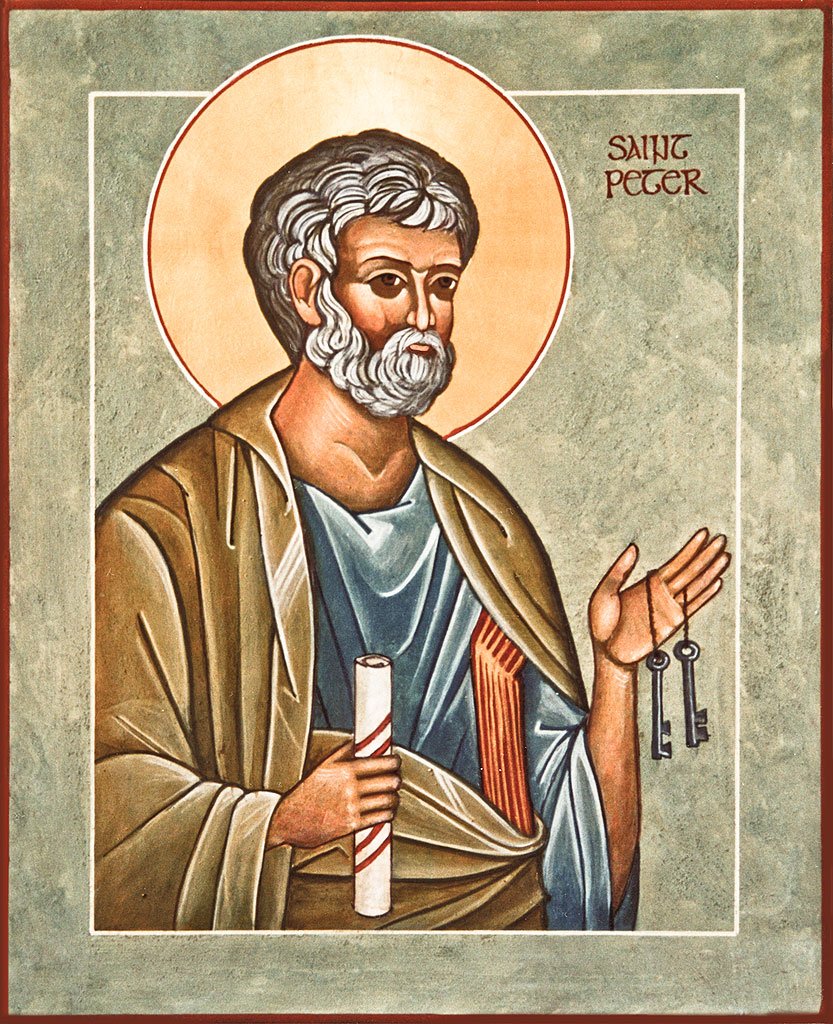
In a chronologically ordered New Testament (NT), the letter that must be considered after second Thessalonians, is First Peter. I suspect that most people have never read or heard First Peter proclaimed. It consists of only five, relatively short chapters.

Two letters in the NT are attributed to Peter, who was, perhaps, the most important of Jesus’ disciples since he was chosen to lead the followers of Jesus. He was executed in Rome around the year 64 C.E.

Most biblical scholars do not think that either letter was written by Peter. The letters reflect a later

historical context. Further, scholars believe that the two letters didn’t have the same author. Second Peter seems to be written significantly later than first Peter.

First Peter was most likely written from Rome. Rome is suggested in its closing, which contains greetings from those “in Babylon”. As in Revelation, “Babylon” had become a name among both Jews and Christians for Rome after Rome destroyed Jerusalem and the temple in the year 70. Babylon was the previous destroyer of Jerusalem and the temple in 586 BCE. Rome was the new “Babylon.”

But there is no unanimity about its date. Some mainline scholars date it to around 90 or as early as the 80s. The reason is that some think that the author of 1 Clement, an early Christian letter not in the NT but dated by some to around the year 96, wrote 1 Peter. If so, 95 or so is the latest possible date for 1 Peter. But it is not clear that 1 Clement was written that early. Moreover, because both 1 Clement and 1 Peter were most likely written in Rome, their authors might well have known each other. Given that, similarity of language need not mean literary dependence. Some of its themes, especially its endorsement of Roman authority and imperial conventions about slavery, suggest a date early in the second century.

The author identifies himself as “Peter, an apostle of Jesus Christ.” Recall that most scholars do not think that Peter the disciple wrote the letter. Later, the author refers to himself as an elder among elders, which implies that he was a leader in a Christ-community in Rome.

This letter uses the term scattered strangers. There is abundant evidence that this refers to Gentile Christian communities. They are envisioned as the new people of God, aliens in the pagan world. It seems that the names included indicate that the letter was meant for communities in Asia Minor

The Spirituality of the Christian East — 20151115

Ladder of Divine AccentThe tenth step on St. John’s Ladder of Ascent, is SLANDER. Malice and the remembrance of wrongs naturally lead to gossip and slander. I am sure that all of us can recall when we have heard persons go on for years criticizing what someone once said or did without any real consideration that the object of their slander or derision has long since repented and been forgiven by God. What a shameful sin this is! God, who alone has authority to forgive sins, who alone is without sin, does not hold the sins of penitents against them, yet we sinners refuse to forgive. Thus St. John writes: To pass judgment on another is to usurp shamelessly a prerogative of God, and to condemn is to ruin one’s soul. No doubt St. John had in mind the words of Paul: Who are you to judge another’s servant? To his own master he stands or falls.

To pass judgment is to usurp shamelessly a prerogative of God because only someone without sin has any right to pass judgment. Thus with these simple words the Lord shamed those who were ready to stone an adulteress: He who is without sin among you, let him throw a stone at her first. Note that “he who is without sin.” There may be sins we have not committed, but this does not give us license to get on our moral high horse and condemn others because they commit a specific kind of sin that we have not.

Christians are often guilty of this sort of discrimination. We may say, “I am a sinner,” but often what we really mean is, “I am a sinner, but not like that person.” “I am a sinner, but I don’t commit that sin. We accept “normal” sins and are only outraged by “abnormal” sins. And by what right, and on what basis, have we decided that one person’s weakness is more worthy of condemnation that our own? I believe this step generates great food for thought!
What do you think?

Understanding Our Ukrainian Greek-Catholic Church — 20151115

patcathIn the last issue of the article I shared that the first characteristic of the Eastern Church is that it is communal. Another characteristic of the Eastern Church is that it is intuitive. Although the Eastern Church is firmly supported by true scholarship, it does not really trust in scholarship as such as faith. It firmly believes that the Christian Faith stands upon both an experiential and objectifiable knowledge of God; neither of which can be separated from the other. Thus, the thinking of Eastern Christians is that it is impossible to encapsulate the Christian faith into intellectual propositions. Doctrines have value in that they can protect the mystery of Christ and redemption from heretical twistings. They can never, however, communicate the faith so well that one could experience God by studying them alone. God will always transcend every one of man’s finite, doctrinal statements and formulations. For this reason, Eastern Christianity shies away from making exhaustive doctrinal confessions and would never put forward any creed or confession as the definition of Christianity.

Although the Eastern Church was greatly instrumental in formulating the Creed that we use every time that we celebrate the Divine Liturgy, this Creed was formulated only to stamp out what was seen as heresy. Eastern Christians would never say that the Creed is the complete substance of what we believe.

The inability to capture the Faith in words is underscored by the fact that, although reason should be used in our attempts to perceive truth, our physical senses will always be unable to fully comprehend the things of the Spirit. The character Job, who is found in the Old Testament, recognized one of his sins as being too quick to declare what he did not understand. The Eastern minded Christian would not want to repeat his error by making any real   dogmatic statements about those things which have not been clearly and unambiguously revealed by the Spirit.

The Eastern Church subscribes to what is known as apophatic theology, that is a theology that attempts to describe God by negation, to speak of God only in absolutely certain terms and to avoid what may not be said. Eastern theology is based on the assumption that God’s essence is unknowable or ineffable and on the recognition of the inadequacy of human language to describe God. It is balanced with cataphatic theology or positive theology and a belief in the incarnation through which God has revealed Himself in the person of Jesus Christ. To know God one must know Jesus.

CALLED TO HOLINESS — 20151115

Archangel Michael

Archangel Michael

St. Paul said this: “Make sure that no one traps you and deprives you of your freedom through some secondhand, empty, rational philosophy based on the principles of this world instead of on Christ. In His body lives the fullness of divinity, and in Him you too find your own fulfillment, in the One Who is head of every Sovereignty and Power. Therefore, we must follow Christ Who has the divine nature to give to us, Who can deal with every power over our lives – physical, spiritual and psychological – and Who can control every worldly value that claims authority over us (e.g., money, pride, selfishness, bitterness).

When we put on Christ, Paul says, we come into the fullness of life, for life is not only physical but also of the spirit. All that is opposed to our life and growth He takes away, forever disarming those powers from having authority over us. All things remain powerless over us as we remain in Christ.

What does it mean to remain in Christ? It means that we live with a New Testament point of view. We literally put on Christ, that is His way of thinking, His attitudes and His behaviors. It means becoming fully and totally conscious of the presence of God in our world and in our lives. It also means becoming truly ourselves. It means being fully alive, understanding who we are in God’s creation. It means freeing our true selves to praise God with all that we have and are. This is truly the first goal of spiritual growth and the first step in understanding what it means to be called to holiness.

Hopefully those who read this will begin to really understand that the meaning and purpose of life is to become transformed people who understand that the goal and task in life is to understand who we are in God’s creation and what it means to be a fully alive human being. I wonder what you think it means to be a fully alive human being.
Think about this and write me!

Learning Our Faith From the Greek Fathers of the Church — 20151115

image379In the last issue, I began sharing the role that Athanasius played in helping the Church find the appropriate words to express its belief in Who Jesus Christ is. This led to a condemnation of the priest Arius who did not believe that Jesus was also God Himself. This all transpired at the Council of Nicea.

Some of the bishops present, although in complete disagreement with Arius, were reluctant to use a term (homoousios) not found in the Scriptures. Eventually they saw that the alternative was to have a creed that both sides would and could sign, each understanding it in its own way. They   realized that the Church could not afford to leave the question of whether the Son is truly God (the Arians said “a god“) undecided. So the result was that the Council adopted a creed which is a shorter version of what we now call the Nicene Creed, declaring the Son to be of one substance with the Father. At the end, there were only two holdouts, the previously mentioned Secundus and Theonas.

No sooner was the council over than its consensus began to fall apart. Emperor Constantine had expected that the result would be unity, but found that the Arians would not accept the decision, and that many of the orthodox bishops were prepared to look for a wording a little softer than that of Nicea, something that sounded more orthodox but that the Arians would accept. All sorts of compromise formulas were worked out, with all shades of variation from the formula of Nicea. As you can see, the Church struggled to come to her understanding of who Jesus is.

In 328, Alexander died, and Athanasius succeeded him as bishop of the city of Alexandria. He refused to participate in these negotiations, suspecting (correctly as it turned out) that once the orthodox party showed a willingness to make reaching an agreement their highest priority, they would end up giving away the store. He defended the full deity of Christ against emperors, magistrates, bishops, and theologians. For this, he was regarded as a trouble-maker by Constantine and also his successors and was banished from Alexandria a total of five times by various emperors. (Hence the famous expression Athanasius against the world.”) Eventually, Christians who believed in the Deity of Christ came to see that once they were prepared to abandon the Nicene formulation, they were on a slippery slope that led to regarding the Logos as simply a high-ranking angel. Some things you just can’t compromise on.