Reflections on the Scriptural Readings for this Weekend — 20151025

The Rich Man and  LazarusThe story we hear this weekend for our Gospel, The Rich Man & Lazarus, is unique to Luke’s Gospel. In this story Jesus is addressing the Pharisees who were fond of money and who thought to find justification in their own punctilious observance of the law. The rich man in this story is similar, in many respects. To the man in the story of the Dishonest Manager. They both seem successful for a time and both are unaware of evil in mishandling money. Similar stories existed in Egypt and among the rabbis. Jesus could easily have adapted this   tradition to his own purpose.

This is the only case where a name is assigned to one of   the characters in the parable. Therefore many scholars feel that the name was later inserted. Was the name borrowed from Lazarus of Bethany who was at a banquet and whose resurrection from the dead failed to convince the Jewish leaders of Jesus’ Messiahship? Because the poor man was given a name, in some manuscripts the rich man is also given a name.

The punch line in the parable not only emphasizes that knowledge of the Law is insufficient for salvation, for the Law must be kept with humble compunction, but also teaches that wondrous events, even resurrection from the dead, do not automatically save men. People are saved through the process of personal transformation.

When you think about this parable you realize that Jesus is teaching about the necessity of having compassion for the poor. Compassion for the poor has the power to promote personal, spiritual transformation. I don’t think it comes as any shock to anyone that Jesus’ ministry was focused on helping the poor. This is one reason why Pope Francis has made that one of the primary foci of his ministry.

One of the major problems that we are confronted with in our modern society is that often we can’t really identify those who are truly poor. There are a lot of things that cause this confusion. And so, since Jesus has revealed that compassion for the poor is vital for our spiritual growth, we have to find a way to be able to develop this compassion without being scammed. This requires a lot of thought and prayer.

Frequently if people don’t work to build compassion for the poor they become like the rich man in the story, oblivious to the plight of others and complacent to only just obey the Law. Personal transformation is not achieved in that manner.

Understanding Our Ukrainian Greek-Catholic Church — 20151025

patcathWhat do we lose if we do not consider the Eastern roots of our Christianity? We first lose a correct interpretation of the   Scriptures. Instead of interpreting the Bible with the mind of the Early, Eastern Church, we end up seeing it from a 15th century European viewpoint. What many of us do not realize is that this Renaissance mind-set contradicts the Early Church’s understandings on several points.

To most people in America, even those who immigrated here some time ago, Christianity is a Western faith. We dress it in Western clothes, make it communicate in Western ways of thinking, and evaluate it with Western rules of logic. By doing so, we impose something strange upon it. Our cultural blindness forces it to labor under chains of bias and ignorance. This error makes it difficult for us either to accurately preach the Gospel or rightly teach the Scriptures.

One author suggests a shocking conclusion to this: If Christianity is Middle Eastern in nature, we must adopt a Middle Eastern world view to understand it. Or, put in the negative, Unless we embrace the decidedly Eastern disposition of Scriptures we will never be able to fully embrace its message. Now the problem is this: with all the chaos currently happening in the Middle East and the fear of the forces in the Middle East, it is hard for good Christians to think about our faith in this manner. Unfortunately what we are currently experiencing in the world is not a true reflection of Eastern thinking as the Early Church experienced it.

Christianity isn’t complicated. It’s our unconscious projection of Western philosophy on it that sometimes makes it hard for us to understand.

Why should we be concerned about the “Eastern-ness” of our Christianity? An Eastern perspective helps us rediscover the faith of the Early Church, and re-acquaints us as Christians with our common origin and history prior to the divisiveness of denominations. The Eastern perspective is important because through it we can better share our faith with a generation grown tired of Western apologetics. The Eastern   approach is significant because our   relationship with Christ and our Christian brethren will be broadened by it. And lastly, our Eastern ancestry is worthy of attention because in it we find sincere Christian unity without the compromise of either theological integrity or love.

Too often we forget that Our Church found Christianity through the Eastern Church. Therefore it is important that we understand Eastern Christianity.

The Divine Liturgy and Our Worship of God — 20151025

Mystical Supper

Mystical Supper

During the past few weeks, I have been sharing ideas about a key Liturgical concept, namely anamnesis. I truly   believe that a correct understanding of this idea changes, radically, the way that we experience the Divine Liturgy. I suggested that this word is found in the New Testament in one form or another.

The form found in 1 Corinthians (11:24-25), ἀνάμνησιν, occurs in only one instance in the New Testament outside of these two verses, that is in Luke’s     account of the Last Supper (22:19). As one scholar points out, the nominative case noun ἀνάμνησις occurs only once in the New Testament, in Hebrews (10:3), and is also found only once in the Septuagint, in Numbers (10:10). In the     latter case, the Israelites are told that their offerings and festivals will serve as a reminder of God’s perpetual presence in their midst.

In the letter to the Hebrews, the limitation of the high-priestly sin offering compared to the offering of the body of Jesus Christ once for all (Hebrews 10:10) is stressed: In those sacrifices there is only a yearly remembrance of sins (v 3) This same scholar assumes that the few incidences of the Greek  ἀνάμνησιν and the Hebrew זִכָּרוֹן  and of their variants, as well as the range of meaning of these words when they do occur in Scripture, indicate that the Christian notion of anamnesis as re-presenting before God an event in the past, so that it becomes here and now operative by its effects is based on myth. Citing another scholar, who, in his commentary on Luke’s Gospel, translates τουτο ποιειτε εἰς την ἐμην ἀνάμνησιν (Luke 22:19) as do this   having me in mind, the scholar first quoted argues that anamnesis in Scripture normally signifies mere recalling or having in mind of a past event. He suggests that anamnesis, when understood as actualizing remembrance cannot find any basis in either the semantics of the word or in the Semitic usage of the first century. He also suggests that the primordial rites of primitive societies do not have anything to say to Christian faith.

Eastern liturgical scholars, however, disagree with this quoted scholar for several reasons. I hope to share these reasons in coming issues. It is truly the view of Eastern Liturgical scholars that our Liturgy is anamnetic, that is that it re-presents the past, in order to make the presence of Christ truly present to us as we celebrate.

Further Thoughts About the WAY of Jesus — 20151025

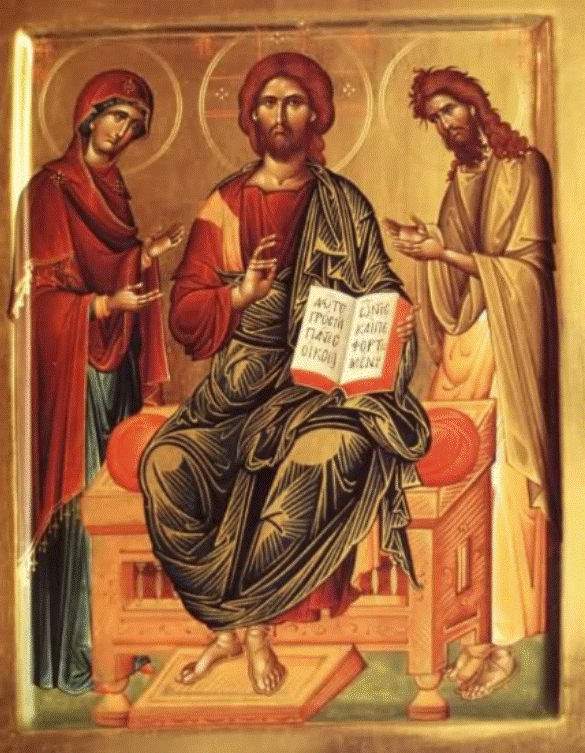
deisisHopefully my thoughts about the WAY of Jesus has stimulated my readers to think about their own understanding of the WAY of Jesus. The WAY of Jesus leads to personal transformation and transformation leads to salvation. The only way that we achieve salvation is by personally transforming the way that we think and behave, hopefully becoming more and more like Jesus Christ. To become more like Jesus Christ means to grow in our likeness of God.

This raises one very important question: What exactly is salvation? I suspect there are many and varied ideas about salvation. Probably the most common one is probably to gain a place in heaven (wherever and whatever it is) after death OR to be joined with God.

It is interesting to note that the new United States Catholic Catechism for Adults doesn’t provide a definition for salvation, even though the index contains many references to salvation. It typically defines basic religious ideas.

Salvation is the restoration of the wholeness of God’s image in us, of the possibility of our union with God. Simply stated, salvation is the restoration of our original essence. Holy Tradition teaches that we will be saved when we become like Christ. Because of our faith in Him and our desire to become God-like, we are not so much saved all at once as slowly changed into the creatures we were created to be.

So salvation doesn’t mean going someplace positive and blessed after death but, rather, becoming something ourselves. Salvation is not a reward for having lived a good life. It is, rather, the result of leading a good life that involves personal transformation.

Salvation is directly connected, I believe, with the meaning and purpose of this earthly life. We are here to achieve a state   of salvation. Salvation, in turn, is a transformed life, that is a life which makes us more in the likeness of God as expressed in the Person of Jesus Christ. This is why the Church often has said that there is no salvation accept through Jesus Christ.

So what about the people who do   not know Jesus Christ, who are not Christians. The true message of other religions is all about transformation, that is leading a good and righteous life. The advantage of Christianity is that we actually have a model that we can strive to imitate. That model is Jesus Christ. So there is a real advantage to being a Christian. We have a definite model who, if we make an effort to imitate Him, leads to personal transformation.

Smart and Stupid Ways to Think About God — 20151025

Picture1The ninth smart way to think about God is: GOD IS FOREVER. The authors I have been using begins this way with words similar to these: Ladies and Gentlemen, we are proud to announce that we have found the slogan for the God account: Get Happy! Get God!

The promise of fulfillment can sound more like sales hype than truth. Especially when confronted with the most devastating doubt of all: Death! The Masked Executioner always seems to stand one step behind us, scimitar in hand. In one fell swoop, He mocks our faith and delivers a coupe de grace to our smart way of thinking about God.

Death scorns us. It reminds us all too painfully that we are, in part, matter. It forces us to admit we are perishable. And even the promise of an Eternal God can seem like so much snake oil when face-to-face with the power of death.

Death has this way of making everything, including God, seem futile. Death can take most everything we’ve worked for, struggled for, and bring it to a grinding halt.

It is often our attitude toward death, even more than toward life, that determines how we live. Some people race around like madmen, trying to get it all in – the Rolling Stone philosophy. Cramming their lives with one thrill after another, they race through life trying to beat death at its own game. Alas, isn’t there a little stone rolling in all of us?

But whether you run toward death, or walk, sooner or later everyone gets there. Few people, atheist or theist, when in death’s embrace, can avoid self-reflection. No one can help but mull over their accomplishments, good, bad, or indifferent, and wonder if they actually achieved anything at all.

For many, it may be the first time they have stopped long enough to think about how they have lived their lives. It is no coincidence that it is the first time many people think seriously about God. Often, they’ve ignored God until the final hour, when, so commonly, they reach out in hope that the stupid way of thinking they were raised with has a shred of truth. They call a priest for the first time in years to administer last rites.

But who can blame anyone. Death is the great unknown. Death appears so opposite from the idea of everlasting life that it has frequently been turned into God’s rival instead of God’s Hand. A demigod, complete with its own independent mythology.

Yet to death, however powerful it appears, God lifts the Executioner’s mask firmly and deliberately – He sticks out His tongue and says, “Phooey.”

Since this is an important “smart” way of thinking about God, I shall continue with some additional thoughts in the next issue

CALLED TO HOLINESS — 20151025

Another spirituality that people have used to excuse themselves from growing spiritually and finding their true selves is to say that God never wants for us what we want for ourselves, our heart’s desires. When we think this way, however, we are saying that God is against us and not on our side, thus contradicting His own Word (Romans 8:31-32). While it is true that God’s ways are higher than our ways, it is also true that in Baptism God writes His law on our hearts (Jeremiah 31:33) and plants within us the desire to live in goodness and truth (Ezekiel 36:27). These are the deepest desires of our hearts. When we choose not to look at our heart’s desires, we choose not to look at God’s desire for us (Psalms 20:4, 21:2), and we choose not to find our true selves! The pursuit to discover our true selves is critical, I believe, for spiritual growth.

Often we are afraid to look at our deepest desires and to admit what they are. Sometimes, because of the way our society programs us and tries to influence our ways of thinking consciously and unconsciously, some of us fear that our deepest desires will be for something shameful, like promiscuous sexual relations. But in none of us is unlimited sex our deepest desire. Maybe love is. Maybe we desire to give love, to receive love. There are so few ways to express love and affection and sex is one of them, so human beings have often confused the desire for sex with the desire for love. It seems that this is true of our society in general. But if we look deep within ourselves for our heart’s desire we will not find something that would shame us; rather, we will find the traces of God’s handiwork in creating us. Do we believe that we are made in His very image and likeness?

The call to holiness is a call to discover and understand our true selves – the persons God intentionally created

Gaining a Deeper Understanding of the New Testament — 20151025

saintlukeAnother tradition, voiced by Eusebius as well as by Julius Africanus and the Monarchian prologue to Luke, identifies Luke’s hometown as Antioch on the Orontes. Granting that Luke is also the author of Acts, it is no surprise that he was aware of the church affairs in Antioch.

Luke appears rather unobtrusively and quite suddenly at Paul’s side during his second Mission. Sections of Acts indicate that Luke accompanied Paul from Troas to the   seaport of Philippi in Greece. He remained at Philippi for six or seven years until Paul returned on his third Mission. Both men traveled by boat to Miletus and Caesarea. After landing at Caesarea they went to Jerusalem. Luke remained near Paul in Caesarea during his imprisonment. He went with Paul and Aristarchus on the perilous journey to Rome. Paul names Luke as one of his most faithful companions during the Roman house arrest. During this time at Rome, Luke may have made personal contact with Mark.

Later Christian tradition continues the life story of Luke, but its historical accuracy cannot be demonstrated. According to the Anti-Marcionite Prologue, Luke was unmarried, labored in Achaia and died at the age of 84. The traditions of his alleged martyrdom are unreliable. The Emperor Constantius II transferred his relics to Constantinople in 357 CE. A later legend tells of a second transfer (1177) to Padus, Italy.

In the 14th century it was believed that Luke was a gifted painter and the artist of a famous icon of Mary, now preserved in Rome. Another tradition, hardly acceptable, claims that Luke was one of the 72 disciples and also the unnamed disciple on the road to Emmaus.

Luke ushers the New Testament into the world of literary excellence. He moves with masterful control and delicate smoothness from the classical style of the Prologue to the strongly Hebraic tone of the Infancy Narrative to the heavily septuagintal pattern of the rest of his Gospel. In Acts he reverts to the         classical style.

Luke writes with an observant eye to mannerisms, psychological reactions and hidden motivations. He alone gives the psychological setting for a number of the included stories. His pagan origin as well as his extensive traveling is probably responsible for his broadminded openness to all groups of peoples. He shows a favoritism for minorities, segregated groups and the underprivileged. They all receive special encouragement in his Gospel.

Learning Our Faith From the Greek Fathers of the Church — 20151025

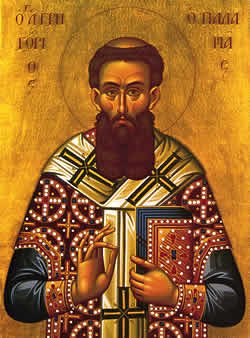
St Gregory Palamas

St Gregory Palamas

I have been trying, in this article, to provide my readers with excerpts from the great Greek Fathers of Our Church. As you have probably deduced from the material I presented from the work of Gregory Palamas, the Fathers are not easy to understand. They all go to great lengths to formulate sound arguments to support their understanding of our faith. Gregory Palamas’ writings on the nature of the Light that emanated from our Lord during His Transfiguration, supports this contention.

All of the Fathers were strong debaters, being very well educated in logic and philosophy. These Fathers of the church indeed formulated our faith.

There was yet another formidable controversialist among the Greek Fathers that should be mentioned. Athanasius the Great. He gave us one of the truly great phrases from the Greek patristic tradition. He wrote of God the Word that He became human that we might be made divine. This pithy statement elegantly describes the true dynamic underlying the Eastern Christian idea of deification, or Theosis.

Athanasius was fully overwhelmed by the lengthy struggles he faced against the teachings about Christ advanced by the Alexandrian priest Arius. This phrase expresses, in a positive way, Athanasius’ persistent claim (so important during the Arian controversy) that, to act as Savior, Christ must be fully divine and fully   human. Only thus could Christ bridge the absolute difference in essence that separates the divine from the created. He wrote, for other things, according to the nature of things originate, are without likeness in essence with the Maker.

Athanasius was similarly outspoken in insisting on the full divinity of the Holy Spirit, who is likewise deeply involved in the work of salvation. Indeed, the Spirit, no less than the Son, is implicated in deifying God’s creation. The actions of the Son and the Spirit are co-ordinated and consistent. It is through   the Spirit that the Son’s activity is accomplished: As then the Father is light and the Son is his radiance – we must not shrink from saying the same things about them many times – we may see in the Son the Spirit also by whom we are enlightened. But when we are enlightened by the Spirit, it is Christ who in him enlightens us.

Athanasius tirelessly asserted the full and equal divinity of the Father, the Son and the Holy Spirit against a range of other theological views. Athanasius’ contribution to our faith is invaluable. We owe him great honor.

The Spirituality of the Christian East — 20151025

Ladder of Divine AccentIn the last issue of this article, I shared with you St. John’s advice on how to build your ability to forgive others. John further reminds us that even speaking of forgiveness and insisting on its importance should make us all the more ardently desire to heed our own advice and to practice what we preach. John said:

I have seen malicious people recommending forgiveness to others and then, shamed by their own words, they managed to rid themselves of this vice.

Unfortunately, many of us refuse to take this   initial step. If we do, we do not then consider the importance of at least   trying to turn this lie into truth. Instead, we remain content with our own hypocrisy and empty apologies and try to justify our bitter refusal to forgive and forget.

True forgiveness is rooted in the Christian principle of loving our neighbor as ourselves. How do we love ourselves? Different people may answer in different ways. Some do not like ourselves very much. Some spoil themselves. Others are hard on themselves. Some think of themselves as good, respectable people, while others truly think of themselves as worthless. This is closely connected to what they experienced in childhood. Everyone, however, wants the best for himself. Everyone wants to be loved. Everyone truly needs compassion and mercy. This is why St. John tells us that feeling pain for the misfortunes of others as though they were our own is a sign of true forgiveness.

Learning how to truly and honestly forgive others is a major step in spiritual growth. There are eight steps that first must be accomplished before we are prepared to tackle this step of forgiveness. Do not despair. If you work at it, it happens!

Learning Our Faith From the Greek Fathers of the Church — 20151018

St Gregory Palamas

St Gregory Palamas

As you have probably gathered if you have been following this article, Gregory uses the Transfiguration of Jesus as a means to help us come to a deeper   understanding of human existence and also the purpose of this life, namely to grow in the likeness of God. Christ’s Transfiguration was not a flash-in-the-pan glorification. Such a view, argues Gregory, would imply that there are now three natures glorified in Christ: the divine, the human, and then that of the light. But although concealed beneath His human flesh until His holy Transfiguration, Christ (the Light of Light) always possessed the light which was revealed on Tabor. Thus, since this light is divine, being that of the Godhead, it must also be uncreated. Gregory’s fundamental presupposition here is, of course, based on the sharp distinction between the created and the uncreated in which there is no room for a third, metaphysical category. Hence, if the Light of Tabor is divine, then it must also be uncreated, since by definition all things divine are also uncreated. In considering why Christ had taken the Apostles up to a high mount apart, Gregory concludes that it must have been in order to make a mystical disclosure, These Apostles were to be the leaders of the Jesus movement. He wanted them to understand exactly Who He IS.

Think about this! What Gregory was attempting to do was establish that the light which the Apostles saw in the Transfiguration of Jesus was not a created light but, rather, the Divine Life within Jesus, the man, which signifies that within humanity there is an uncreated spark or seed of Divine Life. The Light seen in Jesus revealed that God’s Spirit is that which resides in all living things, calling those living things into existence.

I know that this is heavy and, perhaps, difficult to grasp. What Gregory and other Eastern Fathers worked to establish is that God’s Life-force is that which animates all living, created things. Thus, God is truly incarnate in His creation. This, of course, connects us humans to God in a much different way that other humans before Jesus ever conceived. Even Yahweh, the God of Israel, was not considered to be a part of His own creation. Yahweh never became an incarnated part of His creation.

The Fathers, and now we, believe that, if God became incarnate in the Person of Jesus, this reveals that it is His life-force that brings and holds all living things into existence. This is truly a powerful belief. Do you believe this?