Reflections on the Scriptural Readings for this Weekend — 20151018

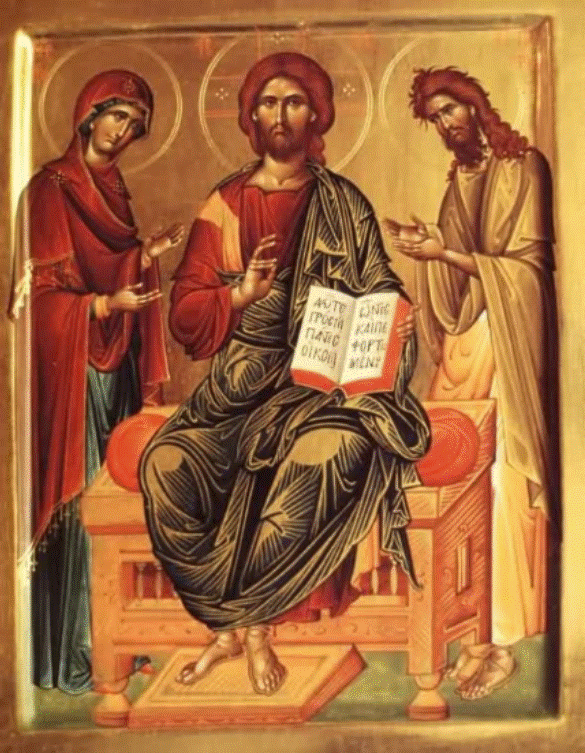
deisisThis weekend, since our calendar repeats a Gospel that we already heard, I’ve elected to proclaim Luke’s version of the Beatitudes of Jesus. It is called the Great Discourse. The Beatitudes only appear in the Gospels of Matthew and Luke. I would encourage my readers to compare the two accounts (Matthew 5:1-7 and Luke 6:20-26).

While Matthew has nine beatitudes and no woes, Luke has four of each. Luke rearranges the sequence presented by Matthew from first, fourth, second and last. The woes follow the reverse pattern of those found in Matthew. Such patterns are typical of Luke’s style. For example, to the blessedness of the poor, the hungry, the weeping, and the persecuted there corresponds the sadness of the popular, the happy, the full and the rich.

It seems obvious that Luke recasts the last of the Beatitudes to emphasize the fact that every follower of Jesus must share the Son of Man’s rejection. Luke highlights the requirement of suffering in the followers of Jesus.

The woes, found only in Luke, cast Jesus in a prophetic role. Luke states that woe will be upon each man who does not acknowledge that he owes every comfort to Jesus.

The Beatitudes, as so many have heard me say before, are truly the BE-ATTITUDES, that is the attitudes of mind that can truly make us other Christ’s or children of God. If we live in accord with these attitudes, we will, most assuredly, be more like Jesus. This, of course, is the purpose of life: to grow in our likeness of God as seen in the Person of Jesus, the Christ.

The Beatitudes fit so well with Paul’s Basic Teaching. He taught that a person is truly not justified before God just by keeping laws. So, a person can keep the commandments or laws of God and miss the meaning and purpose of life.

We have been given this earthly existence for one purpose: for personal transformation. When you think about it, the challenges of life have the power to change us if we respond to them in an appropriate manner. The appropriate manner is to look at life’s challenges as opportunities to become more open and loving people. We have to also admit that life’s challenges can, when not handled in the appropriate way, change us for the worse. Our attitudes truly make the difference. When we have the attitude that we need to change and that life’s challenges can help us change, life is much happier.

Understanding Our Ukrainian Greek-Catholic Church — 20151018

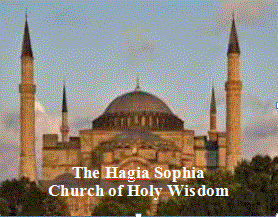
holywisdomAs all probably already know, our Church is truly a part of Eastern Christianity. Although we are within the Catholic Communion of Churches, we are also basically Eastern Christians.

Yes there is only one Faith. But what is little realized is that the roots of this one Faith lead us back to Middle Eastern and Semitic ways of thinking. The Early Church was an Eastern Church. By “the East” then, we are not referring to Indonesia or China but to the East with which those in the Scriptures were familiar: the Middle East, Greece and Asia Minor. It is there that Christianity began. This is obvious to anyone who takes the time to briefly trace Christianity’s birth and formation.

  • Jesus and His disciples were “Middle Eastern” by birth, culture and, of course, language;
  • The Bible is an Eastern book: its languages (Hebrew and Greek), its authors, the people it primarily             addresses, the philosophy it espouses (Semitic), and its cultural context are all Middle Eastern;
  • The “headquarters” of the Christian faith is the Middle East. It was from there that the apostles were sent out with the Gospel. At least forty-four of the forty-six Local Churches which were founded by Christ’s apostles were in the East;
  • For more than 1,000 years, with the exception of Rome, all the major centers of Christian belief were found in the East, in Jerusalem, Alexandria, Antioch and Constantinople;
  • The fundamental dogmas regarding the faith were formulated and defended in the East (e.g., that Christ is “of the same essence” with the Father, that He is fully God and fully man, that the Holy Spirit is a divine Person, and the nature of the Trinity);
  • The very first schools of Biblical interpretation were in the East, that is Antioch and Alexandria. Their           perspectives on interpretation still influence much of our understanding of the Scriptures; and
  • The foundational Church Councils (e.g., the first seven, from 325-787) were all held in the East. The         overwhelming majority of the bishops in attendance were from the East.

Denying our Eastern roots is like denying our parents. To live the Christian life in such cultural and historical ignorance is to lose a great part of our identity. The journey back to Christianity’s beginning not only leads us to a place foreign to us today but also to a culture and way of thinking about life which is very much different from our Western, American way.

We’re looking at the roots of our Church.

CALLED TO HOLINESS — 20151018

CaptureThe call to holiness is a call to discover who we really are in God’s creation and to learn how to reject any false sense of ourselves. If we are convinced of our lovability in our formative years, we will be able to spend the rest of our lives discovering our true selves and using our potential to contribute to life. But, to the extent to which we were taught we were unlovable, we now have a false self that Jesus wants to – and needs to – heal. We must always remember and hold on to the fact that whatever God creates is good and, in the case of humans, also lovable. We have been created out of the love that God has for us.

Our false selves have also been nurtured in our adolescence and adulthood by certain brands of spirituality. We must realize that not all spirituality leads to spiritual growth, and only that which is totally centered in Jesus can bring us into the truth and help us discover our true selves. Our own fears, laziness and lack of courage and self-confidence can provide rather strong psychological barriers to our desire to discover the truth and to follow Jesus. Often we have been easily fooled by spiritualities that tell us we do not have to find our true selves.

The entire idea of metanoia in Eastern Spirituality – personal transformation – is all about discovering our true selves, the selves that God intended when He created us.

One of these spiritualities, for example, says that if we do something well, humility demands that we never do that thing. Thinking realistically, however, we know that if humility means acknowledging the truth about ourselves, it means that we acknowledge this capability and that we also go further and accept the whole truth: that this quality does not originate in ourselves but rather is a gift from the Creator. He Who created us in His image calls us to use our gifts to give Him praise, acknowledging that the gift is from Him and giving Him thanks for it. This is one of the reasons why our worship of God is seen as Eucharistic, that is a sincere act of Thanksgiving!

The Divine Liturgy and Our Worship of God — 20151018

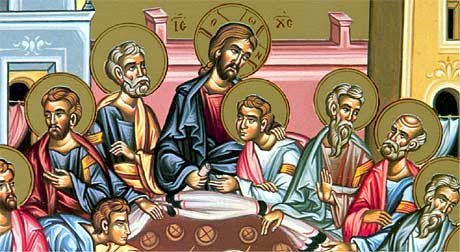
Mystical Supper

Mystical Supper

The Christian concept of anamnesis has Jewish roots and was tied to the covenant theology and worship practice of ancient Israel. Indeed, anamnesis in Christianity coincides with the Jewish understanding of zikkaron, a Hebrew word which has been rendered as a memorial reenactment. One author, Smolarski, explains it as remembrance “that makes the effects of a historical event present and effective for the   believer.”

In accordance with our Christian understanding, the covenant by which God bestowed Canaan upon the Israelites by striking down the Egyptians while passing over the Israelites in Egypt, has not been       abrogated. On the contrary, much as Israel has been instructed to commemorate “the Passover sacrifice of Yahweh”, Christians make present for all time the salvific Passover offering of Jesus Christ. The Pasch of Christ, by which a “new covenant” is established between God and man, is the actualization and fulfillment of the ancient “covenant with Abraham, Isaac, and Jacob”. Truly the synoptic gospels present Jesus as instituting the Eucharist during a Passover meal celebrated with his followers, giving to the Passover a new and distinctly Christian memory.  Jesus gave to an eternal covenant a new sacramental and anamnetic significance. Therefore, by Christian initiation believers are drawn into Christ’s paschal mystery   by participation in the present moment. We who were baptized into Christ were baptized into his life, death and resurrection. We were indeed buried with him through baptism into death, so that, just as Christ was raised from the dead by the glory of the Father, we too might live in newness of life.

On one hand, both the Old and New Testaments are replete with the notion of anamnesis, as the remembrance of God’s past action that leads to “newness of life” in the present. On the other hand, the Greek anamnesis and the Hebrew zikkaron, which has the nearest meaning to anamnesis, are not common words in Scripture. Derivatives of zikkaron appear fifty-nine times in the Hebrew Scriptures, and its usage is most often connected to temple sacrifice. Anamnesis appears only nine times in the Septuagint and, in the New Testament, anamnesis and similar words are even rarer, with only seven appearances

Gaining a Deeper Understanding of the New Testament — 20151018

saintlukeI would continue presenting ideas about those writings ascribed to Luke. Like Luke-Acts as a whole, Luke’s first two chapters emphasize the Spirit. They do so five times (1:15, 25,41, 67; 2:25-27). Luke also emphasizes marginalized people more than any other Gospel. Jesus is born among them in a stable, and angels appear to shepherds, who were among the outcast. Women, that is Elizabeth, Mary and Anna, are prominent in his story of Jesus’ birth.

So also are Gentiles. The final hymn, the Nunc Dimittis, ends with an affirmation of the true       significance of Jesus not only for Jews, but also for Gentiles; he is the salvation that God has prepared in the presence of all peoples, a light for revelation to the Gentiles. Yet the very last line of this prayer reads: and for the glory to Your people Israel. Luke does not overlook or negate Jews, but he does emphasize the expansion of early Christ-communities into the Gentile world and the full inclusion of Gentiles into what began truly as a Jewish movement.

Thus from the vantage point of the early second century, Luke and Acts look back on what had happened since the time of Jesus. The author proclaims in both volumes that the inclusion of Gentiles as well as Jews in the Jesus movement was divinely and also providentially ordained from the beginning of Jesus’ life. It was neither an accident nor a mistake.

Tradition has consistently named Luke, Paul’s beloved physician, as the author of the Third Gospel. Irenaeus is probably the earliest witness. In the beginning of the 3rd century, confirmation comes not only from Africa and Egypt but also Italy. One author points out that Luke was not a prominent figure in the apostolic church. He was neither an apostle nor an eyewitness of Jesus’ earthly life. It is much more difficult, therefore, to explain how Luke’s name later became attached to the Gospel than it is to accept the Church’s long-standing tradition.

The fullest defense that the author of the Third Gospel was a physician has been made by one scholar that claims the language used in the Gospel is that of a physician. Other scholars have shown that one cannot prove from the language that its author was a physician. Not only is the same vocabulary shared by other ancient Greek writers who were certainly not medical men, but it also seems certain that physicians in those days did not have a technical language of their own.

Smart and Stupid Ways to Think About God – 20151018

The ninth stupid way to think about God is GOD AS MOM NATURE. God as Mom Nature leaves a lot of questions open. For one thing, where did Nature come from? Who created her? Sure she is mysterious and seems to work miracles. She is powerful, yet balanced. Subtle in her ways, yet majestic. She has definite wisdom and, as with God, it’s not nice to fool her. It can have dire consequences.

Despite these convincing similarities, if you believe Mom Nature is God Himself, it’s really you who are getting fooled. Because she is a god who’s everywhere but also nowhere.

Nature couldn’t be God. She puts on her bonnet only after the big bang. She was born out of nothing, along with everything else in creation. Though God may be seen to work through nature, He could never really be considered merely nature itself.

If Mom Nature is God, then how come we have the power to destroy her? You’d think any God of ours would be more powerful than we are.

And then, there’s the ever-troubling question of evil. As God, Mom Nature could explain natural evils like the AIDS virus, Mt. Vesuvius, the bubonic plague, and the San Francisco earthquakes. But she is mute when it comes to explaining where moral evil comes from.

Murder, child abuse, inhumanities, war and sins of all kinds, are simply not part of a natural ecosystem. They are outside her domain. So naturally, she could never be considered a true god. Of human beings, that is.

On the contrary, God as Mom Nature could only be the god of everything in nature, except us. Our egos, our goals, our drives for perfection, our creativity, our acquisitiveness, our inquisitiveness, our intellectual gifts, our     capacity for self-sacrificial love, our spirituality are all things this simple god of   nature cannot account for.

Any God of ours must be conscious of our moral dilemma. He must be able to explain why we continue to strive, but suffer. He must be able to account for the nature of our lives – why we feel so alienated, and so   ostracized from the Garden of Eden. And, ideally, He should be able to offer us some ray of hope.

But to say that the idealized unity and goodness of nature are identical to the Unity of the One God is baloney. And dangerously close to idolatry. It is merely one step away from collapsing into multiple gods of wind, rain and sun.

God may have created Mom Nature to be His right-hand gal. And for that she deserves a lot more deference than we are currently showing her on the planet. But as a god in her own right, as our real God, she just wilts.

The Spirituality of the Christian East — 20151018

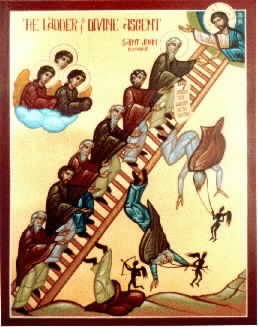
The ninth step on John’s Ladder is

REMEMBRANCE of WRONGS/MALICE.Ladder of Divine Accent

As a remedy to malice or remembrance of wrongs, John recommends a very particular prayer. He states Let the prayer of Jesus put it to shame, that prayer which cannot be uttered in the company of malice.

It is not clear whether by the prayer of Jesus John means the Jesus Prayer (Lord, Jesus Christ, Son of God, have mercy on me, a sinner) or the Lord’s Prayer – the Our Father. Many authors believe John meant the Our Father since it includes a petition to God to forgive our debts as we willingly forgive the debts of others. When we say this prayer, we should pause and reflect when we reach this point, “Forgive us our debts as we forgive our debtors.” Here we have an opportunity to put prayer into practice, to consider what this really implies and to make sure we truly mean what we are saying.

When the wrongs committed against us are great or, if we are not particularly forgiving people, even when the wrongs are small, it is not always easy to forgive. John advises us to take a small, easy step to begin with:

If after great effort you still fail to root out this thorn (malice), go to your enemy and apologize, if only with empty words whose insincerity may shame you. Then as conscience, like a fire, comes to give you pain, you may find that a sincere love of your enemy may come to life.

In other words, even if we have not forgiven with our heart, we should at least humble ourselves and be the first to say sorry. Then, realizing our own hypocrisy, we may be moved to strive all the more to make the forgiveness sincere.

 St. John has very sage advice. Go through the motions. They can help you become sincere!


Further Thoughts About the WAY of Jesus — 20151018

Christ and the Holy ApostlesI thought about what I shared with my readers in the last issue of this article, namely that embracing the WAY of Jesus could be freighting to some. The more I thought about this the more I came to realize that it is only freighting because it challenges us to accept life as it is presented to us and not as we fantasize and wish it to be. For some reason we humans tend to believe that life should turn out the way we want and feel put-upon when it doesn’t. Of course this springs from our belief that somehow our life is ours and that we should have control over it. We seem to do everything in our power to control life and try to make it turn out the way that we want it to be. Then comes the very rude awakening that life doesn’t turn out the way that we want and that we’re only in control of life on a very superficial level.

The WAY of Jesus calls us to accept the life that is given to us, believing that it is uniquely designed to help us grow and change – to help us transform ourselves into beings who are more and more in the likeness of God. The WAY of Jesus helps us to redefine the struggles and challenges of life, turning them into the opportunities for personal growth.

Of course the first hurdle that we all must overcome is the belief that we don’t need to change or transform our lives. To embrace such a belief takes a considerable amount of self-reflection and definitely personal knowledge about ourselves.

As I shared in another article in the Bulletin, the problem usually is that many, if not all of us, have developed, because of life experiences, false ideas about ourselves. It seems that the natural tendency humans have is either to have a puffed-up idea or a very diminished idea of themselves. Having a true and realistic idea of who we are is critical. The WAY of Jesus calls us to a genuine idea of who we are, knowing that life has given us both strengths and weaknesses in the right balance to help us grow and become all that God intended when He called us into existence.

One of the key aspects of the WAY of Jesus is to think about the life that we have been given as God’s gift. We only deserve the life we have because our God-Creator has loved us for all eternity. Think about it! The God our religion presents doesn’t just make up things as time spins on. He does not change and think about new things as history unfolds. Rather, all things are a part of His consciousness (to use a human idea) from all eternity. The idea of who each of us is has always existed in God.

Reflections on the Scriptural Readings for this Weekend — 20151011

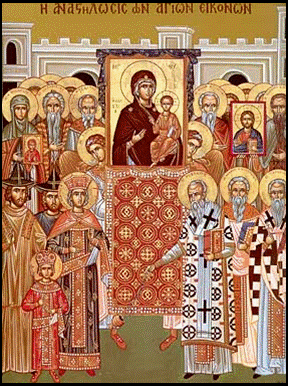
orthodxsundayThis week we again have another special remembrance, that of the Fathers of the Seventh Ecumenical Council. This is truly a special Council for all Eastern Christians. Why? Because it put an end to Byzantine iconoclasm, that movement which declared icons idolatrous and destroyed them.

Iconoclasm refers to two periods in the history of the Byzantine Empire. The First Iconoclasm lasted in the Common Era (CE) from around 726 to 787 and the Second Iconoclasm between 814 and 842. The traditional view states that a ban   was placed on the use of religious images by various religious leaders and Emperor Leo III and continued under several of his successors. It was also accompanied by widespread destruction of icons and the persecution   of supporters of Icons. It seems that the theological motivation for Iconoclasm was based on an Old Covenant interpretation of the Ten Commandments which forbade the making and worshipping of graven images. The two periods of Iconoclasm in the Byzantine Empire made use of this theological theme in discussions over the propriety of images of holy   figures, including Christ, the Virgin and saints. It was a debate triggered by changes in worship, which were themselves generated by the major social and political upheavals of the seventh century.

One of the readings appointed for today is that of the prayer that Jesus offered at the completion of His work. He prayed to the Father that those who followed Him would know the Father as He did. In reality we can only know the Father through the Person of Jesus, the Christ. Why? Because He IS the material incarnation of God.

Icons remind us that Jesus was and is real! People knew Him personally and came to realize that His teaching is truly the WAY God intends us to live. Icons also tell us that others in our history accepted Jesus as God incarnate.

It must be pointed out that we do not worship icons but only use them to remind us that Jesus and those who followed Him were real in history. This very fact, the Church believes, should help us to accept the teachings of Jesus.

Think about God’s revelation through the Person of Jesus. He told us that in order to have a deeper relationship with God, we must learn how to have authentic and real relationships with our fellow men. We must live in accord with the Golden Rule, truly loving our neighbors as ourselves.

Understanding Our Ukrainian Greek-Catholic Church — 20151011

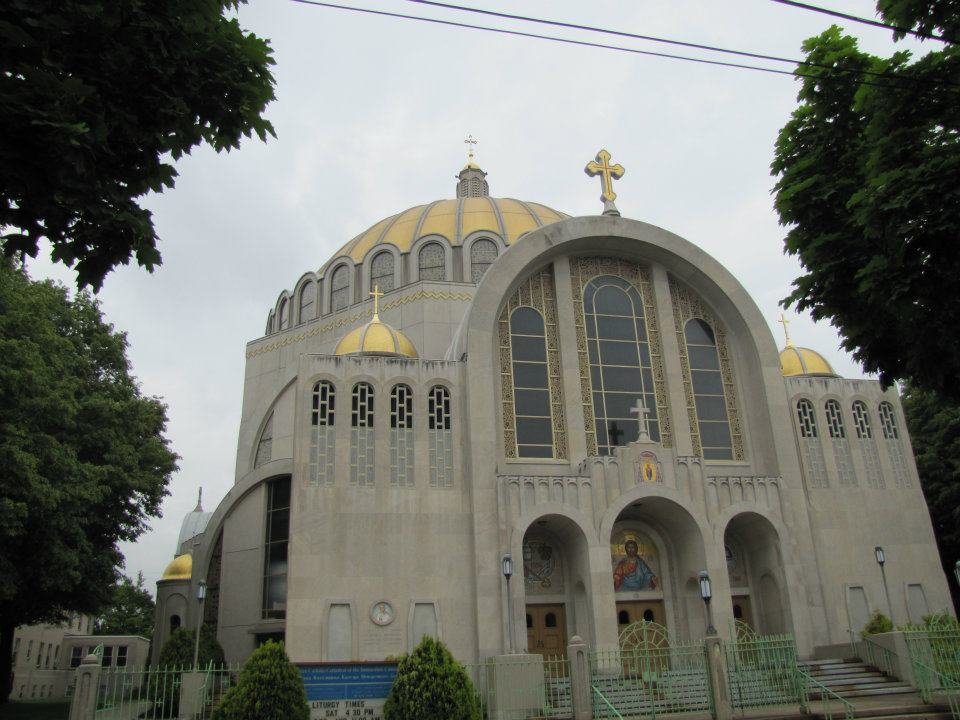
Ukrainian Catholic Cathedral of the Immaculate Conception, Philadelphia, PA

Ukrainian Catholic Cathedral of the Immaculate Conception, Philadelphia, PA

I began sharing the thoughts of our Metropolitan about our Ukrainian Greek-Catholic Church in the United States. He went on to state that in order for us to truly become a real Church here in this country, we must strive to develop Church decision-making structures which provide for greater   involvement of laity. Our Church must be less hierarchical and involve the faithful. On the other hand, the faithful must learn to accept decisions made for the larger common good and not look to a hierarchical decision to suit specific desires.

We must, our Metropolitan wrote, radically reorient ourselves within our parishes and communities to give greater attention to the needs of our children and youth. Religious education programs must be offered not just for the understanding of the reception of the mysteries of Holy Communion and Reconciliation. Religious education must be provided at all levels, including Adult Discussion Groups, so that all members have a firm understanding of our faith and worship.

Our Metropolitan further states, our sense of community, of family, needs to be fostered by welcoming committees in every parish. We must be prepared to welcome strangers and assist them in becoming engaged in our worship.

I would add that our worship can be challenging for those exposed to it for the first time. People feel welcome if they don’t feel lost in following the Liturgy, especially if they have never attended one before. In particular, it is probably helpful to speak to them about the difference in our Communion and advise them how to receive.

While our Metropolitan shared many other ideas, I believe these are some of the main points. I would like to share some further ideas about our Church.

One of the principal differences between the Roman Catholic Church and our Church is our relationship to the local people. The Roman Church in its structural organization and in its liturgical aspect is basically a universal, supranational entity. Our Church, on the other hand, is closer to local cultural tradition. Therefore it is tightly united with the destiny of a local nation. Thus, our Church cannot be easily separated from its people and traditions.

Although we are Greek-Catholic and our services and many of our traditions were influenced by the Byzantine experience of Christianity, we have developed a host of customs and traditions which are unique to Our Church. Like all customs, they are quite universal in thought and, if properly presented, can be embraced by all.