CALLED TO HOLINESS — 20150906

Vision-logic consciousness is the next level that develops in most people. Its primary characteristics are the identification of the self with the abstract mind and the ability to think from many different perspectives. It is global in its interest in, and concern for, other persons.

In terms of spirituality, at this level we appreciate the fact that the Scriptures can be read on many different levels. We begin to appreciate and understand how the Scriptures use the mind-body symbolism used by Jesus, St. Paul and the evangelists. An example of this is Jesus’ constant references to “seeing” and “hearing.”

At this vision-logic level we now have a global perspective. We no longer define the self in the narrow terms of race, color, national origin, or sectarian-based religion. As a result we are tolerant of persons of other cultures, religions and races. This is the spirituality of Jesus.

At this level spirituality is paired with a deep consciousness of the unity of all of God’s creation. We become aware that God’s life-force and consciousness fills all things. All things have their existence in Him and through Him. Therefore how we treat one another and deal with creation is filtered through our awareness that all things, ourselves included, have their origin and continued existence in Him through the power of His Spirit. All this will begin to make sense as you attempt to develop your spiritual nature. The deeper one’s spirituality the deeper is one’s awareness or consciousness of how things really are in the world. Spiritual people find God in all the things of creation. In order to do this they have to have a deep consciousness of things and not just a surface awareness. When a person can finally look at a stranger and see a brother, then they know that they have spiritually grown in their likeness to God as manifested in the Person of Jesus Christ. Spirituality and consciousness are intimately connected.

Smart and Stupid Ways to Think About God – 20150906

Picture1The sixth stupid way to think about God is GOD THE GARBAGEMAN. The authors begin their description of this way in this manner: City of Heaven, Department of Sanitation, God speaking. How may I help you?

Two mortal sins for immediate pickup? One can of cardinal sins, one carton of venial? And an assortment of lust, greed and sloth bundled and ready to go? Of course I can handle it. Just leave them on the side of the house. I’ll be there Tuesday to take them away.

We’ve all got them. Stored up in the basement of our souls. Cluttering up our spirits. All that junk. All that gunk. Filthy, dirty, nasty, mean little sins.

But we don’t have to carry them around, thank God. Not when we have a dumpster for a deity. God the Garbageman at your service. Or if you wish to sound more reverent, God the Sanitation Engineer.

You have a sin? God will cart it off to the great incinerator in the sky! Get out your trash bags!

You’ve sinned again? Oops! Well, have no fear. God will come back and come back and keep coming back to make sure your spirit stays neat and tidy. All you have to do is ‘fess up and keep ‘fessing up. Because this god is a bottomless pit. There’s no limit to the refuse he can hold.

God the Garbageman is neither a dedicated civil servant nor a god. His job is simply to help mankind in what often seems like its most avid pursuit: escaping responsibility.

We’ve taken the marvelous concept of a forgiving God and distorted it completely. This is not the God who is beyond pagan acts of retribution. This is not the God who respects us so much He made us morally responsible. This is certainly not the God who guarantees us freedom of conscience even if we err.

God the Garbageman is a vehicle for an endless obsessive-compulsive ritual that would make Lady     Macbeth seem pure. A kind of bulimia of the soul. Sin binging and sin vomiting.

But God the Garbageman only makes things worse for everyone. By making forgiveness so   convenient, he allows us to take our own behavior for granted. We become so morally lazy we cease to grow as spiritual beings.

And we’ll never grow until we stop depending on someone else to dispose of our garbage for us – until we chuck God the Garbageman in the can and forget him.

Think about this. When we don’t take responsibility for our own behavior and expect God to always forgive us, we never grow because we always feel we have an escape from displeasing Him. That’s not mature Christianity

Understanding Our Ukrainian Greek-Catholic Church — 20150906

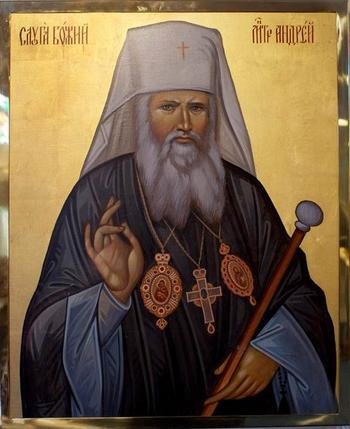
Venerable Andrey Sheptytsky

Venerable Andrey Sheptytsky

I have, in this article, been sharing some thoughts about one of the great leaders of our Church,     Metropolitan Sheptytsky. I shared how he courageously dared to protest to the leaders of Nazism about their treatment of Jews. A

Vatican official, Hansjakob Stehle, was to write later that Sheptytsky “had to be respected [by the Germans] because he had already been imprisoned in tsarist Russia and Poland”.  It would seem that Sheptytsky was not only saved by his being an “old” man. Himmler had ordered the death of many an old man before. Sheptytsky however, was a particularly difficult case. Prior to his entry to the priesthood, he had been an officer in the Austro-Hungarian army; he was also a Count who had held position and favor among the families of the Habsburg Empire. As Metropolitan of the Ukrainian Greek-Catholic Church he had enjoyed the personal high esteem of Emperor Fransz Josef. He held a   similar sentiment for the Emperor.

Sheptytsky was loved passionately by his Ukrainian Greek-Catholic faithful and highly respected by the Orthodox. To harm Sheptytsky would have thus made the position of the “liberating” German forces in the East completely untenable.

In August 1942, confident of Sheptytsky’s sensitivity to the plight of the Jewish people, Rabbi Kahane   entrusted to him the Scrolls of the Torah. Sheptytsky, by way of couriers of “undercover clergy” sent a note to Rome in which he described the horrors of the Nazi clearing of the L’viv ghetto.

Most of Sheptytsky’s rescuing of Jewish citizens was to take place in a period from August 1942 to May 1943. During this time the Metropolitan was able to build up a solid network of approximately 250 Ukrainian Greek-Catholic clergy, each of whom risked martyrdom for their involvement in a scheme to rescue Jewish citizens. Sheptytsky ordered that false baptismal certificates and also Ukrainian names be given to Jewish children, who were then secreted to Ukrainian Greek-Catholic orphanages, monasteries and convents.

The Director of Holocaust studies at Ben Gurion University, Shimon Redlich has emphasized that no         attempt was made by Sheptytsky’s assistants to convert the rescued Jewish children, and after, when the war was over, they were returned to the Jewish community”. Redlich wrote that the Ukrainian Greek-Catholic Order of Studite monks assisted countless Jews across the borders into Romania and Hungary. I think that it is important to know this about our Church!

Gaining a Deeper Understanding of the New Testament — 20150906

saintlukeThe next book that must be considered in a chronological New Testament (NT), is the Gospel of Luke. The gospel of Luke and the Acts of the Apostles belong, as many already know, together. They were written, scholars tell us, by the same person and share unifying themes, which suggests that the author conceived them as a single work contained in two volumes. But for about 1,700 years, they have been separated by the Gospel of John. Why? Simply because the canonical NT places all four gospels first.

That Luke and Acts were written by the same person is obvious from their introductions. Both are addressed to Theophilus. Moreover, the first verse of Acts refers back to the gospel: In the first book, Theophilus, I wrote about all that Jesus did and taught from the beginning. The name could refer to an individual – but it also means lover of God, so it could be addressed to a group, namely, the God-lovers.

Their thematic unity is apparent. One major theme is the geographical progression of the Jesus movement from Galilee to Jerusalem, the center of Judaism and then from Jerusalem to Rome, the center of the empire.

A second major theme is their common emphasis on the Spirit. In the gospel, Jesus is conceived by the Spirit; then the Spirit descends upon him at His baptism; and the first words of his public activity are: The Spirit of the Lord is upon me. His last words from the cross are, Into your hands I commend my spirit. The Spirit of God that animated Jesus returns to God, and the gospel ends with the promise that the Spirit will descend upon his followers.

That promise is fulfilled in the opening chapters of Acts with the descent of the Spirit upon the       community at Pentecost. Throughout the rest of Acts, the Spirit guides and leads the expansion of the Jesus movement from the homeland to the ends of the earth.

Many scholars discern in the Lucan gospel and Acts an apologetic strain presumably directed against unfounded criticisms of Christian teaching. Written after the persecution of Nero that began in 64 C.E. and caused hostility toward Christians throughout the empire. Luke-Acts reveal that Jesus Himself was accounted innocent by the Roman governor Pontius Pilate and that St. Paul, founder of many         Christian communities in the empire, was often acquitted by the Roman magistrates of charges against him. He was a Roman citizen.

Reflections on the Scriptural Readings for this Weekend — 20160830

Saint PaulOne of the most profound statements St. Paul makes in his second letter to the Corinthians, which we use as our Epistle reading this weekend, is this: God is the one who firmly establishes us along with you in Christ; it is he who anointed us and has sealed us, thereby depositing the first payment, the Spirit, in our hearts. Think about the meaning of these words. They tell us of Paul’s belief that God gives his help to those who believe in Him. Paul relates the effects of a person’s initiation into the Christian life. First, a seal, which was the personal mark that an owner placed on his   property, is given to a new Christian, indicating that s/he belongs to God; and second, a pledge is given by God to provide help and assistance. That pledge is God’s Spirit, indicating His commitment to be with a person on her/his life’s journey.

Paul clearly states his belief that God makes a personal commitment to be of assistance to those who commit themselves to the WAY of living revealed by Jesus Christ. Paul reminds us that this belief can be of great help and support as we deal with the struggles and challenges that are a part of every person’s life journey. We are encouraged to believe this.

God’s commitment to support those who make a commitment to live the Jesus WAY is reinforced, I believe, by the message contained within the parable of the Wedding Banquet, our Gospel reading this weekend. To receive God’s help and support, we need to make a real commitment to the Jesus WAY. The fullness of life cannot be experienced if we do not dispose ourselves to receive it. Think about the end of the parable. One man freely gained access to the wedding banquet. Since he did not come appropriately dressed, he could not partake in the banquet. To have access to the fullness of life, we have to make an effort to dispose ourselves to be able to accept it. Salvation, which is the experience of fullness of life, is only gained through cooperation with the Spirit of God. The cooperation required for salvation is more than just belief in God and in His Son, Jesus Christ. The cooperation required entails changing our hearts and minds to such an extent that we live more and more like Jesusit means that we commit ourselves to a life of real effort to live more in the likeness of Jesus. God showed us how   to live by becoming incarnate and living as a human being. The Jesus WAY is God’s WAY of living this human life.

The Spirituality of the Christian East — 20160830

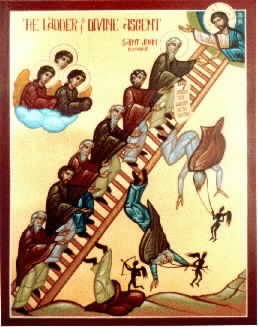
Ladder of Divine AccentAs I shared in the last issue of the Bulletin, the eighth step on the Ladder is MEEKNESS/LOSS OF ANGER. We so often judge meekness and patience by externals. Malice often thrives in the deceptively meek and silent. Often people, who appear to remain calm in the face of abusiveness, will confess their internal boiling rage.

When we are angry with others, we should not seek solitude on the grounds that no one can provoke us to anger. Our desire to escape confrontation and seek solitude is because of our pride and because we do not wish to blame ourselves for our anger. As long as we assign the causes of our weaknesses, especially anger, to others, we cannot attain the virtue of long-suffering.

We must remember, no one can make us feel what we feel. Our feelings are always our own and come from how we think and our attitudes. How we react to what others say or do comes from our own unconscious mind. If we wish to spiritually grow, we must own our own reactions and assume a personal responsibility for them.

Self-reform and peace are not achieved through the patience which others show us, but through our own change of heart and mind which is achieved through our long-suffering of the action of others. When we try to escape the struggle for long-suffering by retreating into solitude, we take our unhealed passions with us. They are not hidden or erased. For unless our passions are first purged, solitude and withdrawal from the world not only fosters these passions but also keeps them alive and prohibits us from perceiving what passion it is that enslaves us.

Spiritual growth requires a conscious effort to know ourselves and how we react to what others do or say and to accept responsibility for our reactions.

Further Thoughts About the WAY of Jesus — 20160830

5125870112_c630d33278_bThe WAY of Jesus is a way of personal transformation. It is our belief that we have been made in God’s image and also given the potential to grow in His likeness by cooperating with the help that is provided by the Holy Spirit, Who is within us. This doesn’t happen by osmosis or accident. It takes deliberate acts of cooperating with God’s Spirit in responding to the challenges of life.

This requires, first and foremost, that we come to an understanding of how life works and embrace the fact that life is given to us out of love to help us spiritually grow. This, I find, is the first and almost most important step in embracing the WAY of Jesus.

I believe that life, as I have shared with you many times, is uniquely designed to assist us in activating our potential to grow in God’s likeness. I believe that life is truly different for each and every one of us and, at the same time, the same for each and every one of us. It is different in that it provides the exact challenges that we personally need to spiritually grow and in this regard it is the same for each of us. Think about your life! You will find, if you open your mind to think about your life, that the challenges that you have had to face are quite unique to you and definitely have the power to change your life in a positive manner, helping you to be more like God as He manifested   Himself in the Person of Jesus, the Christ.

I think that you will also find, if you take the time to reflect on your life, that it seems that there are certain lessons that each of us must learn and that there are multiple opportunities to learn these lessons. Life is kind in that it never expects us to learn a lesson very first time that it is presented to us. There are always multiple opportunities to learn the lessons of life.

The lessons of life come in many different challenges. Some, I know, require more courage than others. All, however, are within our power to learn. Recall the words of God to Paul: My grace or help is sufficient for you. We are never given any challenges that are beyond our ability. That is why I can say that life is very loving, even though it might be very challenging.

What is further exciting about life is that God has seen fit to give us the help or a religion that believes the He Himself became incarnate in order to show us how to live and, therefore, derived that greatest benefit out of the challenges of life. He, in the Person of Jesus Christ, made sure that we had a model on which to fashion our life.     Think about this!

Gaining a Deeper Understanding of the New Testament — 20160830

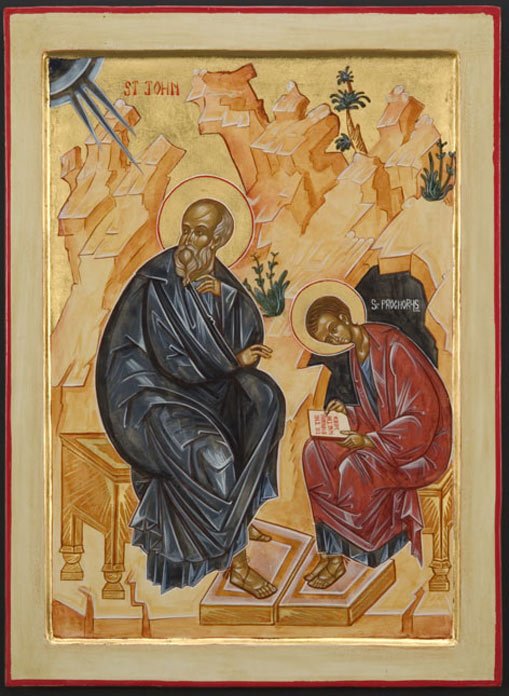
John the TheologianLet us now consider 3 John, almost as short as 2 John. Like 2 John, the sender is “the elder,” but the recipient is specified as a man named “Gaius.” Though the author is the same, there is no reason to think that this letter was sent to the same community as 2 John.

The letter commends Gaius and, of course, his community, for showing hospitality to Christians: “the friends” or “brothers and sisters”, even though they were strangers. It goes on to condemn an unknown Christian   by the name of “Diotrephes” for refusing the elder’s authority, not providing hospitality to the friends and also spreading false charges. It continues with a general exhortation: Beloved, do not imitate what is evil but imitate what is good. Whoever does good is from God; whoever does evil has not seen God. It concludes with a commendation of another otherwise unknown early Christian named “Demetrius,” who is presumably a teacher. They are to trust him. Its closing echoes the end of 2 John. The elder declares, “I have much to write to you, but I would rather not write with pen and ink; instead I hope to see you soon, and we will talk together “face to face.”

Despite its brevity and the inadequacy of its details, 3 John furnishes an extremely important insight into the problem of authority and influence in Christianity at the end of the first century.

Since the three letters of John are so very short, I would strongly urge all of my readers to read them and then reflect upon them.

Again this letter, like other letters, even those by St. Paul, give us an insight into the struggle that early Christianity went through before it was established. Since there was no central authority to guide the understanding of what Jesus taught and how He lived, there were differences of opinion. As one might guess, many of the early Christian teachers were people who embraced Judaism and saw the teaching of Jesus as a refinement and reform of Judaism since it had become quite ritualistic and rule-bound instead of spiritual. We understand this from the way that Jesus addressed the Pharisees, Scribes and other official/clerical persons. Jesus, as the prophets before Him, felt that the “spirit” of the religion had been subverted and had become a set of rules and regulations without any sense

Smart and Stupid Ways to Think About God — 20160830

Picture1The fifth smart way to think about God is that GOD HAS A PLAN. It is smart to believe that God has a plan and that plan includes Him as well as you. Even God must play by God’s rules. He can’t break them like Don Godleone (hopefully you remember him).

One of those rules is that God made man special. He made him a creator, gave him free will, making him responsibility for his decisions and actions. God can’t just decide to swoop down and make our lives perfect. That would be an insult against us as humans – against our nature. It would violate the very free will He gave us.

God’s plan must have respect for the creators He created. He must allow man his rope, even if man hangs himself so that there can be a relationship between him and God. God can’t just give us choice and then take it away. He’d would break His Word if He did and violate His own Spirit, too. And what kind of God would that be? He’d be someone you couldn’t trust! Any plan God has is meaningless unless we can trust Him.

And what is God’s plan? He wants everything in the universe to return to the Origin – to Him. That doesn’t mean He wants to destroy it, disassemble every atom and start afresh in some apocalyptic nightmare. It means He wants it to return to the Origin of the   origins. To Spirit. To God.

God wants us to become so acutely aware of our divine origin that we act it. He wants us to become divine creators in our own right – to live in accordance with the laws He created with Creation.

God can help somewhat. He can inspire revelations like those received through Jesus but He cannot force us to be moral. He cannot make choices for us. He cannot, and will not, interfere with our free will or freeze our hands to prevent us from creating evil. He cannot free our souls from the divisions within us.

God has no intention of creating a world filled with evil. He’s not the Marquis de God. But clearly, by creating us, our God left room for evil – the evil which our freedom can create.

That’s why God’s plan requires our cooperation. It’s not enough for us to blindly trust Him, like Little Mary Sunshine. God has to trust us too.

All creation is free to act in its own way. God cannot stop a volcano from erupting or a hurricane from forming. These events are just a part of nature which was created to change as we do.

Theosis, the foundation of Eastern Spirituality, is a process wherein we cooperate with God in growing and changing, becoming ever more like our brother Jesus in the way that we think and live.

The Divine Liturgy and Our Worship of God — 20160830

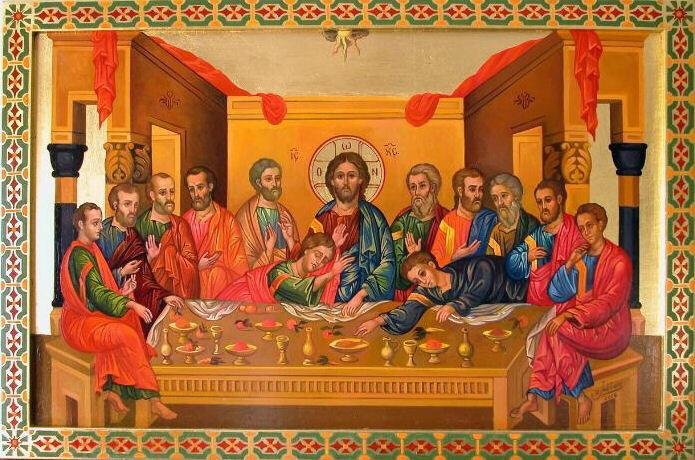
Mystical Supper

Mystical Supper

In this article I have started sharing my thoughts on worship and spiritual sacrifice so that, as we celebrate our Divine Liturgy, we might come to a truly deeper understanding of what we do. I shared that humans have, traditionally, found it necessary to worship a Being they considered greater than them and, in some way, responsible for what happens in life and in the universe. Of course there have always been groups of people who reject the idea of a god and offering worship. In more recent years we experienced Communism which, although it rejected the idea of a god, replaced the State as their god.

Until the Christian era, human acts of worship always remained external to the people engaged in worship. The rituals of worship destroyed objects or things humans selected as special with the belief that this act displayed honor to the one being worshipped.

Jesus Christ, Who we believe is God Incarnate, came and modeled for us true worship which is not external to us but internal. Through His actions Jesus modeled the offering of self to God as   a sign of worship and transformation instead of destruction as a sign of true honor and praise.

Jesus taught us through His actions that offering our lives back to God in thanksgiving for the gift of life truly gives the Creator more praise and honor than destroying something that belongs to us but is external to us. The act of offering ourselves in thanksgiving for life highlights our awareness of God’s love for us and His presence within our lives. The type of worship Jesus offered taught us that worship deals with our personal relationship with God.

An intrinsic and intimate part of our personal offering of self involves our commitment to personal change and transformation. Since we offer our very lives back to God in communion with Jesus, we signify our awareness that the meaning and purpose of human life is to use all of the opportunities it presents to bring about personal change metanoia.

Metanoia is the process of changing our personal attitudes and thinking and engages us in activities that will bring change in our thinking and attitudes, bringing them more in concert with those of Jesus. Engaging in personal change is, then, the spiritual sacrifice that we offer to God when we celebrate the Divine Liturgy!